
Can a Web3 game ever become something people play because they actually enjoy it, instead of something they open because rewards are available that day?
That question has followed the entire play-to-earn sector for years. Every new project that introduces a token economy inside gameplay inherits the same tension: are players participating in a world, or are they extracting value from a system? When I first heard about Pixels, I assumed I already knew the answer. A farming-style social MMO with token incentives usually fits a familiar pattern in crypto gaming.
At the beginning, I thought Pixels would likely behave like most GameFi environments we’ve already seen. A large spike in users during reward campaigns, a token narrative tied to activity loops, and then a slow adjustment period once incentives stabilize. The presence of land NFTs and seasonal reward structures made it feel recognizable in a way that was not necessarily negative, but also not especially surprising.
But after spending time reading about the design choices behind the economy, the relationship between Coins and PIXEL, and the way the team structured progression versus governance layers, something started to feel different. It became clearer that Pixels might not be trying to make the token the center of gameplay. Instead, the token looked more like a coordination layer sitting around the gameplay.
This made me think the project might be responding directly to the biggest problem in the Web3 gaming sector today, which is sustainability. The sector has struggled because too many games reward activity instead of contribution. Players log in, complete repetitive loops, extract tokens, and eventually leave once the reward curve changes. That cycle has repeated enough times that many players now approach GameFi environments with expectations shaped by previous reward seasons rather than by curiosity about gameplay itself.
Pixels seems to be attempting a different approach by separating gameplay progression from token extraction. Most of the daily activity inside the world runs through Coins and resource layers that are not designed to function as speculative assets. PIXEL appears positioned more as a governance and ecosystem coordination token rather than a farming output token. Conceptually this is an important shift, because it suggests the team is trying to avoid tying the value of the token directly to routine gameplay loops.
At first this distinction felt subtle, but the more I thought about it, the more meaningful it seemed. If a token becomes the primary output of gameplay, the entire economy begins to revolve around selling pressure. If the token instead becomes a participation and coordination layer, the economic behavior inside the world can develop differently. That does not guarantee sustainability, but it creates the possibility of it.
Still, there is always a gap between economic theory and player behavior. Even if the structure encourages long-term participation, players often approach systems in ways designers cannot fully predict. Many users still interpret game tokens as income streams. Once that expectation exists, it becomes difficult to reshape the relationship between the player and the economy.
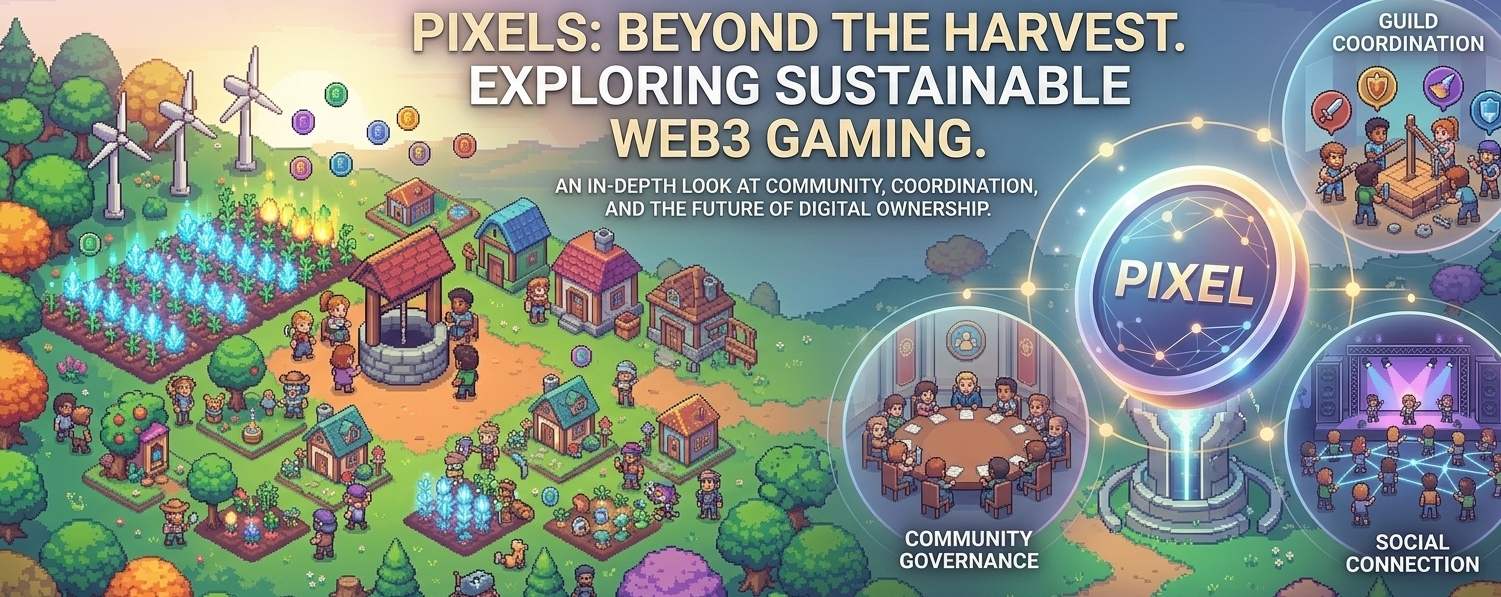
This is why incentive design matters more than hype in Web3 gaming. A project can have a strong narrative, strong partnerships, and even strong early adoption, but if incentives reward extraction more than contribution, the system eventually weakens. Pixels appears to be experimenting with reward layers that depend on participation quality rather than simple activity counts. The introduction of land hosting dynamics and guild coordination suggests an attempt to create roles inside the economy rather than just tasks.
I was surprised by how much attention the project seems to place on contribution-based structures. Instead of locking rewards permanently into rigid emission schedules, Pixels appears to rely on seasonal adjustments that respond to player behavior. That approach resembles live service game design more than traditional token distribution planning. It suggests the team is watching retention patterns and resource circulation closely instead of assuming the original design will remain optimal forever.
This made me think about how important data-driven reward tuning is for long-term survival. Web3 economies that adapt slowly tend to break quickly. When reward structures remain fixed while player behavior changes, imbalance grows silently until participation drops. A flexible reward strategy does not remove risk, but it creates space for correction.
Even with these adjustments, the PIXEL token still carries structural uncertainty. Supply size alone creates expectations that must be managed carefully. Early participants often interpret launch distributions as signals about future opportunity, and those expectations shape behavior inside the ecosystem whether the designers intend that or not. It is still unclear how the community will ultimately position PIXEL in their own mental model. Whether they treat it as infrastructure or income will affect the trajectory of the economy.
User behavior always plays a larger role than documentation suggests. Game designers can describe ideal loops, but players create real ones through their actions. If users interact with Pixels as a daily farming routine designed around token optimization, the system behaves one way. If they treat it as a social progression environment connected to guild activity and land participation, the system behaves differently. At the moment, Pixels feels like it exists somewhere between those two interpretations.
Another question that kept coming back while thinking about the project was whether Pixels is trying to be a game or something closer to a platform. On the surface it clearly presents itself as a farming-style MMO with casual progression loops. But underneath that layer there are signs of something broader. Guild coordination, land hosting structures, seasonal contribution systems, and identity-style participation patterns all suggest that Pixels could evolve into a lightweight social infrastructure layer inside the Ronin ecosystem rather than remaining a single isolated game environment.
This possibility creates the conditions for a network effect if adoption stabilizes. When more players interact with land, guilds become more active. As guilds become more active, coordination increases. As coordination increases, retention improves. As retention improves, token utility becomes more meaningful. That loop is simple, but it can become powerful if it holds over time. Social economies tend to produce stronger persistence than reward-only systems.
The long-term vision of Pixels still feels open rather than fixed. It does not feel like a finished product trying to protect a stable identity. Instead it feels like a framework that is still discovering its role inside a larger ecosystem. That uncertainty creates both opportunity and risk. A flexible structure allows adaptation, but it also means outcomes depend heavily on execution.
What stayed with me after researching the project was not a sense of certainty about its future, but a sense that it is at least trying to respond to the lessons of earlier GameFi cycles. The separation between gameplay currency and ecosystem token shows awareness of inflation risks. The seasonal reward adjustments show awareness of behavioral complexity. The guild and land layers show awareness that social participation often matters more than mechanical repetition.
At the same time, there is still a risk that expectations formed during early reward periods continue shaping how players interact with the world. Changing incentive perception inside a live crypto ecosystem is never easy. Even thoughtful design cannot fully control community psychology once tokens begin circulating.
So where this leaves me personally is somewhere between optimism and caution. The concept behind Pixels feels stronger than many earlier play-to-earn environments because it attempts to treat incentives as coordination tools rather than simple outputs. The structure suggests the team understands the sustainability problem that has affected the sector.
But execution still determines everything. Adoption must remain steady. Retention must become social rather than purely economic. Contribution-based participation must actually influence rewards in visible ways.
If those things happen, Pixels could become something closer to a persistent Web3 social game environment instead of another seasonal reward cycle. If they do not, it risks repeating patterns the industry has already experienced before.
For now it feels like a project with a thoughtful direction and realistic uncertainty around outcomes. The concept looks strong enough to be taken seriously, but the future still depends on whether players decide they are staying for the world itself, not just the incentives attached to it.