while scanning the chain last night
While I was knee-deep in the staking dashboard around 2 a.m., cross-checking flows in the Pixels ecosystem, one mechanic refused to let go.
Stacked — that quiet AI layer the team at @pixels_online spun out from years inside the game — wasn’t just another rewards app.
It was quietly rewriting how on-chain token flows actually sustain play instead of burning it out.
I’d gone in expecting the usual play-to-earn script: hype the emissions, watch the charts, hope the loop holds.
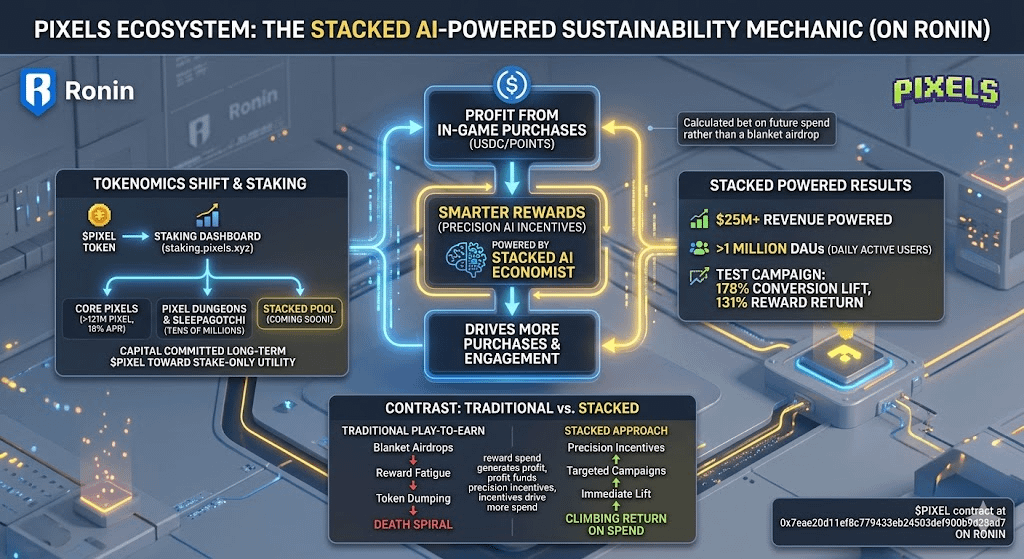
What I saw instead was something more surgical. Two actionable things stood out right away. First, Stacked matches rewards to real player behavior in real time, turning every distribution into a calculated bet on future spend rather than a blanket airdrop. Second, it flips the old incentive model on its head — profit from in-game purchases now funds smarter rewards, which in turn drive more purchases. Simple on paper. Brutal in practice.
The numbers weren’t abstract. Stacked had already powered over $25 million in revenue for Pixels while pushing the ecosystem past one million daily active users.
A single test campaign re-engaging lapsed spenders delivered a 178% lift in conversion and 131% return on the reward budget.
That wasn’t marketing copy. It was the output of an engine that had been stress-tested inside the core game for years before ever seeing the light of day as a platform.
the contrast that stuck with me
A few weeks back I pulled an all-nighter during the CreatorPad challenge, digging into how Pixels had scaled without the usual death spiral.
I remembered the early days — the rush of new wallets, the frenzy of land sales, the inevitable sell pressure. Classic web3 gaming pattern.
Then Stacked arrived, and the on-chain behaviors shifted.
Staking pools told the story clearest. As of my latest check on the dashboard, the core Pixels pool sat at over 121 million $PIXEL staked with an 18% APR, while Pixel Dungeons and Sleepagotchi held steady in the tens of millions each.
Stacked itself showed as “Coming soon!” with zero stake — a deliberate placeholder signaling the next layer of integration. No fanfare. Just the quiet architecture of moving $PIXEL ward stake-only utility while USDC and points handle the cash-out side.
That dashboard wasn’t flashy, but it grounded everything. You could see the capital committed long-term, not just chased for quick flips.
The on-chain flows weren’t leaking into endless inflation; they were cycling back as real economic activity.
I caught myself smiling at one point — actually — because this was the opposite of what most projects claim. They promise “sustainable play” while printing tokens like there’s no tomorrow.
Pixels, through Stacked, had built a hidden feedback loop: reward spend generates profit, profit funds precision incentives, incentives drive more spend. Three interconnected layers, all traceable on-chain if you know where to look.
hmm... this mechanic in practice
The real test came when I mapped it against two timely examples playing out elsewhere in the market right now.
One mid-tier title I won’t name had just slashed emissions after a brutal quarter — classic symptom of reward fatigue, wallets dumping, engagement cratering.
Contrast that with how Stacked’s AI economist had operated inside Pixels: plain-language prompts from studio operators identifying churn points, then instantly deploying targeted campaigns.
No data scientists in the middle. No six-week delays. Just immediate, measurable lift.
Another example hit closer to home. A bigger ecosystem partner had leaned hard on broad token incentives last month and watched daily actives plateau.
Meanwhile, Stacked’s internal data showed the opposite — return-on-reward-spend climbing steadily because the system only paid out when behavior justified it. It wasn’t luck. It was mechanics refined over four years inside one game before productizing for others.
I felt a flicker of honest skepticism there, though. Could this precision really translate beyond Pixels’ controlled environment?
The team had perfect visibility into their own loops. External studios would bring messier data, fragmented wallets, competing incentives.
Would the AI still hold? Or would it quietly degrade into the same blunt instruments everyone else uses? I didn’t have a clean answer. Still don’t.
still pondering the ripple
Late sessions like that one tend to leave loose threads.
I kept circling back to the human side — the player who logs in not for the token dump but because the reward actually felt earned, timed, personal.
Stacked didn’t remove the on-chain component; it made it secondary to the experience. $PIX$PIXEL me the stake that signals alignment rather than the prize that gets flipped.
There’s a quiet reevaluation happening here for anyone watching closely. The old narrative was that sustainable play-to-earn required killing emissions entirely or pivoting to NFTs forever.
Stacked suggests a third path: keep the token, keep the chain, but make the distribution engine intelligent enough that every outflow has a measurable inflow. It’s not revolutionary in theory. It’s stubborn in execution.
I’ve been reflecting on the ripple since. How many games will plug into this without the same founding discipline?
How long until the broader market notices that real revenue — not just TVL — is the only metric that survives the next cycle?
The dashboard keeps updating. The stakes keep compounding. The questions keep lingering.
What happens when the first external studio ships their own Stacked-powered loop and the on-chain flows start looking… different?