

I’m going to say something slightly uncomfortable.
Pixel looks obvious.
And in crypto, obvious things tend to be misunderstood.
Most people see Pixels and immediately reduce it to a simple narrative: on-chain game, strong user base, social farming loops, token tied to activity. It’s easy to grasp. Easy to explain. Easy to trade.
That’s exactly why I hesitate.
Because when something is this easy to understand, the market usually prices the surface… not the structure underneath.
$PIXEL doesn’t feel like just a game token to me.
It feels like an experiment in behavior design.
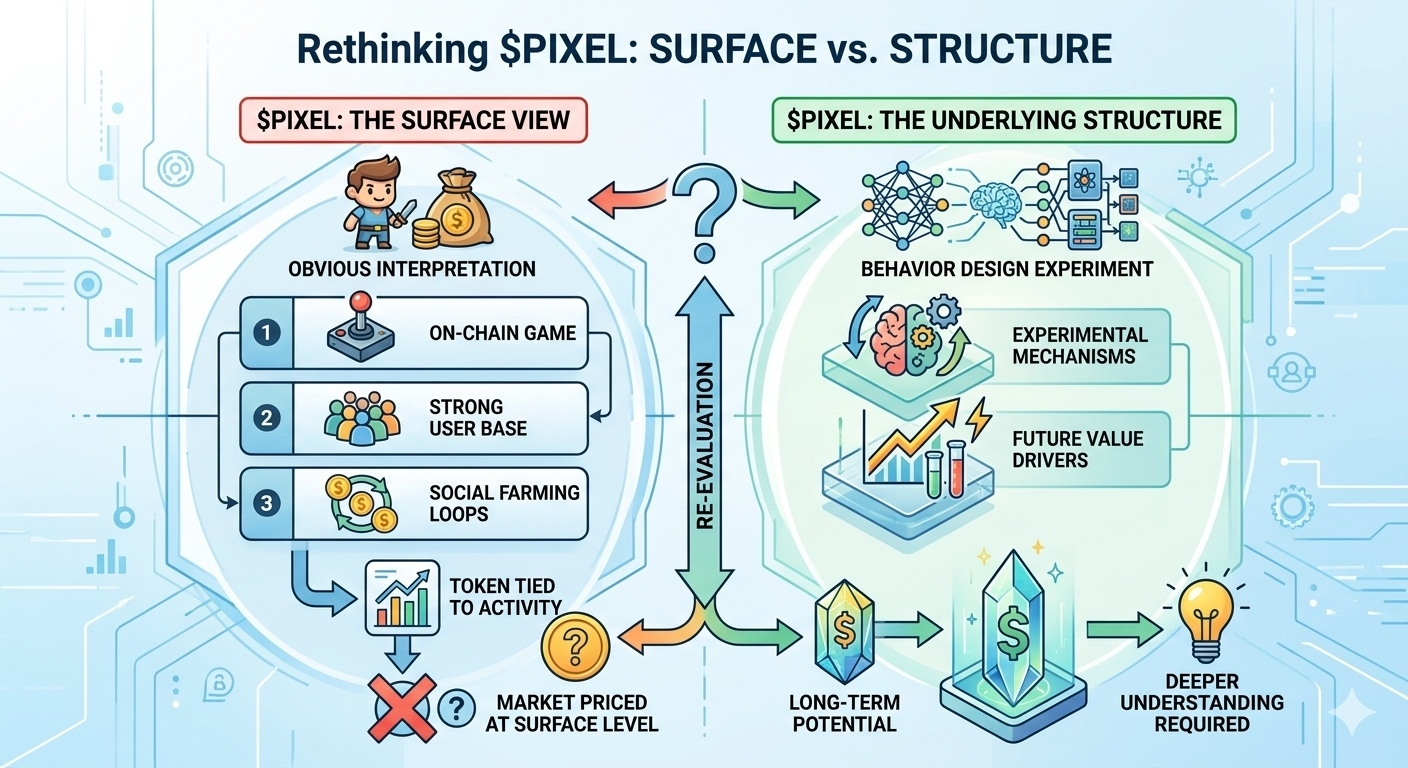
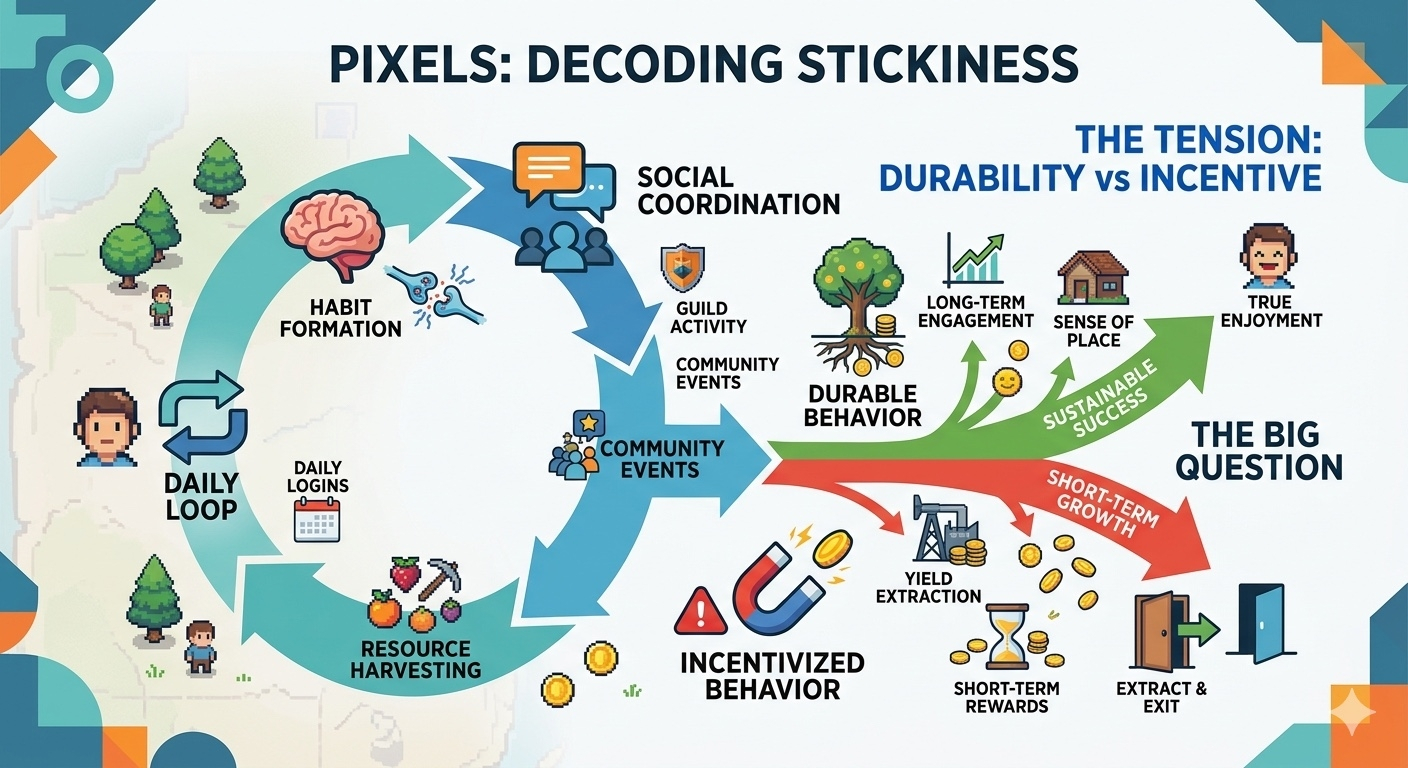
There’s something subtle happening inside Pixels — not just gameplay, but habit formation. Daily loops, resource cycles, social coordination. The system nudges users to return, to optimize, to participate even when there’s no immediate “fun” in the traditional sense.
That’s not accidental.
And that’s where it gets interesting.
Because if Pixels succeeds, it won’t be because it became the best game. It will be because it became a place people keep coming back to without questioning why.
That’s a different kind of stickiness.
But here’s the tension.
We don’t yet know if that behavior is durable or just incentivized.
Crypto games often blur this line. Users show up because there’s yield, because there’s extraction opportunity, because there’s short-term reward. And when that reward weakens, the behavior disappears just as quickly.
I’ve seen this cycle too many times.
Activity looks real… until it isn’t.
Still, there are signals that make me pause.
Pixels doesn’t feel rushed. The loops are simple, almost deliberately repetitive. The social layer isn’t overengineered. It leans into familiarity rather than complexity. That usually means the team understands something about retention that most crypto games ignore.
But simplicity can cut both ways.
It can create long-term engagement… or it can plateau quickly once users exhaust the loop.
I’m not fully sure which path this takes.
Another layer people overlook: economies inside games are fragile. The moment value extraction outweighs value creation, things start to unwind. Inflation creeps in. Rewards dilute. The system either adapts or slowly drains itself.
$PIXEL sits right inside that tension.
It’s not just about users showing up. It’s about whether the system can sustain why they show up.
Right now, it feels like it’s working.
But “working” in early phases doesn’t guarantee stability later.
So I don’t see $PIXEL as a guaranteed winner.
I see it as a live system under observation.
Maybe the real question isn’t whether Pixels grows.
Maybe it’s whether, months from now, users are still there when incentives normalize.
If they are, something deeper is happening.
If they’re not… then this was just another well-designed loop that couldn’t escape its own economics.
I’m watching closely.
Not for spikes in activity.
For signs that behavior is becoming habit — or quietly fading once the rewards start to feel thinner.
