
Most projects in the Web3 gaming space begin with a promise of ownership, earnings, or disruption—but very few begin by asking a quieter, more important question: what makes a game worth returning to, even when no rewards are involved? That question sits at the heart of how Pixels positions itself, whether intentionally or not, and it’s what makes the project worth examining beyond the usual narratives.
At first glance, Pixels may resemble many other blockchain-based games—token integration, digital ownership, and an open-world environment. But the difference begins to emerge in its design philosophy. Instead of building the experience around financial incentives first, it leans into familiar, almost nostalgic gameplay loops: farming, exploration, and gradual creation. These are not new mechanics, but their familiarity may be the point. Pixels doesn’t try to reinvent interaction—it tries to make it comfortable, accessible, and socially driven. That subtle shift in priority, from extraction to engagement, gives it a slightly different tone compared to more aggressively monetized ecosystems.
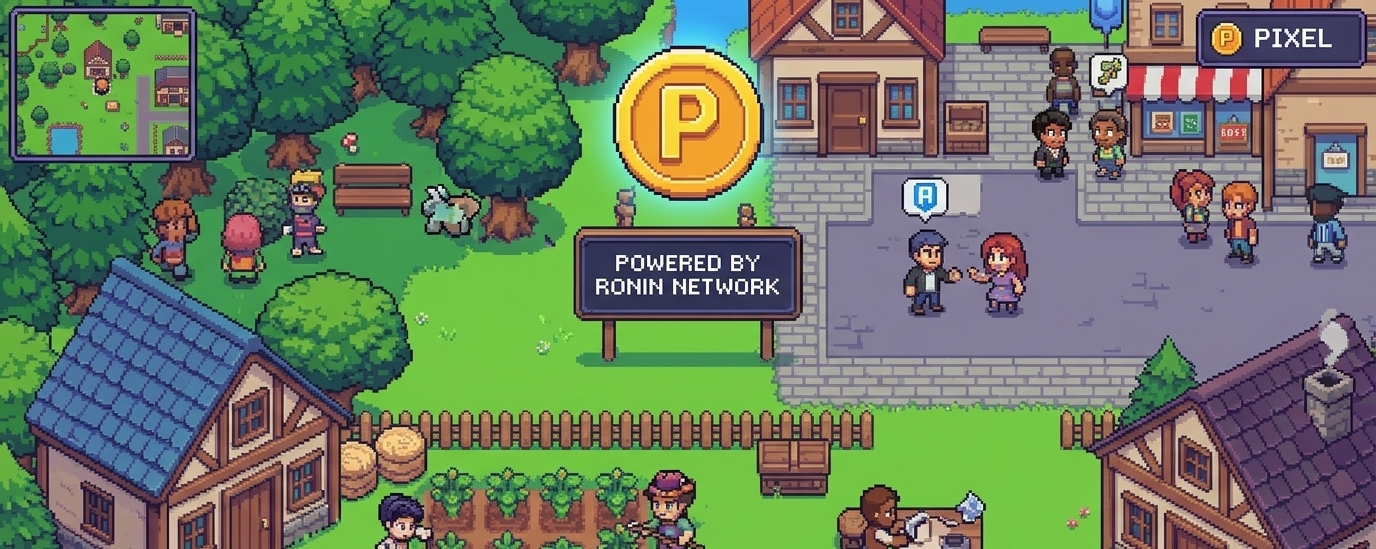
The core system itself is intentionally simple. Players enter a shared world where they cultivate land, gather resources, and interact with others. Progression comes from repetition and refinement—planting, harvesting, upgrading, and exploring. There is no immediate pressure to optimize everything for efficiency, which is often the trap in tokenized environments. Instead, the loop feels closer to traditional casual games, where time spent naturally translates into gradual growth. The open-world aspect adds another layer, allowing players to move beyond isolated gameplay into a more connected, persistent environment.
Where things become more delicate is in the integration of the token economy. In many Web3 projects, tokens feel like an external layer—something added after the fact to create incentives or liquidity. In Pixels, the intent appears to be more integrated, though the balance is still evolving. The token exists as part of the ecosystem, tied to actions within the game, but the long-term question is whether it enhances the experience or subtly reshapes it into something more transactional. If players begin to see every action through the lens of earning potential, the original design philosophy risks being diluted.
User behavior is often the clearest signal of a system’s true design. A well-balanced environment encourages players to stay not because they have to, but because they want to. Pixels seems to aim for this by creating low-pressure engagement—players can log in, make incremental progress, and leave without feeling penalized. However, as with any tokenized system, there is always a tension between long-term participation and short-term extraction. If the majority of users begin optimizing purely for rewards, the social and creative aspects may weaken. On the other hand, if the game successfully nurtures a community that values interaction and progression over immediate gains, it could sustain a more stable user base.
What makes Pixels interesting is not any single feature, but the way it combines simplicity with ambition. It doesn’t rely on high-end graphics or complex mechanics. Instead, it focuses on creating a space that feels alive through its players. The idea of blending a casual farming game with a persistent online world—and layering ownership on top—is not revolutionary in concept, but it is rare in execution within Web3. There is a certain restraint in its design, a willingness to let the experience breathe rather than overwhelm the user with systems.
Still, there are risks that cannot be ignored. The biggest challenge lies in maintaining balance. If the economy becomes too dominant, the game risks turning into a repetitive task engine. If rewards are too limited, users driven by financial incentives may lose interest. There is also the broader question of scalability—can the experience remain meaningful as more users join, or does it lose its sense of intimacy? Additionally, like many Web3 projects, Pixels still needs to prove that its model can sustain itself over time without relying on constant new user inflows.
In the end, Pixels should not be viewed as a finished product or a guaranteed success, but rather as an ongoing experiment. It sits at the intersection of gaming and digital economies, trying to find a balance that many before it have struggled to achieve. Whether it succeeds will depend less on its current features and more on how it evolves—how it protects its core experience while adapting to the pressures of a tokenized environment. For now, it remains a thoughtful attempt to answer a difficult question: can a game be both meaningful to play and sustainable to own, without compromising either?
