
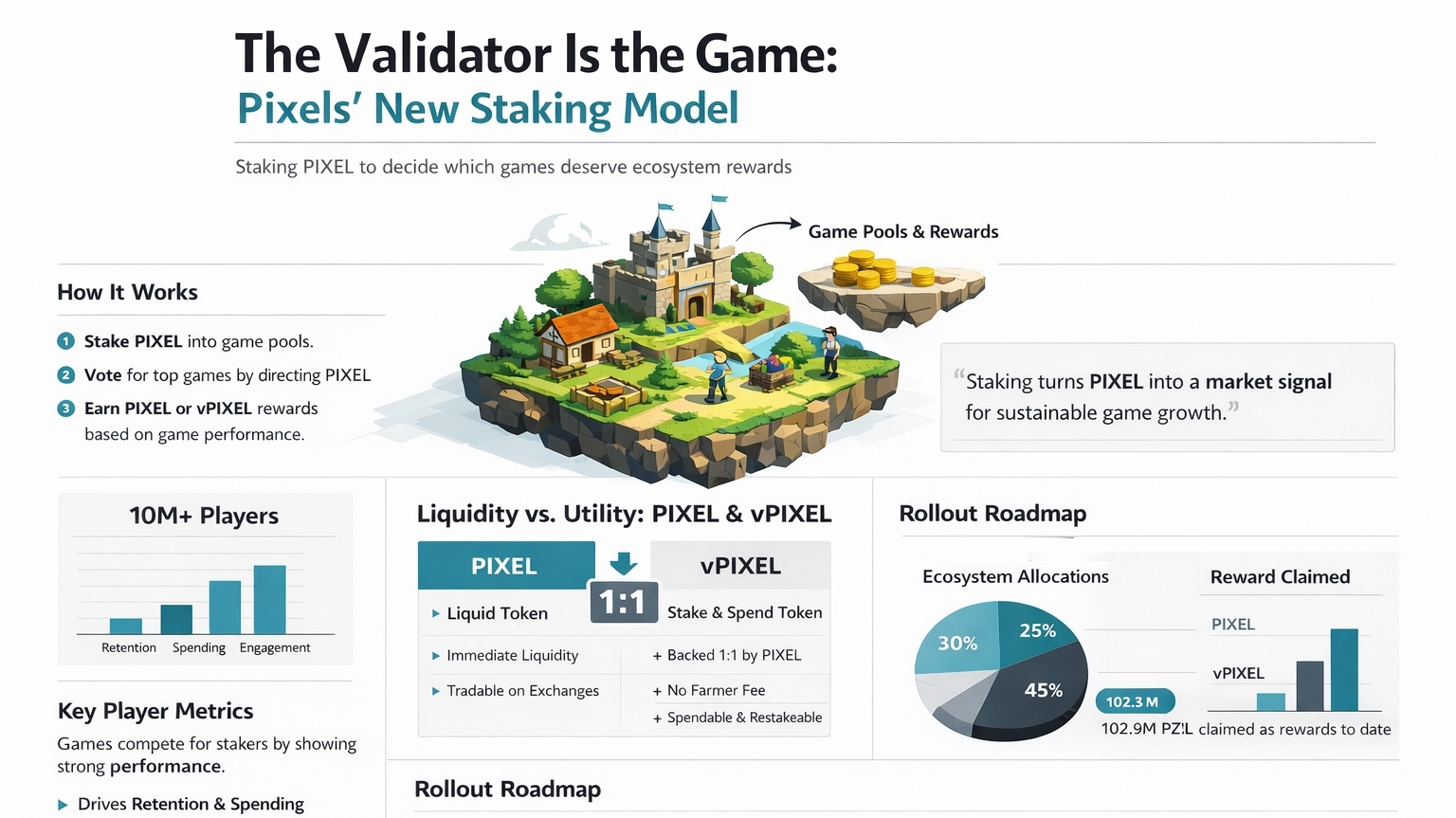

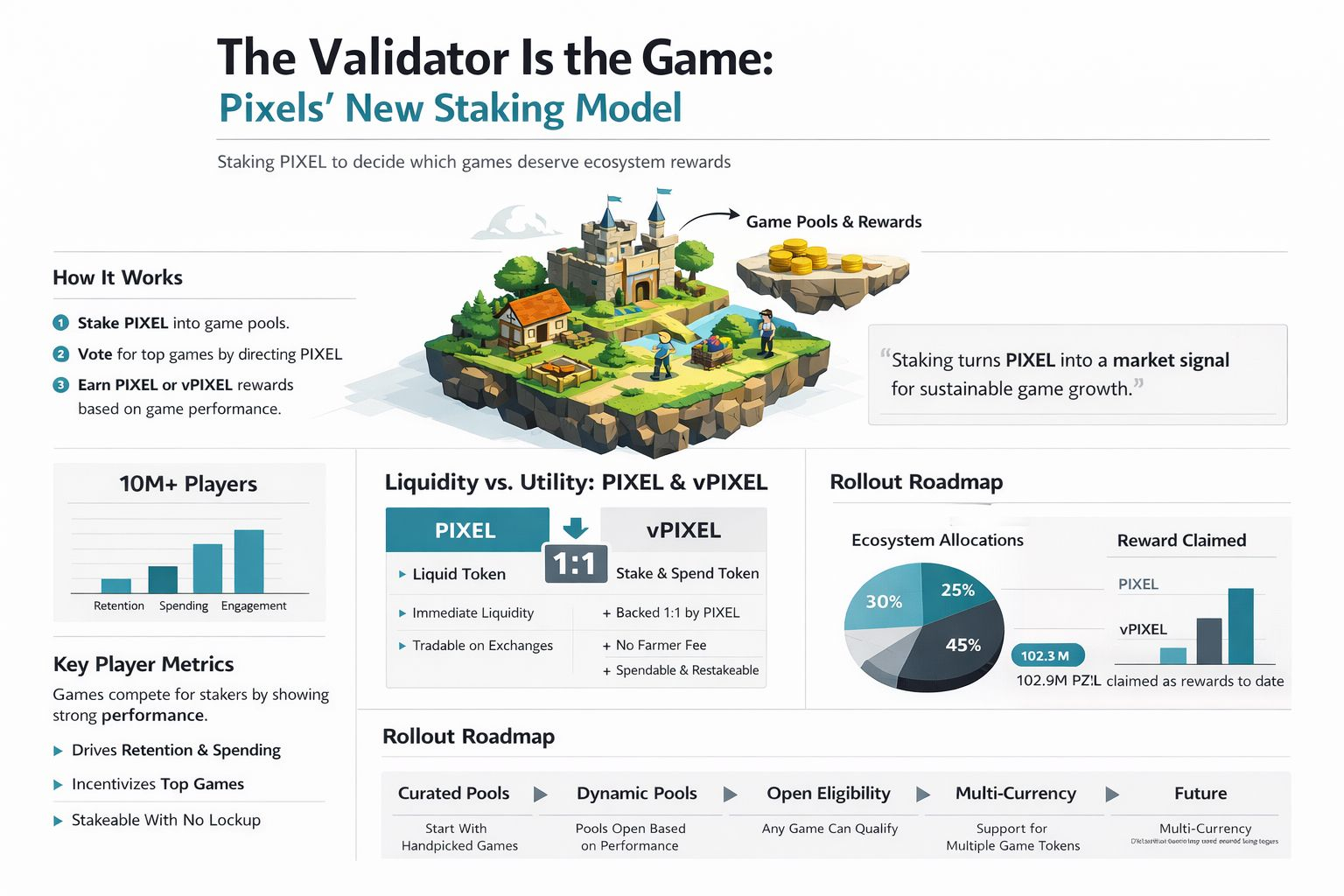
@Pixels I think most people are reading Pixels’ new staking model through the wrong lens. To me, this is not mainly a token-yield feature; it is a redesign of how a game network decides who gets distribution, rewards, and attention. Pixels’ whitepaper is explicit that “the validator is the game,” meaning staking no longer exists to secure a chain in the usual sense. Instead, players direct PIXEL toward game pools, and those choices shape which games receive ecosystem incentives. That shift matters because it turns staking into a market for publishing power. In a sector that often confuses emissions with traction, Pixels is trying to make capital allocation depend on retention, spending, and ecosystem contribution.
What makes this timely, in my view, is that Pixels is not presenting the model as a thought experiment anymore. Staking is already live through both in-game and dashboard flows, with external staking requiring no minimum deposit and in-game staking requiring 100 PIXEL plus recent activity. The official materials also spell out practical mechanics that real users care about: there is no on-chain lock while staked, but there is a three-day unstake delay, and rewards can be claimed in either PIXEL or fee-free vPIXEL depending on whether a user wants liquidity or wants to stay inside the system. That tells me Pixels is moving from narrative to operating rules, where markets start judging execution.
The smartest part of the design is not the word “validator.” It is the attempt to solve a basic problem that has hurt game tokens for years: rewards hit wallets, wallets sell, and the economy weakens. Pixels’ answer is vPIXEL, a spend- and stake-only token backed 1:1 by PIXEL. According to the whitepaper, users who withdraw vPIXEL avoid the Farmer Fee, can still spend it in games, and can even restake it with full staking power. Every time vPIXEL is spent, the backing PIXEL is permanently unlocked inside the system for user acquisition rewards or treasury operations. I see the logic here. Pixels is trying to separate liquidity from utility. That does not remove risk, but it is a more serious design than simple APR marketing.

I also think the market may be underestimating what Pixels is really testing. This is not just player staking; it is a competitive admissions process for games. The whitepaper says games compete for stakers by showing strong retention, net in-game spending, and good use of ecosystem tools, while partner studios are expected to share data, integrate PIXEL and vPIXEL, and work toward healthy reward efficiency. In plain terms, Pixels wants staking to function like a scoreboard for which games deserve subsidized growth. If that works, the long-term upside is bigger than token yield because the product becomes a publishing system. If it fails, the model is only as strong as the games that can attract and keep real users.
That is where I stay cautious. A clever staking design cannot manufacture demand on its own, and the whitepaper shows that rollout was meant to happen in phases, starting with curated pools, then moving to dynamic pools, then open eligibility based on performance thresholds, and eventually a multi-currency model. That is sensible, but it is also a reminder that the hardest part is not writing the mechanism; it is proving that reward allocation can keep improving as more games enter. Add in the fact that PIXEL has a capped supply of 5 billion and a 60-month unlock schedule, and I think investors should treat this as an execution story, not a clean scarcity story.
My practical takeaway is simple. I would not look at Pixels’ staking model as a passive-income product first. I would look at it as a market signal. The key question is whether stake flows begin to identify games that genuinely monetize, retain players, and recycle value back into the ecosystem instead of just consuming emissions. Pixels says it already has over 10 million players, so it has enough scale to test this idea in the open. For me, that is why the model matters now. The real bet is not on yield alone. It is on whether Pixels can make publishing discipline visible on-chain and make that discipline worth staking for.