
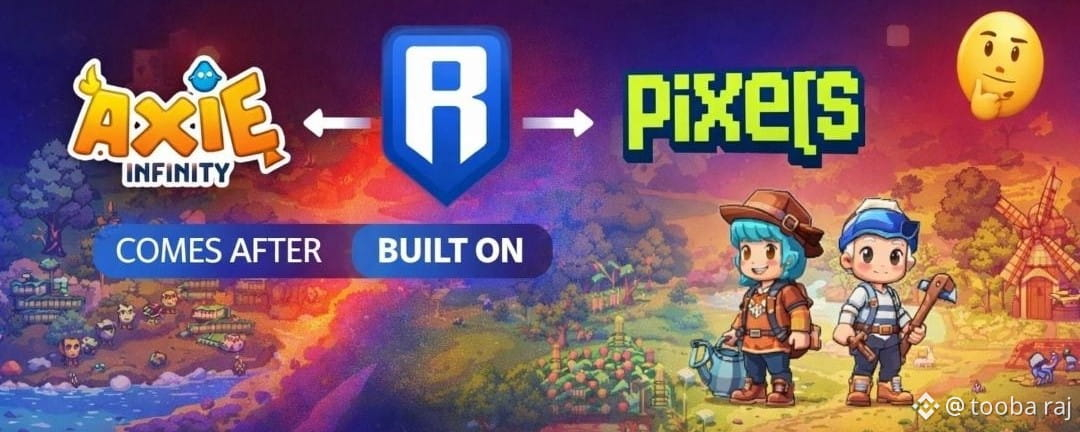

I’ve played through a ton of Web3 games in the last couple of years.
The usual story goes like this – you play the game, do a little grinding, rack up some tokens, and soon enough, you realize that there's less focus on the game itself and more on the reward mechanisms. Once those stop, you lose your motivation.
That’s why going into @Pixels, I wasn’t expecting much.
But after really getting into it, I’d say... it's different.
Not in a boisterous way. In a calm, understated way.
On the surface, it seems straightforward. You farm, explore, gather resources. Not too complex, not too difficult. And it’s precisely that aspect that makes it attractive to you. No attempt is made to bombard you with every feature in the first few minutes, something that every Web3 game does.

You simply play.
That’s when it starts standing out.
The difference being that most Web3 games are not really played; they have systems for extracting value. This one, however, feels like a real game.
The more you engage yourself with the game, the more you can feel the interconnection of all those activities. There is nothing boring about the farming cycle. It relates to exploring and utilizing resources and even further, to an economy driven by players.
It is constructed step by step for a reason.
And truth be told, that pace is actually more important than one would expect.
Most games try to force you to learn their mechanics right away, link your bank accounts and spend your money. Pixels, however, take quite a different approach. They allow themselves to grow on you.
$PIXEL is not shoved down your throat right from the get-go. You do not have a feeling of always being encouraged towards either making or taking money.
This makes a difference to how your mind works.
Instead of playing in order to make money, you find yourself playing, and money-making comes secondary to this process.
That's quite a transformation.

Another feature that caught my eye is the feeling of actual ownership in the game. The majority of games promise ownership of assets, but we all know that for the most part, it makes no difference in terms of gameplay. The assets are merely stored in your virtual wallet.
Pixels allows you to use your assets.
Land, items, upgrades, and everything else that you earn in the game directly impacts your gameplay. You feel like you are building something rather than accumulating stuff.
And when you feel like that, you start caring.
Economy is an intriguing element when taking into consideration its underlying concept. It does not have the characteristics of a predetermined reward system. Instead, it is created by players' actions and develops through time.
The process involves meeting each other, trading and building. This causes movement within the economy.
There are some imperfections to this process, and it is definitely still being developed. However, there is an unmistakable trend towards becoming something sustainable.
Ronin's presence in the background plays a bigger role than one may think.
It all feels so smooth. No more having to wait for your transactions to go through or be worried about fees while doing small actions. This is usually a pain point in Web3 gaming applications but here it’s pretty much nonexistent.
All you have to do is play.
That’s how it should feel.
The thing that I’m finding really fascinating about Pixels is its lack of constant need to show off.
While other projects attempt to do everything possible to attract as many users as they can in an incredibly brief amount of time, such a strategy sets it apart from the crowd.
It appears more down-to-earth.
When taking a step back, Pixels seems to be doing more than simply developing the game. It's testing how Web3 technology might sustain a community built on long-term engagement and organic economic growth without any external stimuli.
This is extremely difficult to achieve.
Other projects rely too much on extrinsic motivators, which ultimately bring the project to its knees. Others, on the other hand, tend to ignore economic considerations altogether, disregarding the very nature of Web3 technology.
And so far, I think that it might be one of the few initiatives that gets closer to achieving that kind of balance.
To start off, here's my honest opinion on the matter.
While it's not yet perfect and definitely far from complete, I believe that it is among the few initiatives out there that actually learns from its previous mistakes.
Rather than striving for overnight perfection, it takes a more pragmatic path towards development and improvement.
And this sort of attitude often leads to longevity.
Currently, everyone’s eyes are on pricing, trends, and short-term actions.
However, if you take note of how people act in the system, things start to get interesting.
Is there return of players?
Is their investment of time rather than mining?
Are they developing in the system?
When it comes to Pixels, it seems that things are starting to answer in the affirmative.
And that may well be the key indicator.
