
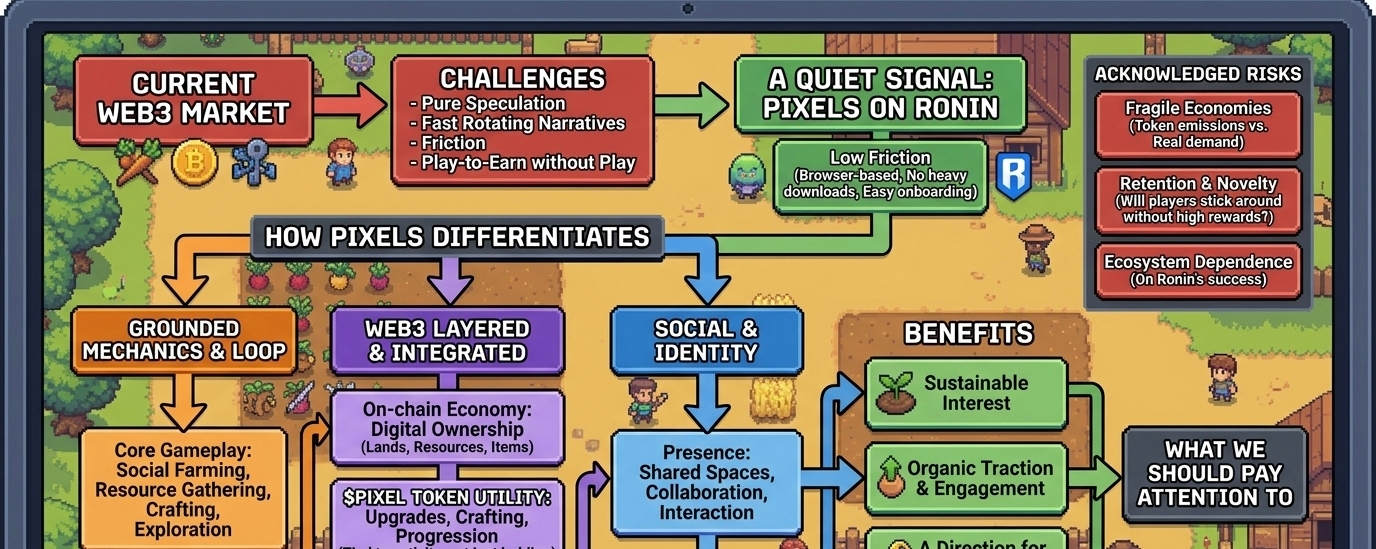

I didn’t expect a farming game to catch my attention in this kind of market. Lately everything feels like it’s rotating fast narratives come and go, liquidity chases whatever moves, and most projects are trying a little too hard to stay relevant. But then I stumbled into Pixels, and something about it felt… different. Not louder, not more complex. Just oddly grounded.
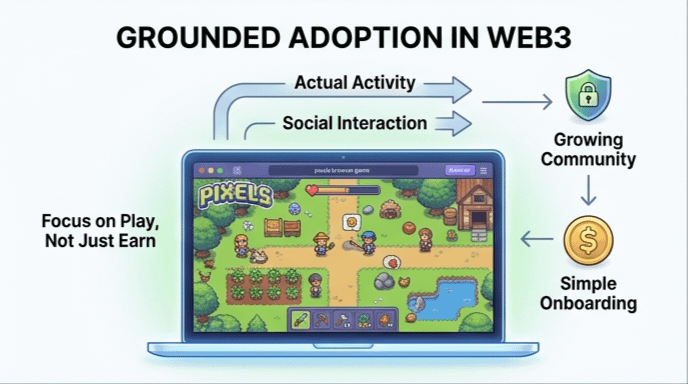
From what I’m seeing right now, the market is slowly shifting away from pure speculation and back toward actual user activity. Not completely, of course we’re still in crypto but there’s a noticeable appetite for products people actually use, not just hold. That’s where Pixels started making sense to me. It’s not trying to reinvent gaming with some grand promise. It’s just quietly building a loop that people keep coming back to.
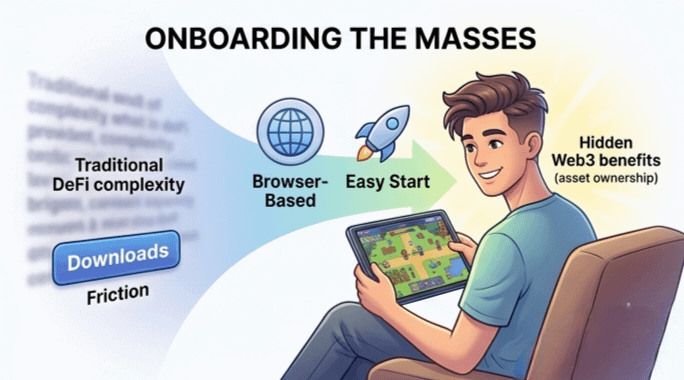
At its core, Pixels is a browser-based social farming game running on Ronin. That already tells me something important. It’s not targeting hardcore gamers chasing graphics or DeFi users chasing yield. It’s going after a much broader, more casual audience the kind of people who don’t want friction. No heavy downloads, no complicated onboarding. You just jump in and start planting crops, exploring land, interacting with others.
That simplicity is deceptive though. What caught my attention is how they’ve layered ownership and economy into something that feels familiar. You farm, you gather resources, you craft items, and all of that feeds into an on-chain economy. But unlike a lot of earlier Web3 games, it doesn’t immediately feel like you’re working a second job. That’s been one of the biggest problems in this space. Too many games leaned hard into “play-to-earn” and forgot the “play” part.
Pixels seems to be learning from that mistake.
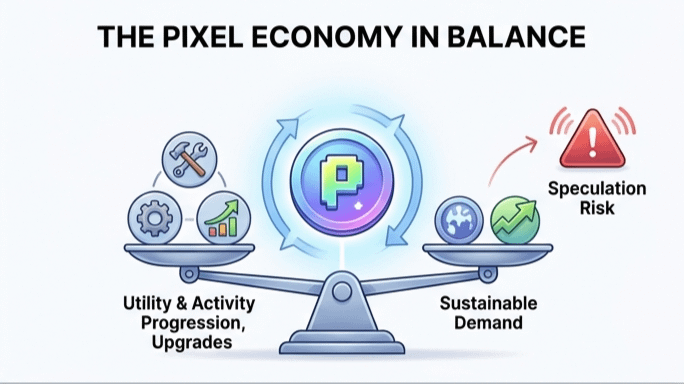
The PIXEL token sits at the center of this ecosystem, but it’s not aggressively shoved into your face. It’s used for in-game utility upgrades, crafting, progression and that matters because it ties demand to actual activity. I’ve noticed that when tokens are integrated this way, they have a better chance of sustaining interest, even if price action goes quiet for a while.
And then there’s Ronin. That part is easy to overlook, but I think it’s a big deal. Ronin already proved with Axie Infinity that it can onboard millions of users when the timing is right. Infrastructure matters more than people give it credit for. Cheap transactions, fast confirmations, and a familiar gaming ecosystem lower the barrier in a way most chains still struggle with. Pixels is basically plugging into an environment that’s already optimized for its use case.
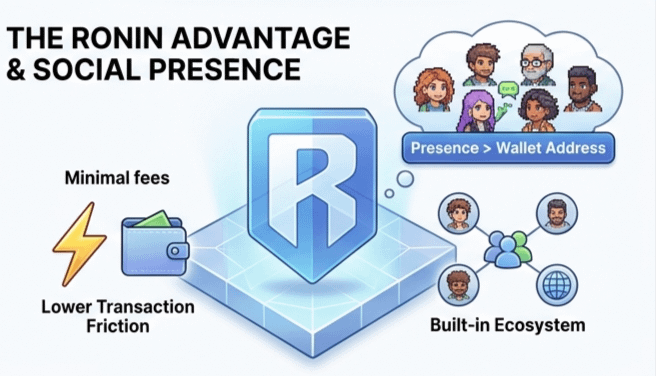
What I find interesting is how social the game feels. It’s not just about farming your own land. There’s this layer of interaction shared spaces, collaboration, even a bit of digital identity forming around how people play. That’s something Web3 has been trying to nail for years. Ownership alone isn’t enough. People want presence. They want to feel like they exist in a world, not just a wallet.
Compared to other blockchain games I’ve looked at, Pixels doesn’t try to overwhelm you with tokenomics complexity or AAA ambitions. If I think about competitors, a lot of them fall into two extremes. Either they’re too financialized, where everything revolves around earning, or they’re too ambitious, promising massive open worlds that take years to deliver. Pixels sits somewhere in the middle. It’s already playable, already active, but still evolving.
That said, I’m not ignoring the risks here. Game economies are fragile. We’ve seen how quickly things can unravel if token emissions outpace real demand. If too many players are extracting value without enough new users entering or spending, the system can tilt. That’s just the reality of any tokenized game.
There’s also the question of retention. Right now, a lot of Web3 games benefit from novelty. People try them because they’re new, because there’s some incentive, or because the ecosystem is buzzing. The real test is whether players stick around when rewards normalize. I think Pixels understands this, but execution is everything.
Another thing I keep thinking about is how dependent it might be on the broader Ronin ecosystem. That’s a strength, but also a kind of concentration risk. If Ronin thrives, Pixels benefits. If attention shifts elsewhere, it might feel that impact more than a fully chain-agnostic project.
Still, I can’t ignore the traction signals. Player activity, community engagement, the way people talk about the game it feels organic. Not forced. And that’s rare. Most projects try to manufacture hype. This one feels like it’s growing because people actually enjoy spending time in it.
One underrated thing I’ve noticed is how accessible Pixels is for non-crypto users. That might sound small, but I think it’s one of the biggest unlocks in this space. If someone can enter the game without fully understanding wallets, tokens, or DeFi mechanics, and only later realize they’re interacting with a blockchain system, that’s powerful. It flips the usual model. Instead of onboarding people into crypto first and then pushing them into products, it brings them into a product first and lets crypto sit quietly in the background.
I didn’t expect to spend this much time thinking about a pixel-style farming game, but here we are. It feels like a small experiment that might be pointing at something bigger. Not a revolution, not a guarantee, just a direction.
And I keep coming back to one question. If the next wave of adoption in Web3 doesn’t come from complex financial systems or high-end gaming, but from simple, social, low-friction experiences like this… are we actually paying enough attention to where the real signal is?
