 I have noticed something about blockchain games over the years.
Most of them struggle with the same issue.
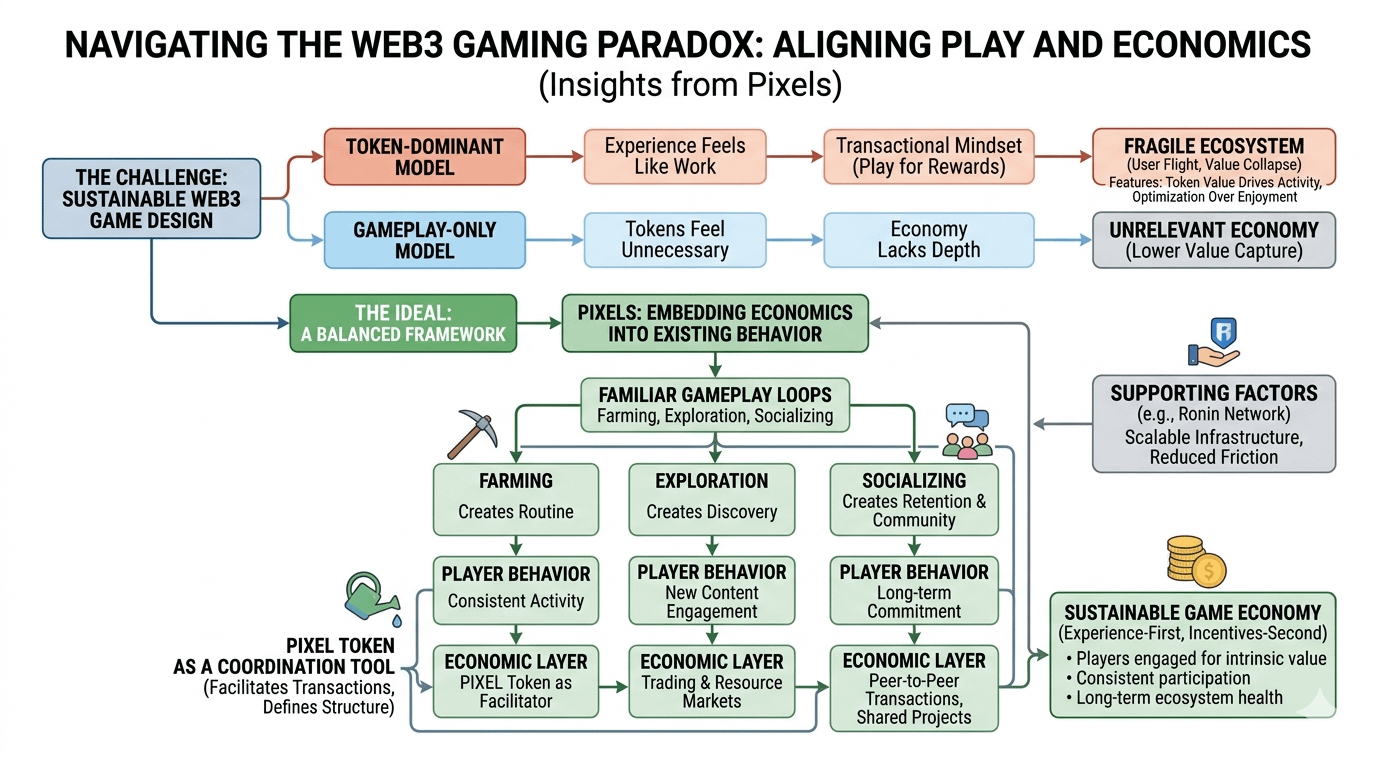
They are either fun or they are financial.
Rarely both.
Some games focus on gameplay but ignore the economy, making tokens feel unnecessary. Others focus on token mechanics so heavily that the experience starts to feel like work instead of play.
That imbalance is where most Web3 games lose users.
Pixels is interesting because it sits directly inside that tension.
At first glance, it looks simple.
A farming game.
Exploration.
Resource gathering.
A social open-world environment.
Nothing about that sounds revolutionary.
But the structure underneath is what makes it different.
Pixels is not trying to turn gameplay into finance.
It is trying to embed economics into behavior that already feels natural.
Farming, crafting, trading, and interacting are not new mechanics. They are familiar loops that players already understand from traditional games. The difference is that in Pixels, those actions exist inside an on-chain environment powered by the Ronin Network.
That changes what those actions represent.
Time spent in the game is not just progression.
It becomes participation in an economy.
But this is where things usually break.
If the economy becomes too dominant, the game starts to feel like a task system. Players optimize for rewards instead of enjoyment. The experience becomes transactional.
If the game ignores the economy, the token loses relevance.
Pixels is navigating that balance.
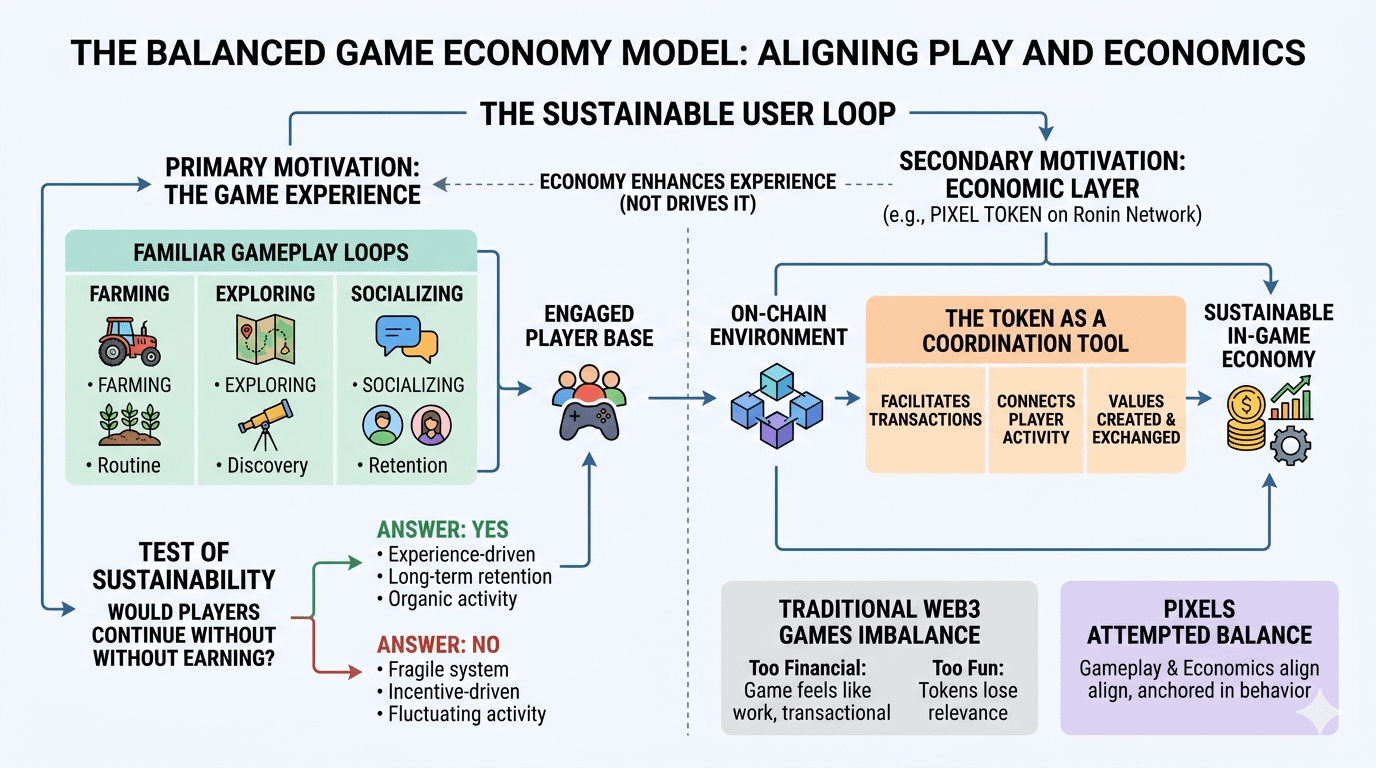
The question is not whether players can earn.
The question is whether they would still play without earning.
That is the test most Web3 games fail.
A sustainable game economy depends on players who are there for the experience first and the rewards second. When rewards become the primary reason to play, the system becomes fragile. Participation rises and falls with incentives instead of staying consistent.
Pixels attempts to anchor its system in familiar gameplay loops.
Farming creates routine.
Exploration creates discovery.
Social interaction creates retention.
These elements exist independently of the token.
That separation matters.
Because it allows the economy to layer on top of the experience instead of replacing it.
The PIXEL token then becomes a coordination tool within that environment.
It facilitates transactions.
It connects player activity to the broader system.
It gives structure to how value moves through the game.
But it does not define the game itself.
That distinction is important.
Successful game economies are usually built around activity that people would engage in regardless of rewards. The economy enhances the experience rather than driving it entirely.
Pixels is operating within that framework.
The use of Ronin Network also plays a role here.
Ronin has already supported large-scale gaming ecosystems, which suggests that the infrastructure can handle high levels of player activity. That reduces friction in how players interact with the system.
But infrastructure alone does not guarantee success.
The real question is whether Pixels can maintain engagement without relying heavily on incentives.
Early activity in Web3 games often comes from curiosity and rewards. Players explore the system, test mechanics, and participate because there is value attached to being early.
The long-term signal appears later.
Do players continue to engage when the initial excitement fades?
Do they return because the game itself is enjoyable?
Do social and gameplay loops create habits that persist over time?
These are the conditions that determine whether a game becomes sustainable.
Pixels is positioned as a social environment as much as a game.
That may be its most important feature.
Social systems create retention that incentives alone cannot replicate. When players interact, collaborate, and build within a shared environment, the game becomes more than a set of mechanics.
It becomes a place.
That is where long-term value can form.
Pixels is not trying to solve a technical problem.
It is trying to solve a behavioral one.
Can a blockchain game feel like a game first and an economy second?
If it can, the model becomes more sustainable.
If it cannot, it risks becoming another system where participation depends on rewards rather than experience.
That distinction will determine how the ecosystem evolves.
For now, Pixels represents an attempt to align gameplay and economics without forcing one to dominate the other.
And in Web3 gaming, that balance is where everything either works olr breaks.