
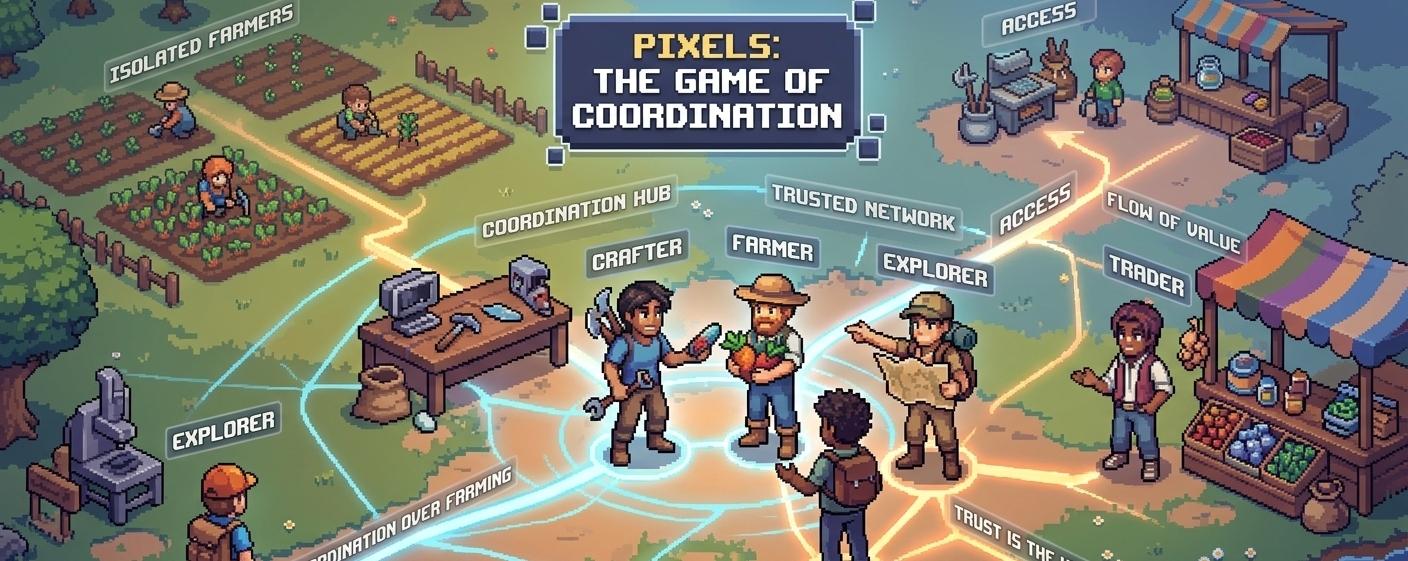
I often notice something that most people tend to overlook — whenever Pixels is discussed, the conversation almost always revolves around token prices, rewards, or farming efficiency. As if the entire system is just a numbers game. But the more time I spend in this world, the more I feel like people are missing what truly matters.
For me, the core gameplay of Pixels isn’t farming. It’s coordination.
When I first entered the game, I did exactly what every new player does — planted seeds, watered them, harvested crops. A simple loop. But within a few days, I started feeling like I was progressing artificially slow. I was putting in effort, yet my growth felt linear.
So I began to observe more closely.
I noticed that some players were doing the exact same things as me, yet progressing much faster. At first, I assumed they simply had more time or better items. But eventually, I realized something else — they weren’t playing alone.
That’s when my perspective shifted.
I slowly began to understand that Pixels isn’t an isolated game. It’s an interconnected system where every role matters — farmer, crafter, explorer, trader.
A farmer produces crops, but without a crafter, their efficiency is limited. A crafter creates tools, but without raw materials, they can’t function. Explorers bring rare items, but without a market, those items have no real value.
This doesn’t feel like coincidence. It feels like intentional design.
And the most interesting part? These dependencies aren’t forced — they emerge naturally.
Over time, I noticed something even more subtle: players don’t really choose their playstyle… their social positioning shapes it.
For example, players who start crafting early often become the “go-to” people in the community. Others rely on them, trade with them, and their network keeps growing. Their gameplay evolves beyond crafting — they become hubs.
On the other hand, some players quietly continue farming. They may be efficient, but their influence remains limited. Their networks stay small, and they depend heavily on the market.
Then there are explorers — unpredictable, somewhat isolated, yet occasionally holding the most valuable assets in the game.
These roles aren’t just mechanics. They evolve into social identities.
One pattern I’ve seen repeatedly is this: value doesn’t come from rarity alone — it comes from flow.
If a rare item sits with an isolated player, its practical value is limited. But when that same item moves through a connected network — from explorer to crafter to farmer to market — its value multiplies.
That’s when I realized: in Pixels, access matters more than ownership.
And access is social.
I remember a phase where I intentionally changed my strategy. Instead of focusing purely on improving efficiency, I started building relationships. I returned to the same crafters. I made direct deals with explorers. I didn’t just use the market — I started reading it.
In the short term, nothing dramatic changed.
But a few weeks later, the difference was obvious.
I was getting things faster. I was getting better rates. And most importantly, I could predict where the next opportunity would come from.
That’s when it clicked — Pixels is less of an economic game, and more of a social coordination game.
Another subtle thing people often miss is that trust acts as a hidden currency.
There’s no formal system measuring trust, yet every transaction depends on it. If you’re reliable, people come back to you. If you’re opportunistic, you might gain in the short term, but you lose long-term access.
And because the system is interconnected, even a small shift in reputation can create a cascading effect.
I’m not saying farming or tokens are irrelevant. They matter.
But they’re just the surface layer.
Underneath, something far more powerful is happening — coordination, trust, and positioning between players.
Today, when I play Pixels, I don’t just see crops or items on my screen. I see flows. I see who’s connected, who’s isolated, and who is quietly building their position.
And maybe that’s why I feel like I’m playing the game differently now.
Because when you look at a system through mechanics, you become part of it.
But when you understand it through patterns and relationships…
you begin to influence it.
And for me, that’s where the real advantage lies.
