
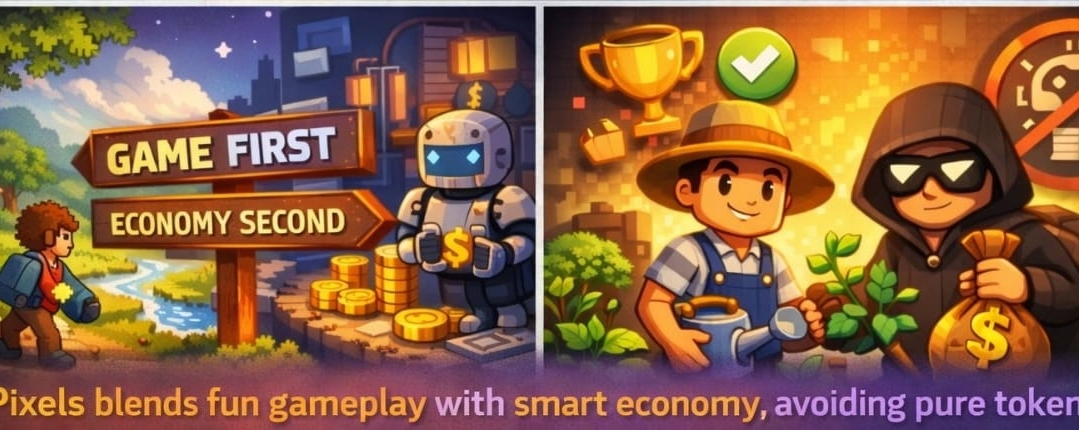
When I look deeper into crypto gaming, one
question keeps coming back to me: are these projects actually building real games,
or are they just wrapping financial extraction systems inside game like designs?
This question became even more relevant when I explored Pixels.
At first sight, Pixels feels similar to many other play-to-earn projects.
There is a token, a reward system, farming mechanics, and an active community focused on earning.
We’ve seen this formula many times before. It usually starts with hype, grows through speculation, and eventually slows down when rewards lose their attraction.
Because of this pattern, I initially assumed Pixels would follow the same path.
But after spending more time understanding it, I started noticing something slightly different.
The core problem with most crypto games is not graphics or gameplay complexity.
The real issue is design intent. Many projects are built around extraction from the beginning. They bring players in through rewards, but fail to create long-term emotional or gameplay value.
Once incentives reduce, players lose interest. In such systems, the economy controls the game instead of the game supporting the economy.
That is where most of them begin to collapse.
A successful game works differently. People return because they enjoy it.
Progress feels rewarding. The world feels engaging. Players are not constantly thinking about profit; they are focused on experience. But in most play-to earn environments,
this balance breaks. Gameplay turns into routine. Exploration disappears. Efficiency replaces fun. Slowly, the game starts feeling more like a job than entertainment.
What makes Pixels interesting is that it seems at least aware of this issue.
Its approach feels more “game-first” rather than “token-first.”
That may sound simple, but in crypto gaming, it is a major shift. Most projects design the economy first and then try to force gameplay around it.
Pixels appears to reverse that process by prioritizing engagement before rewards. That mindset is healthier and more sustainable in theory.
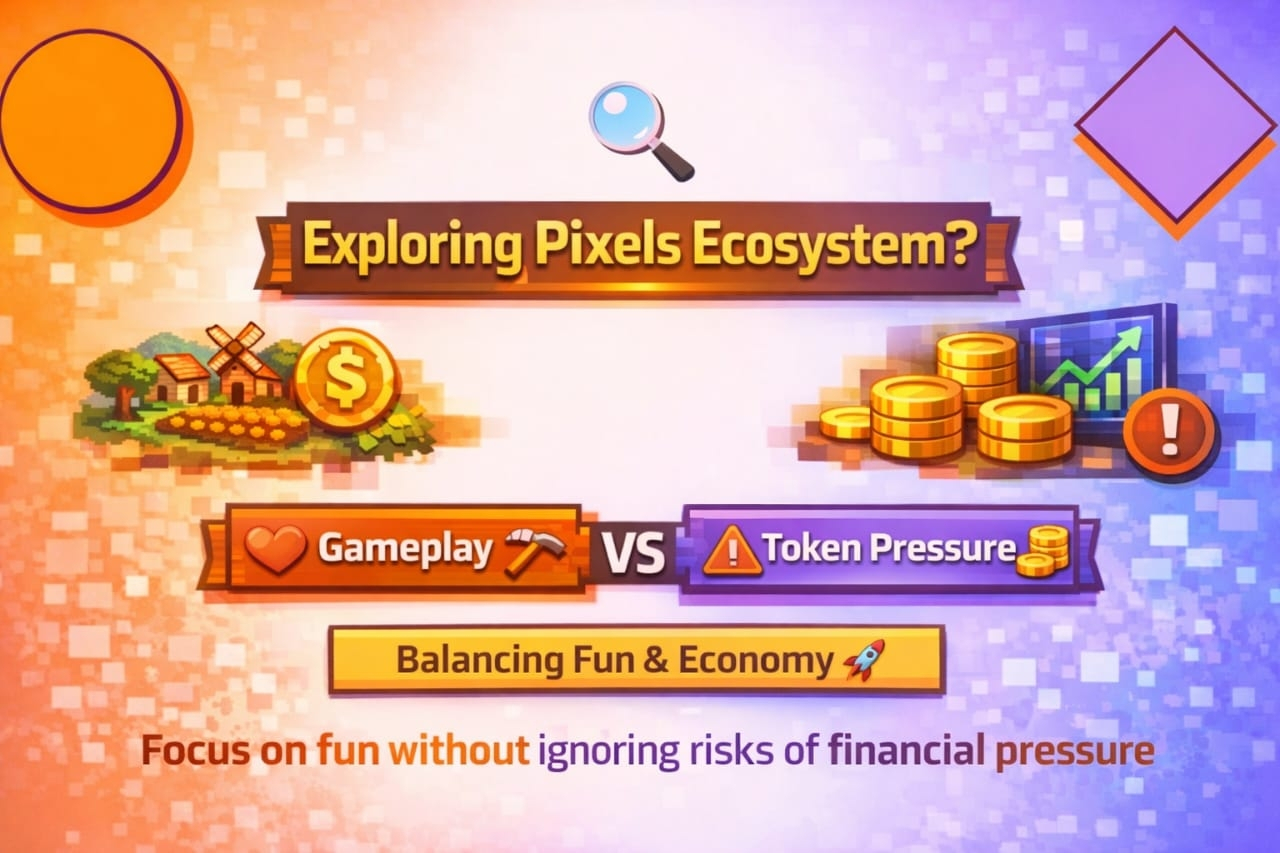
However, this is where caution comes in.
Saying a game is “fun-first” is easy. Maintaining that balance after introducing real financial incentives is extremely difficult. Once money becomes part of gameplay,
user behavior naturally changes. Players start optimizing every action. Strategies replace enjoyment. People search for the most profitable loop rather than the most fun experience.
This gradually changes the entire environment of the game.
Pixels seems aware of this risk and tries to manage it by rewarding meaningful participation instead of simple farming.
In theory, this helps reduce bots and low effort activity while supporting real engagement.
But execution is where things become complicated.
The line between a genuine player and an optimized farmer is very thin. A player can enjoy the game and still play efficiently.
So designing a system that rewards fairness without punishing smart gameplay is a difficult challenge. Any mistake in this balance can affect trust in the ecosystem.
Another interesting angle is the wider vision behind Pixels. It doesn’t look like just a single game project.
It feels more like an attempt to build a larger ecosystem where multiple games, users, and behavioral data connect together.
If successful, this creates a strong network effect: better games attract more users, more users generate better data, and better data improves distribution and growth.
On paper, this flywheel is powerful.
But early stage flywheels are always fragile. They only become effective once momentum already exists.
Before that, everything depends on user retention, quality content, and consistent engagement.
Without enough players and strong gameplay loops, the system remains theoretical rather than functional.
Because of this, Pixels is not something that can be judged as a guaranteed success or failure yet. It sits somewhere in between.
What stands out is that it seems to understand the real problems in crypto gaming
It recognizes that rewards alone cannot sustain a game. It understands that extraction-heavy systems eventually break.
And it tries to shift toward a more balanced model where gameplay matters again.
As for the token $PIXEL, its long-term strength will depend on utility.
If it only functions as a reward mechanism, selling pressure will remain constant
For it to be sustainable, it must be tied deeply to real ecosystem value, not just incentives.
In the end, Pixels is not perfect, but it is asking better questions than most projects in this space.
And in crypto gaming, asking the right questions is often the first step toward building something meaningful