

Why would anyone spend hours farming in a game when they could just buy the token and move on?
That question stayed with me longer than I expected. When I first came across Pixels, I assumed it was just another casual loop dressed up in blockchain language. Plant something, wait, harvest, repeat. If the outcome of all that effort is a token—something you can instantly purchase elsewhere—then the time spent inside the game starts to feel optional, almost irrational. So I looked closer, not because I was convinced, but because I couldn’t quite explain why people were choosing the slower path.
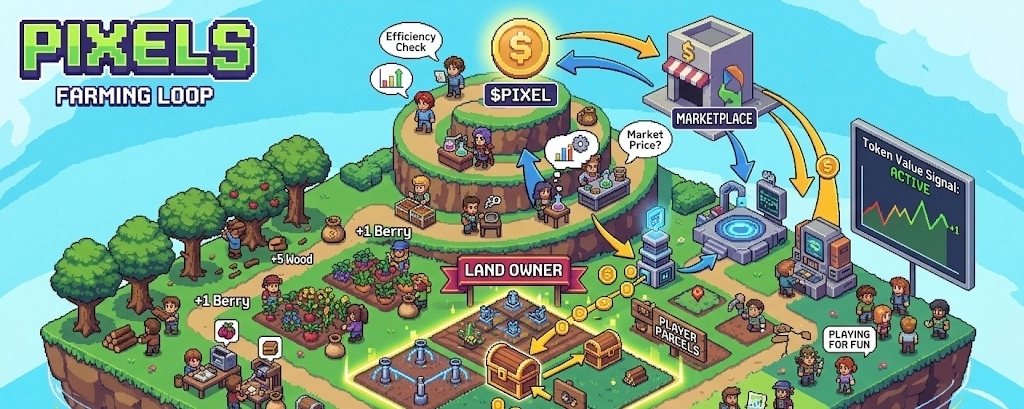
The more I watched how the system behaves, the harder it became to describe it as “just a game.” Farming didn’t feel like an activity layered on top of something else; it felt like the system itself. Every action produced something that could move, circulate, or accumulate. Time wasn’t just time—it was input. Output wasn’t just progression—it was inventory. And all of it lived on top of the Ronin Network, which quietly turned in-game actions into something that could exist beyond the game.
That’s when another question started forming. If this is an economy, then what role is a player actually stepping into? I initially thought everyone was doing roughly the same thing, just at different speeds. But that didn’t hold up. Some players were clearly spending their time producing—farming, gathering, crafting—while others seemed to benefit without doing much of that work directly. The difference, I realized, often came down to ownership. Land wasn’t just a place to stand; it was a position inside the system. It shaped who earned from activity and who enabled it.
That shifted the frame for me. Participation alone didn’t seem to be the primary lever. Ownership carried weight in a way that activity alone couldn’t fully match. And yet, the system didn’t lock people out entirely if they didn’t own anything. You could still enter, still farm, still earn something. It felt like a careful balance—open enough to attract new participants, structured enough to reward those who had already committed capital.
But if more people keep entering and producing, what happens to all that output? It doesn’t just disappear. It accumulates, and eventually, it competes. Prices respond. Margins tighten. And slowly, behavior changes. What started as casual farming begins to look more like optimization. Players experiment less for fun and more for efficiency. They adjust, specialize, coordinate. The system doesn’t tell them to do this, but it quietly nudges them in that direction.
At that point, I couldn’t ignore the role of the token anymore. If the value of what you’re producing is tied to something traded outside the game, then the system isn’t fully self-contained. A drop in token value doesn’t just affect portfolios—it changes motivation. Time inside the game starts to feel different when the external signal weakens. And yet, not everyone leaves. Some stay, which makes me wonder whether the system is relying on two different kinds of engagement at once—those who are here for the mechanics, and those who are here for the market.
That tension is difficult to resolve. Is this a game that uses a token, or a token system that uses a game? The answer doesn’t stay fixed. It seems to shift depending on who you ask, or when you ask it. Early on, exploration dominates. Later, optimization takes over. What felt open-ended begins to develop patterns, then strategies, then hierarchies. At scale, the system starts to resemble something more organized than it first appeared.
And when that happens, control becomes harder to ignore. Decisions about rewards, balance, or access begin to matter in a different way. They’re no longer just design choices—they start to shape the economy itself. Governance, whether formal or informal, becomes part of the experience. Not something separate from the product, but something embedded within it.
I don’t think I fully understand where this leads yet. There are still too many open questions. I don’t know if new participants will continue to find meaningful ways to progress without feeling pushed toward ownership. I don’t know how the system behaves if external market conditions stop supporting it. And I don’t know whether the core loop remains engaging once the financial layer becomes less compelling.
What I do know is that watching systems like Pixels requires a different kind of attention. It’s less about what the system claims to be, and more about what it quietly encourages people to do over time. The interesting part isn’t the mechanics themselves, but how those mechanics scale, how they reshape behavior, and how they hold up when the initial excitement fades.
Maybe the better way to approach it isn’t to decide what it is, but to keep asking what it becomes as more people pass through it—and what signals would suggest it’s working as intended, or drifting into something else entirely.
