
I’ll be honest.... when I first looked at Pixels, I didn’t expect much.
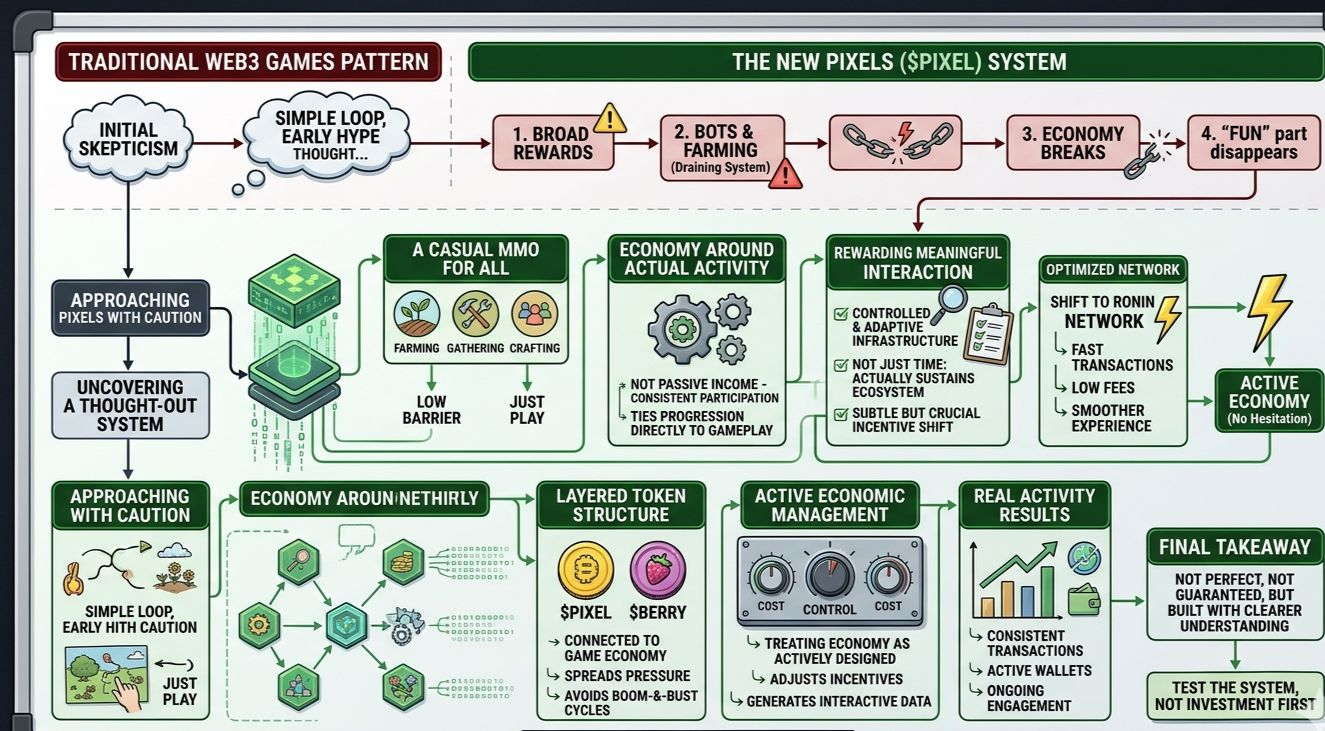
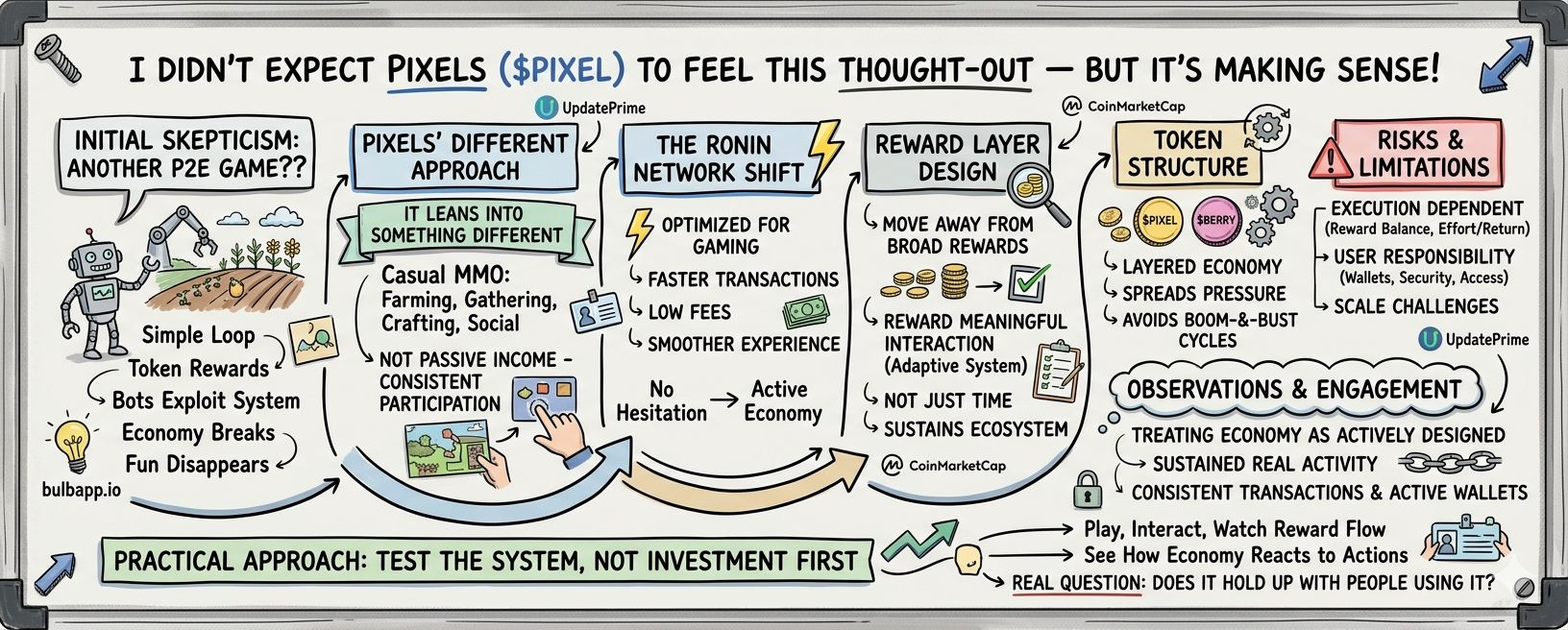
I’ve seen too many Web3 games follow the same pattern. A simple loop, some token rewards, early hype, then slowly the system gets drained by bots or people farming it harder than actually playing it. Eventually the economy breaks, and the “fun” part disappears with it.
So when I came across Pixels, I approached it with that same skepticism. Another farming game, another token, another attempt at play-to-earn dressed up slightly better.
But the more I looked into it, the more it didn’t quite fit that pattern.
At a surface level, Pixels looks familiar. It’s a casual MMO built around farming, gathering, crafting, and social interaction. That part is intentional it lowers the barrier. You don’t need to “learn crypto,” you just play.
What changes things is what sits underneath that loop.
Most Web3 games talk about ownership, but in practice, the system still relies heavily on user behavior staying “honest.” Pixels leans into something different it builds the economy around actual activity and ties progression directly to what you do inside the game world.
And importantly, it doesn’t try to hide the fact that this is a system you have to interact with consistently. It’s not passive income. It’s participation.
That distinction matters more than it sounds.
The shift to the Ronin network is also part of that design. Instead of operating on expensive infrastructure, Pixels moved to a chain optimized for gaming faster transactions, low fees, and a smoother experience overall.
That sounds like a technical detail, but it actually changes behavior. When transactions are cheap and instant, people interact more. When they’re not, people hesitate. And hesitation kills game economies faster than anything.
What started to catch my attention though wasn’t just the gameplay or the tech it was how the reward layer is being handled.
This is where most systems fail.
In typical play to earn setups, rewards are distributed broadly and blindly. Everyone farms the same loop. Bots exploit it. Real players either grind harder or leave.
Pixels, through its evolving system (especially with what they’re building around reward infrastructure), seems to be moving toward something more controlled and adaptive.
Instead of rewarding time alone, the system leans toward rewarding meaningful interaction. That might sound vague, but in practice it’s the difference between do this task repeatedly and engage in ways that actually sustain the ecosystem.
It’s subtle, but it changes incentives.
And incentives are everything in Web3.
Another thing I noticed is how the token structure is positioned. $PIXEL isn’t just sitting there as a speculative asset. It’s tied into the ecosystem alongside in game resources like $BERRY and connected to how players move through the game economy.
That creates a more layered system, where not everything is reduced to a single token loop. It spreads pressure, which in theory helps avoid the usual boom and bust cycles.
Still, none of this automatically makes it sustainable.
There are real limitations here.
The system still depends heavily on execution. If reward distribution becomes misaligned, or if the balance between effort and return shifts too far, the same issues could resurface. And like any blockchain-based system, users still carry responsibility wallets, security, and access are all on them.
That’s not something you can design away completely.
There’s also the question of scale. It’s one thing for a system to work within its own ecosystem. It’s another for it to hold up when user numbers grow, behaviors change, and new types of participants enter.
That’s where most projects quietly break.
But even with those risks, I think Pixels is doing something that a lot of Web3 games avoided for too long it’s treating the economy as something that needs to be actively designed and adjusted, not just launched and left alone.
And that’s probably why it’s been able to sustain real activity. The numbers themselves reflect that consistent transactions, active wallets, and ongoing engagement rather than short bursts of hype.
From a practical perspective, this kind of system makes more sense in environments where user behavior directly impacts value. Gaming is one of those areas. It’s interactive, it’s repeatable, and it naturally generates data that can be used to adjust incentives.
It’s very different from trying to force token mechanics into systems that don’t need them.
If I were approaching Pixels today, I wouldn’t treat it like an investment first. I’d treat it like a system to test.
Play it. Interact with it. Watch how rewards flow. See how the economy reacts to your actions. That tells you more than any whitepaper ever will.
Because at the end of the day, the real question isn’t whether the idea sounds good.
It’s whether the system holds up when people actually use it.
And that’s where Pixels, at least so far, feels a bit more grounded than most.
Not perfect. Not guaranteed. But built with a clearer understanding of where things usually go wrong.
And in this space, that alone is worth paying attention to.