I used to think Pixels was easy to explain. A farming game on Ronin. A Web3 game with a token. A colorful world with quests, resources, and progression loops. That description is not wrong, but the more I looked at it, the more incomplete it felt.
What started to stand out to me was not one feature. It was the way the pieces kept connecting.
A lot of Web3 games look fine when you examine them one layer at a time. The gameplay might look decent. The token might have utility. The social side might sound interesting on paper. But once you step back, the whole thing still feels thin. The systems sit next to each other without really strengthening each other. You can feel the gap. The world exists, but it does not feel alive.
That is where Pixels starts to look different to me.
The more I went through its structure, the less it looked like a simple game and the more it looked like a system built around behavior, trust, progression, and participation. That difference matters to me because a game can attract attention for a while, but a system is what gives people a reason to keep coming back.
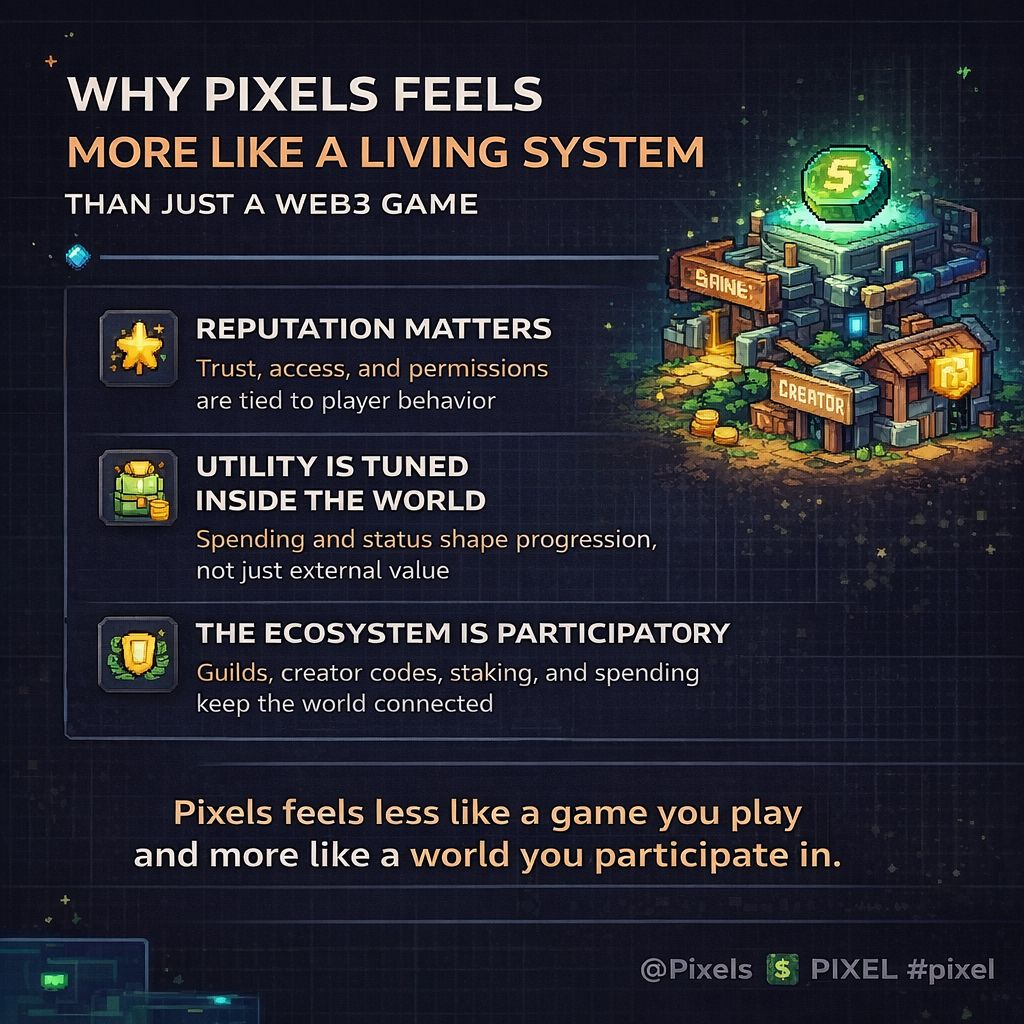
I think reputation is one of the clearest examples of that. In weaker projects, trust usually becomes a concern only after abuse starts damaging the economy. Then the team reacts. Then the fixes come late. Pixels feels more deliberate than that. Reputation is not sitting outside the experience as a background metric. It is tied to what players can actually do. That changes the texture of the whole world. When access, limits, and permissions start depending on player behavior, the game stops treating trust like an afterthought. It starts building it into the environment itself.
That is where it stops feeling casual to me.
Because once trust becomes part of the rules, the economy becomes harder to fake. The player journey becomes harder to exploit. And the world starts feeling less like a temporary loop designed for short-term activity and more like a place that wants to protect itself over time.
The same thing shows up in how Pixels handles progression and spending. This is another place where a lot of projects get exposed. They say the token has utility, but what they usually mean is that the token exists somewhere around the product and occasionally touches it. That is weak design. Utility sounds impressive until you realize it does not meaningfully improve the experience.
Pixels looks more convincing to me because the premium layer is not framed as some empty badge. It is tied to convenience, speed, access, boosts, cosmetics, and deeper participation inside the world. That makes the token feel less like an external narrative object and more like a tool that actually changes how the world is experienced. I pay more attention when a project uses its premium layer to shape the inside of the product rather than just the market around it.
That difference matters to me.
Because when spending is connected to the way the world actually feels, the economy stops being decorative. It starts becoming structural.
Then there is the social layer, and this is where I think Pixels gets more interesting than people give it credit for. Most people still talk about Web3 games as if the important relationship is only between player and token. I think that framing is too narrow. In Pixels, the more interesting relationship is between player, community, and system. Guilds are not just social wrappers. Creator codes are not just superficial marketing tools. These things create channels through which activity, rewards, and identity move across the world. That makes the economy feel shared rather than isolated.
And when that happens, the game starts becoming harder to reduce to a single loop.
It is not just farming. It is not just earning. It is not just spending. It is not just socializing. The project becomes more compelling when all of those things start leaning on each other.
That is where Pixels starts to feel like a living system to me.
Even the broader direction reinforces that feeling. The project does not just present itself as a game people play. It increasingly looks like something that wants to become a wider environment for participation, development, and ecosystem growth. Once staking, game support, creator incentives, player behavior, premium utility, and social coordination all start feeding into the same structure, the real story changes. At that point, I stop asking whether Pixels is simply a good Web3 game. I start asking whether it is quietly building a stronger kind of game economy than most people realize.
And I think that is the more important question.
Because attention is cheap in this space. Hype is cheap too. A project can borrow those for a while. But a world that can keep adapting, filtering bad behavior, rewarding real participation, and connecting its systems with intent is much harder to build.
That is why Pixels feels more interesting to me now.
Not because it is louder.
Not because it is easier to market.
But because the structure underneath it looks more connected than it first appears.
A lot of Web3 games try to look alive.
Pixels looks like it is trying to function that way.
Built like a world, not just sold like one.