

I’ve spent enough time around Web3 games to recognize the pattern early.
You log in, there’s a token, there’s some loop that looks like gameplay, but underneath it’s just a liquidity machine. Emissions go out, users come in, price goes up, everyone calls it adoption. Then emissions keep going, users start extracting instead of engaging, and the whole thing slowly bleeds out.
We’ve seen this movie before.
Most “play-to-earn” games weren’t really games. They were DeFi protocols with a UI layer pretending to be gameplay. The core loop wasn’t designed for retention. It was designed for extraction. And once mercenary capital figured that out, it was over.
So when I first looked at Pixels, I wasn’t expecting much.
It looked… simple. Almost too simple. Farming, walking around, gathering resources. No complicated mechanics. No aggressive token hooks thrown in your face. Honestly, it felt closer to an idle browser game than anything “innovative.”
But that’s exactly where it gets interesting.
Because Pixels does something most Web3 games failed to do. It acts as a time sink first, economy second.
And that sounds trivial until you realize how rare that actually is.
The core issue with P2E has never been rewards themselves. It’s been when and how those rewards are introduced into the system.
If your primary loop is “do action → get token,” you are training users to think like extractors. They optimize for output, not experience. Retention becomes directly tied to token price. The moment price weakens, engagement collapses.
That’s not a game. That’s a yield farm with extra steps.
Pixels flips that sequencing.
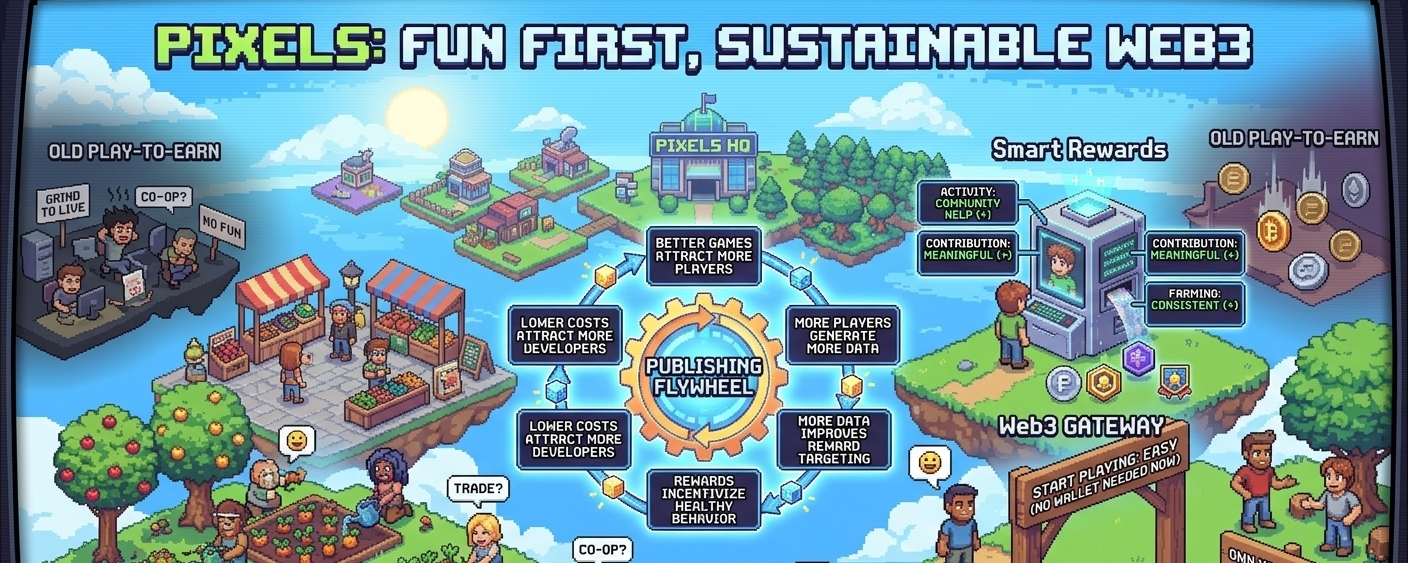
You log in, and nothing is screaming at you to optimize. You plant crops. You move around. You talk to people. There’s no immediate pressure to maximize earnings per minute. In fact, if you try to approach it like a yield farm, it feels inefficient.
That friction is intentional.
It filters out pure mercenary behavior and slows down the rate of extraction. And more importantly, it builds a base layer of users who are actually spending time in the system for reasons other than immediate financial return.
That’s your first real moat.
Now, the second layer is where most people misunderstand what Pixels is doing.
They see “rewards” and assume it’s just another emission schedule. It’s not.
The interesting part is the targeting.
Instead of distributing rewards evenly or based on easily gameable actions, Pixels leans heavily on data-driven allocation. Think of it less like a faucet and more like an ad network. The system is constantly trying to answer a simple question:
Which user behaviors actually increase long-term retention and ecosystem value?
And then it routes incentives toward those behaviors.
That matters because it changes the incentive gradient. You’re no longer just rewarding activity. You’re rewarding useful activity.
In most Web3 games, volume looks like growth but is actually just churn in disguise. Here, the idea is to identify signal inside that noise. Players who contribute to social density, economic circulation, or progression loops get prioritized.
It’s closer to performance marketing logic than traditional game design.
And yes, it’s not perfect. Any system like this can be gamed at the margins. But it’s directionally correct, which is more than you can say for most P2E economies.
The third piece is the so-called publishing flywheel, which sounds like a buzzword until you break it down operationally.
More players → more behavioral data
More data → better reward targeting + lower UA costs
Lower UA costs → more developers willing to plug into the ecosystem
More games → more players
It’s a loop, but not the kind people usually talk about in Web3.
This isn’t reflexive price action. It’s operational efficiency compounding over time.
User acquisition is one of the biggest hidden costs in gaming. In Web3, it’s even worse because most users are low-retention, high-extraction participants. If you can actually reduce UA costs while improving retention quality, you’re not just growing. You’re improving margin structure.
That’s what Pixels is quietly trying to do.
Not by shouting about “mass adoption,” but by tightening the feedback loop between player behavior and incentive design.
There’s also something worth mentioning about how Pixels handles on-chain elements.
A lot of projects force ownership into the experience. Everything becomes a token, whether it needs to be or not. It creates cognitive overhead and often breaks immersion.
Pixels integrates it more passively.
Progression, items, identity. They map to ownership, but they don’t interrupt the loop. You’re not constantly thinking about wallets or transactions while playing. The chain is there, but it’s not the product.
That’s a subtle design choice, but it reduces friction significantly.
And friction, in these systems, is usually where users drop off.
If I had to summarize the difference in one line, it’s this:
Most Web3 games tried to financialize gameplay. Pixels is trying to operationalize retention.
That’s a much harder problem.
Because now you’re not just managing token supply. You’re managing time, attention, and behavior across a large user base. You’re effectively running a live economy where every incentive decision feeds back into user psychology.
Get it wrong, and you either choke growth or reopen the door to extraction loops.
Get it right, and you start to see something rare in this space. Users who stay even when the immediate rewards aren’t optimal.
I’m still skeptical, by the way.
Any system with token incentives is always at risk of drifting back toward extraction. Markets are very good at finding inefficiencies and exploiting them. If reward targeting slips, or if new user inflows slow down too much, the balance can break.
And once extraction exceeds genuine engagement, it’s very hard to reverse.
But at least here, the foundation isn’t purely financial.
It’s built on something much more boring. Time spent. Small actions. Low-pressure loops. A system that doesn’t immediately convert every interaction into a payout.
And ironically, that boring layer is doing most of the heavy lifting.
Because if your game isn’t a real sink for attention, your token is just a timer counting down to imbalance.