
PIXEL protocol as emergent coordination substrate for player driven metaverse governance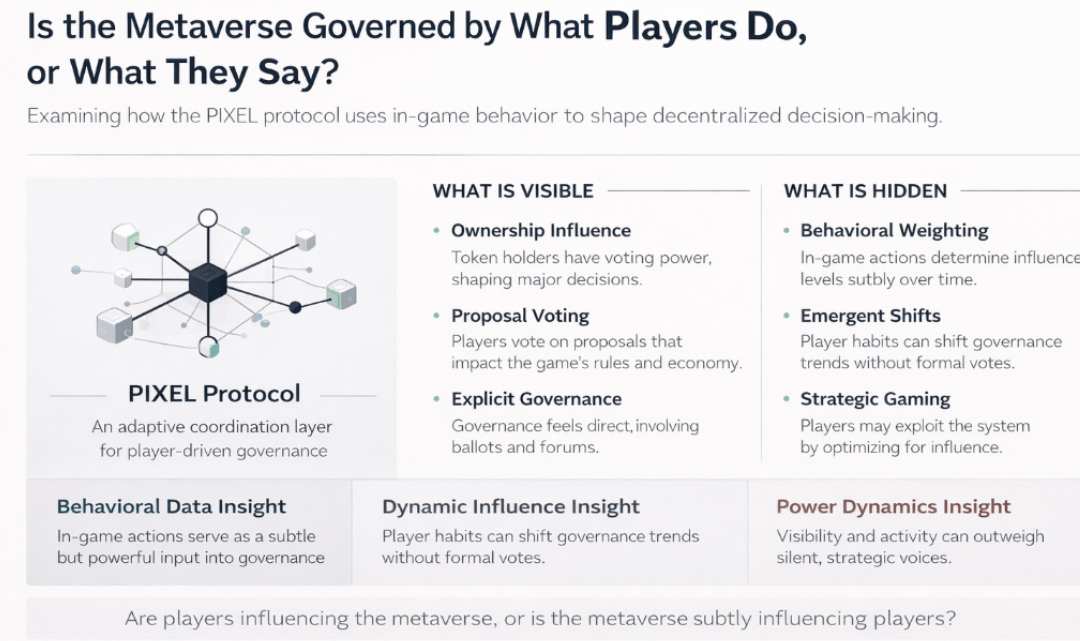
Good Morning Binancians Let me tell you what I noticed something that Most “player-owned” worlds don’t actually feel owned. They feel rented with a slightly better UI and a governance tab nobody really touches.
That disconnect is where things start to get weird. Because on paper, tokens like $PIXEL (@Pixels ) are supposed to turn players into participants. In practice, most players still behave like… players.
The real issue isn’t ownership. It’s coordination.
Take any multiplayer system game, DAO, even a college group project. The breakdown rarely comes from lack of incentives. It comes from misaligned timing, unclear signals, and nobody knowing whether their action actually matters. Everyone’s technically “in the system,” but no one’s actually coordinating.
Most metaverse governance models right now look like early-stage democracies with no shared context. You vote on proposals you barely understand, outcomes lag weeks behind, and by the time anything changes, the meta has already shifted. It’s like trying to steer a car by sending emails.
What PIXEL seems to be doing whether intentionally or not is shifting governance from explicit decisions to behavioral signals.
Instead of asking players what they want, it watches what they do.
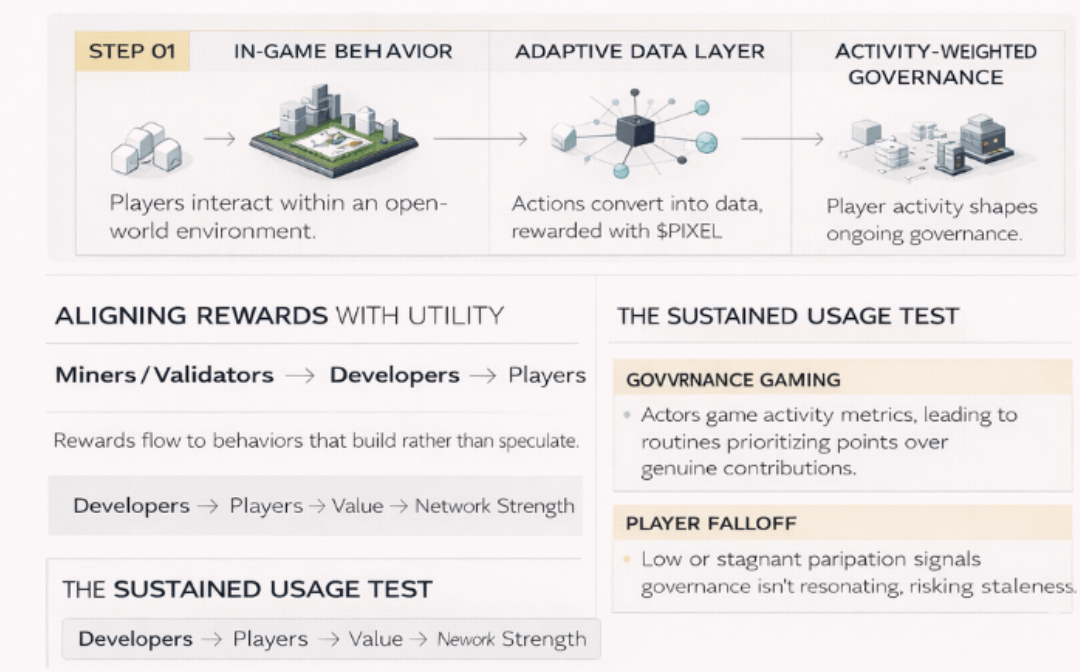
One mechanism that stands out is how in game actions can translate into governance weight. Not in a vague “activity matters” way, but in a more structured sense where participation patterns resource allocation, land usage, interaction frequency start forming a kind of soft consensus layer. It’s not just “who holds the token,” it’s “who is shaping the environment.”
That changes things. Because now governance isn’t an event. It’s a byproduct.
Another piece is how #pixel ties economic flows directly to player driven loops. If certain areas of the game world become more active, more valuable, or more contested, that activity doesn’t just stay local it feeds back into the system’s broader decision-making structure. Think of it like traffic data in Google Maps. No one votes on which road is congested. The system just knows.
This is where it gets interesting and slightly uncomfortable.
Because once governance becomes behavioral, it also becomes less visible. You’re influencing the system without always realizing it. And more importantly, others are too.
There’s a subtle shift here from “I have power because I hold tokens” to “I have power because my behavior is legible to the system.” That’s a very different model. It rewards consistency over speculation, presence over intention.
But it also raises a question: what happens when behavior is gamed?

If players realize that certain actions increase their governance influence, those actions stop being organic. They become strategies. And once that happens, the system starts drifting again just in a different direction.
It’s similar to how social media algorithms changed user behavior. People didn’t just post what they wanted. They posted what performed. Over time, the signal became noise.
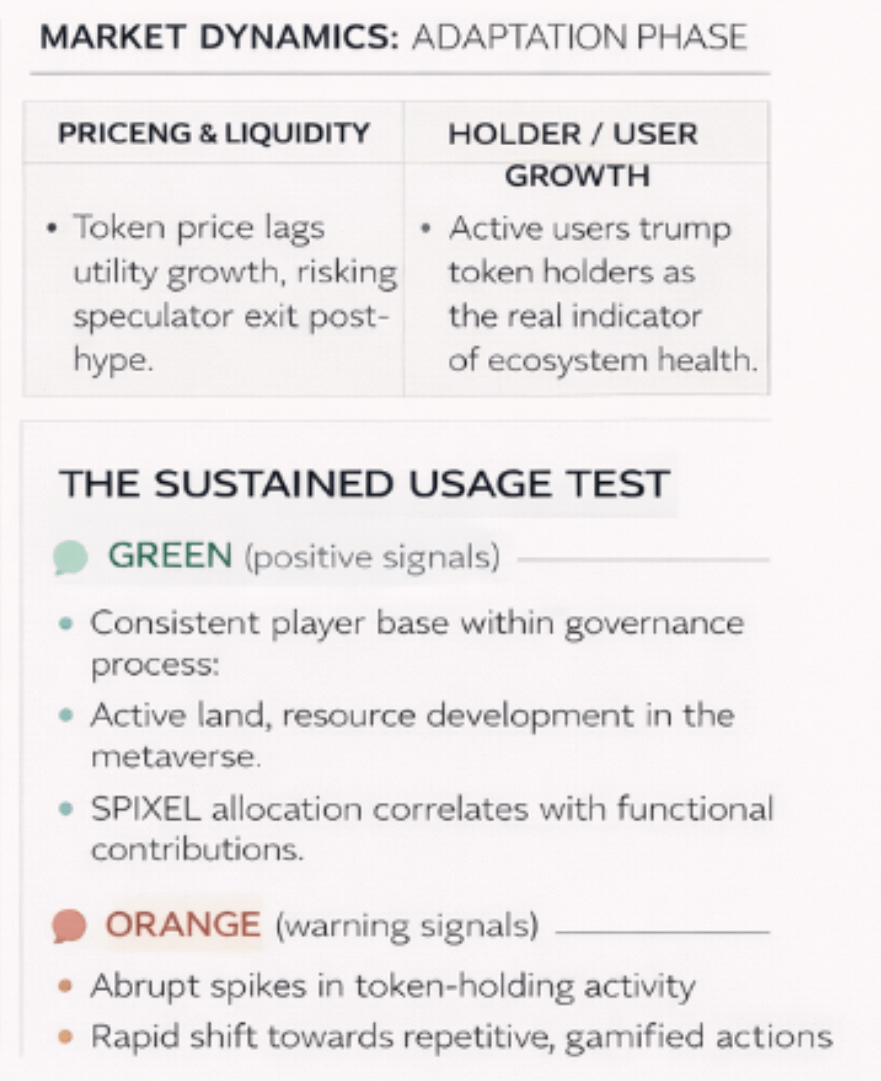
PIXEL could face the same risk. If governance weight is tied too closely to measurable activity, you might end up optimizing for the wrong kind of engagement,,grind over meaning, volume over impact.
There’s also the issue of silent players. Not everyone who understands a system participates actively. Some observe, adapt, and move strategically. In a behavior-driven governance model, those players might end up underrepresented ,not because they lack insight, but because they lack visibility.
And yet… there’s something compelling about this direction.
Because traditional governance assumes that people know what they want and can articulate it clearly. But most of the time, they don’t. Preferences are messy, contextual, and constantly changing. Behavior, on the other hand, is immediate. It’s honest in a way that votes aren’t.
PIXEL is essentially betting that a metaverse can govern itself the way ecosystems do not through top down decisions, but through continuous feedback loops.
That’s a bold assumption.
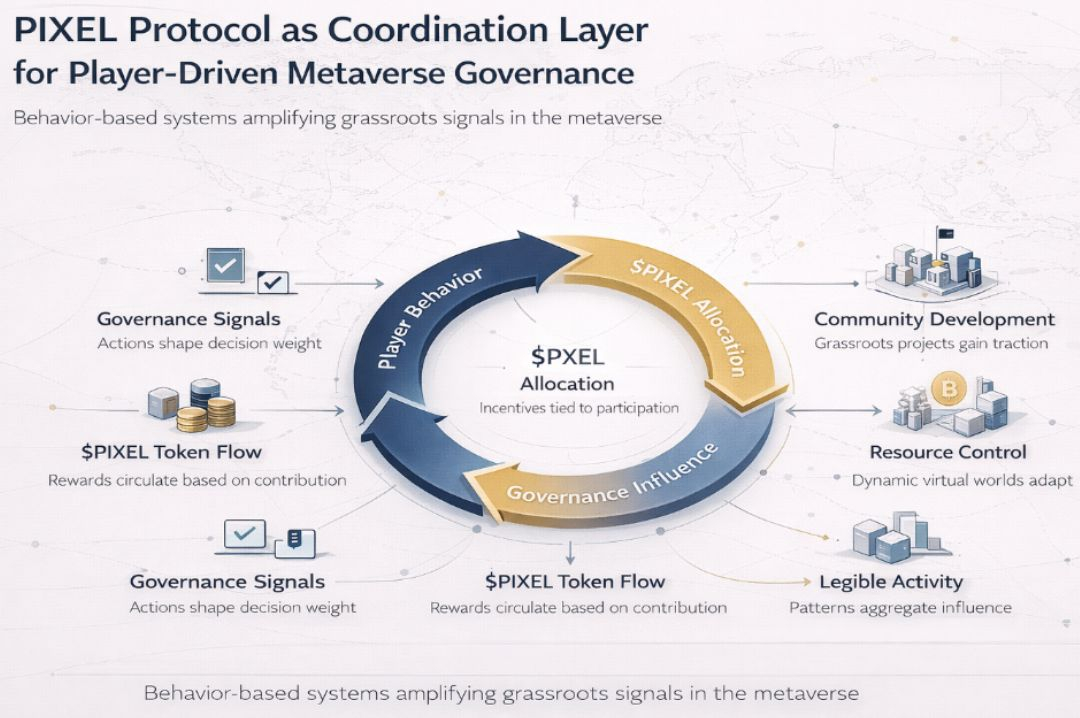
It turns the token into less of a voting tool and more of a coordination layer a way to aggregate, interpret, and respond to collective behavior in real time. Not perfectly, not cleanly, but dynamically.
The strange part is, if this works, governance might start to disappear. Not because it’s gone, but because it’s embedded everywhere.
You won’t log in to vote. You’ll just play and the system will adjust around you.
Whether that leads to more aligned worlds or just more sophisticated chaos… that’s still open.
