
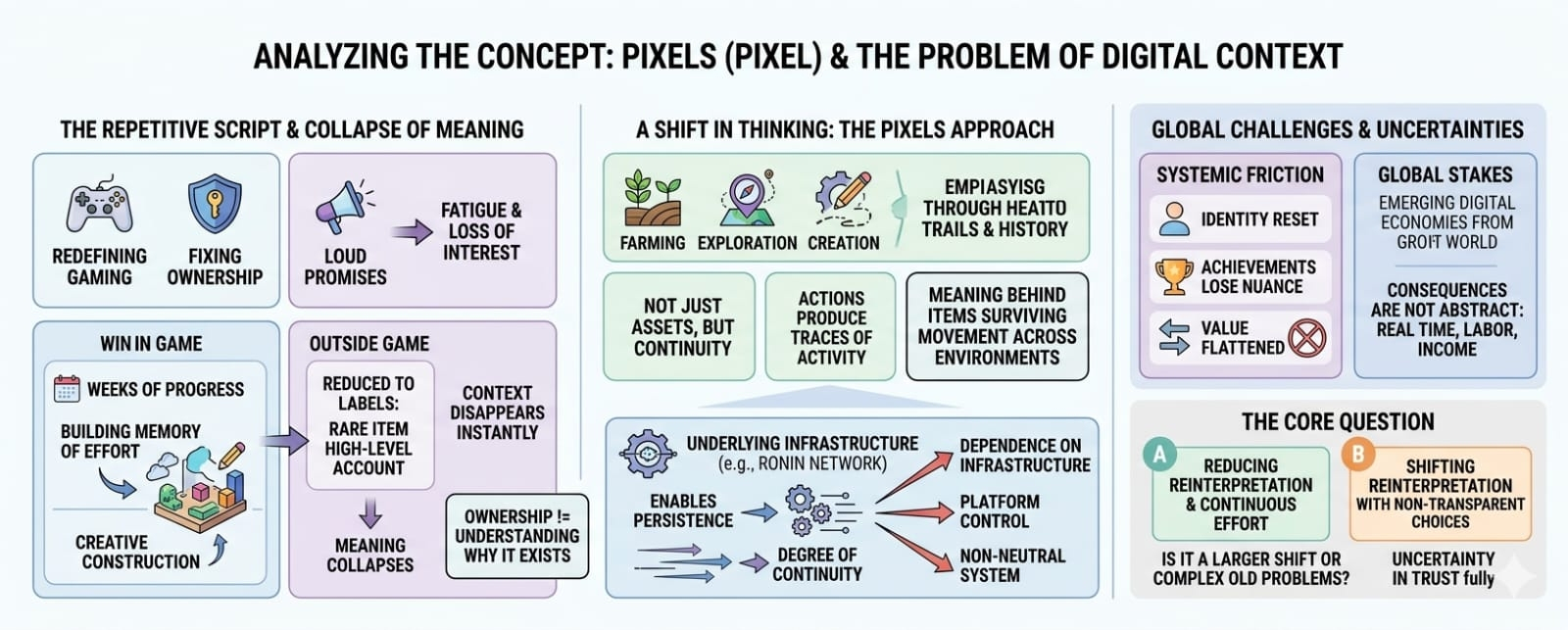

I opened Pixels on a Tuesday afternoon, the kind of idle moment that usually dissolves into scrolling or distraction, and I expected very little from it. A farming game, built on the Ronin Network, sounded like a contradiction I had already lived through too many times. In earlier cycles, “games” in this space were rarely games at all. They were thin economic shells dressed in mechanics, systems designed less for play and more for extraction. You didn’t log in to enjoy them; you logged in to optimize them. So when Pixels presented itself as something casual, something almost indifferent to financial urgency, I approached it with a kind of fatigue that only repetition can produce.
And yet, the experience unsettled me precisely because it did not immediately confirm my expectations. You plant crops, you wander, you gather resources. The loop is simple, almost stubbornly so. There is no aggressive onboarding into token logic, no early demand to financialize your attention. The world feels familiar in a way that disarms skepticism. It echoes older, softer design traditions—games where time spent was not constantly translated into measurable yield. That alone creates a strange tension, because the infrastructure beneath it insists that yield must exist somewhere, even if it is not immediately visible.
This is where the ambiguity begins to matter. The presence of PIXEL is not incidental. It is structural. Whether or not a player engages with it directly, the token implies an economy, and the economy implies incentives that extend beyond the visible surface of the game. That duality—between what the player feels and what the system encodes—defines the entire experience. Pixels wants to be a place you can inhabit without thinking about markets, but it is also built on a framework that cannot fully detach from them.
What makes this more complex is that the game does not collapse under that contradiction, at least not immediately. It holds itself together by leaning into routine rather than urgency. You return not because you are chasing a spike in value, but because the actions themselves create a rhythm. Planting, harvesting, moving through space—these are not new mechanics, but here they are positioned as ends rather than means. That shift, subtle as it is, changes the emotional texture of the experience. It allows the player to forget, if only temporarily, that they are operating inside a system that could be optimized.
But that forgetting is fragile. The moment you begin to interrogate the structure—how resources flow, how value accumulates, how ownership is defined—the illusion of simplicity starts to thin. You become aware again of the underlying machinery, of the fact that this is not just a game but a layered system where behavior can be incentivized, redirected, or exploited. This is not a flaw unique to Pixels; it is a condition of the entire category. The question is not whether the tension exists, but whether it can be managed without breaking the experience.
What stands out about Pixels is that it appears to recognize this tension rather than ignore it. Many projects in the past accelerated toward financialization, amplifying incentives until they overwhelmed the play itself. The result was predictable: players became workers, engagement became extraction, and the system hollowed out from within. Pixels, by contrast, seems to be moving more cautiously. It does not eliminate incentives, but it does not foreground them either. It attempts to preserve a space where participation can feel voluntary rather than instrumental.
That approach, however, introduces a different kind of risk. By softening the visibility of the economy, the game relies more heavily on the durability of its routine. It must be compelling enough, on its own terms, to sustain attention once the initial curiosity fades. This is where many systems fail, not because they lack design, but because they lack weight. Routine without depth becomes repetition, and repetition without meaning eventually collapses into disengagement.
In this regard, Pixels feels less like a finished product and more like an ongoing test. Its early traction is not particularly meaningful; attention is easy to capture in this space. What matters is whether the system can maintain coherence as conditions change. As speculative interest declines, as the broader market cools, the composition of its player base will shift. Those who remain will do so for different reasons, and the system will have to adapt to that change without losing its identity.
There are signs that this process is already underway. Adjustments to incentives, shifts in pacing, subtle recalibrations of progression—these are not the moves of a static system. They suggest a project that is responding to internal pressures, attempting to stabilize itself before those pressures become visible fractures. This is not a guarantee of success, but it is a signal of awareness, and awareness is rare enough in this context to be noteworthy.
Still, skepticism remains justified. The history of Web3 gaming is not one of gradual refinement but of cyclical overreach. Systems that begin with restraint often drift toward optimization as participants discover and exploit their edges. The transition is rarely abrupt. It happens slowly, as efficient behaviors outcompete expressive ones, as the logic of the system narrows around what it rewards most effectively. The danger is not that Pixels will suddenly become unplayable, but that it will gradually become something else—something thinner, more mechanical, less capable of sustaining the illusion that makes it work.
And yet, there is something here that resists easy dismissal. Perhaps it is the way the game allows space for disengagement, for moments that are not immediately productive. Perhaps it is the absence of urgency, the refusal to force the player into a constant negotiation with value. Or perhaps it is simply that, for a brief period, it feels like a place rather than a system—a world you can enter without immediately calculating your position within it.
That feeling may not last. It may not even be the point. But it is enough to complicate the narrative, to suggest that the trajectory of this space is not entirely fixed. Pixels does not resolve the contradictions of Web3 gaming; it inhabits them. It does not eliminate the tension between play and extraction; it redistributes it, pushes it just far enough into the background that the foreground can function.
Whether that balance can hold is an open question. It depends on forces both internal and external, on decisions that have yet to be made, on behaviors that have yet to emerge. What can be said, with some confidence, is that Pixels has moved beyond the phase where novelty alone sustains it. It is now operating in a more demanding context, one where continuity matters more than attention, where the ability to endure is tested not by spikes of interest but by the slow passage of time.
For now, it holds. Not perfectly, not permanently, but convincingly enough to keep attention anchored. And in a space defined by rapid decay, that alone begins to feel significant.