
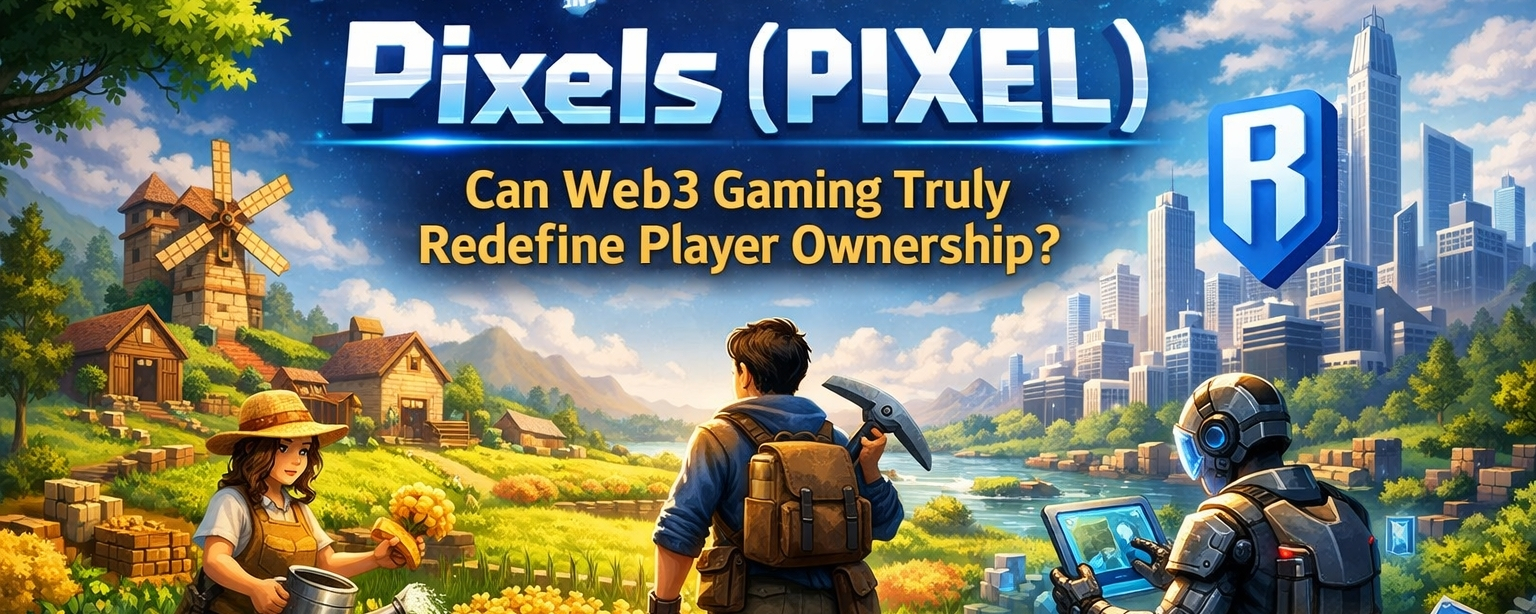
Why do most online games still treat players as temporary participants rather than longterm stakeholders? It’s a question that keeps resurfacing as digital worlds grow larger, yet ownership within them remains limited.
For years, traditional gaming ecosystems have operated under centralized control. Players invest time, creativity, and sometimes money, but ultimately have little authority over what they build or earn. Progress, assets, and even identities remain locked within publisher-controlled systems.
This imbalance has long been recognized, yet difficult to solve. Game developers need control to maintain balance, security, and revenue models, while players increasingly expect more agency and persistence. Bridging that gap has proven technically and economically complex.
Earlier attempts to address this issue came through player-driven economies and modding communities. These allowed limited ownership or creative contribution, but still operated within strict boundaries defined by game publishers.
The introduction of blockchain-based gaming promised a structural shift. By enabling verifiable ownership of digital assets, these systems aimed to give players more control over their in-game items and identities.
However, early Web3 games struggled to deliver compelling gameplay. Many focused heavily on financial incentives rather than user experience, leading to ecosystems that were unsustainable or unattractive to mainstream players.
This is the context in which Pixels (PIXEL) emerges. It presents itself as a social, casual Web3 game built on the Ronin Network, combining familiar gameplay elements like farming, exploration, and crafting with blockchain-based ownership.
Rather than reinventing gameplay entirely, Pixels adopts a more accessible approach. It leans on mechanics that are already well understood, lowering the barrier for users who may not be familiar with blockchain technology.
The choice of the Ronin Network is also notable. Designed to support gaming applications, it aims to offer lower transaction costs and smoother user experiences compared to earlier blockchain infrastructures.
Pixels emphasizes social interaction as a core feature. Players are encouraged to collaborate, trade, and build within a shared open world, suggesting an attempt to recreate the community-driven aspects that made earlier online games successful.
At the same time, the integration of tokenized assets introduces new dynamics. Ownership becomes portable and potentially transferable beyond the game itself, which could reshape how players perceive value in digital environments.
Yet this design raises important questions. True ownership in a game context can conflict with game balance. If assets can be freely traded or accumulated, disparities between players may widen over time.
There are also technical trade-offs. While blockchain systems offer transparency, they can introduce complexity. Wallet management, transaction fees, and security risks remain barriers for less experienced users.
Another limitation lies in accessibility. While Pixels is designed to be casual, participation still requires some familiarity with Web3 tools. This may exclude players who are uninterested in or cautious about blockchain technologies.
From a developer perspective, maintaining a decentralized yet engaging game world is challenging. Too much control undermines the promise of ownership, while too little can lead to instability or exploitation.
It is also unclear who benefits most from such systems. Early adopters and experienced users may gain advantages, while late entrants might find it harder to compete or participate meaningfully.
The broader question is whether gameplay and ownership can be balanced in a way that prioritizes long-term engagement rather than short-term incentives. Pixels attempts to explore this balance, but the outcome remains uncertain.
In many ways, Pixels reflects an ongoing experiment within the gaming industry. It does not fully resolve the tensions between control, ownership, and accessibility, but instead highlights them in a new form.
As more projects follow similar paths, the key issue may not be whether blockchain can be integrated into games, but whether it genuinely improves the player experience in a meaningful and sustainable way.
If digital worlds are evolving toward greater player ownership, the question remains: can that ownership coexist with fair, engaging gameplay, or will one inevitably undermine the other ،
