
There’s a certain kind of game you don’t plan to keep playing.
You open it once, maybe twice, just to see what it’s like. No expectations. No commitment. Just curiosity.
And then, without really deciding to, you open it again the next day.
Not because you have to.
Just because it feels natural.
That’s the part I’ve started paying attention to more in Web3 games.
Not how they launch.
But whether they create a habit.
Most crypto games struggle here.
They attract attention early rewards, incentives, early access but the moment those incentives slow down, so does the engagement. The gameplay doesn’t hold on its own, so people drift away.
It becomes a cycle.
Interest comes from outside the game, not from inside it.
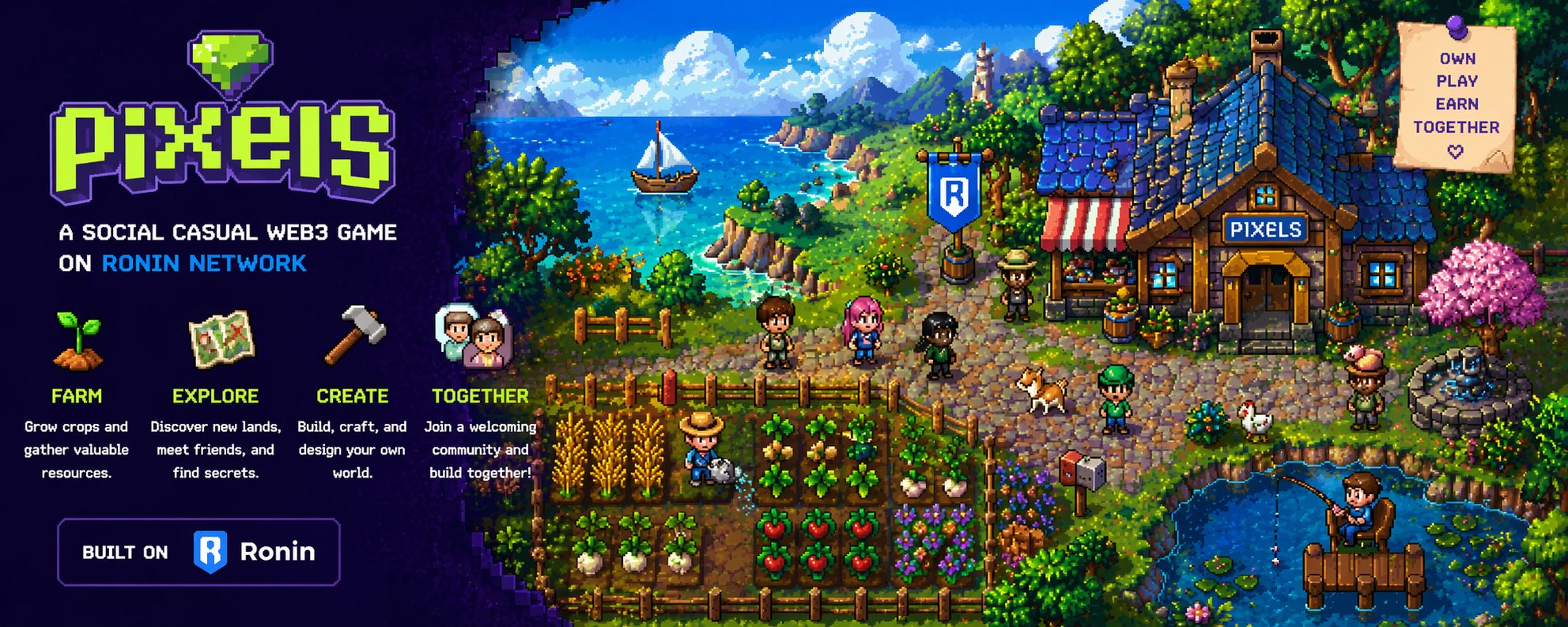
That’s where something like Pixels feels slightly different.
Not because it’s doing something revolutionary, but because it leans into a loop that’s already proven to work.
Farming.
Exploring.
Building something small, then coming back to it.
These aren’t new ideas.
But they don’t need to be.
What matters is how they feel over time.
When a loop is simple enough, it doesn’t demand attention.
You don’t feel like you’re committing to a session.
You just check in.
Harvest something.
Move something.
Adjust something.
And then leave.
That’s the kind of interaction that builds habits quietly.
No pressure.
No urgency.
Just repetition that feels light enough to fit into your day.
That’s something most Web3 games haven’t fully understood yet.
They try to create engagement through complexity or rewards.
But habit doesn’t come from complexity.
It comes from consistency.
Doing something small, repeatedly, without friction.
Pixels seems to understand that.
The world isn’t overwhelming.
The actions aren’t complicated.
You’re not constantly learning new systems or managing multiple layers of mechanics.
You’re just… interacting.
And that makes it easier to return.
Of course, the presence of crypto still changes things.
Even if it sits in the background, it’s there.
Assets have value.
Actions can be optimized.
And over time, that can shift behavior.
Players start thinking about efficiency.
About returns.
About whether their time is being used “correctly.”
That’s where many Web3 games lose their balance.
The moment optimization replaces enjoyment, the habit breaks.
Because habits depend on low friction.
And optimization introduces pressure.
I haven’t seen Pixels fully solve that.
I don’t think any Web3 game has yet.
But what it does differently is where it places the focus.
The core loop comes first.
The crypto layer sits underneath.
Not the other way around.
That ordering matters.
Because if the habit forms around the game itself, the system has something stable to build on. If the habit depends on rewards, it disappears the moment those rewards change.
That’s the risk most projects take.
Pixels seems to be trying to avoid that, even if it’s not perfect.
And honestly, perfection probably isn’t the goal here.
Consistency is.
Can the loop stay engaging over time?
Can players return without feeling like they need a reason?
Can the system avoid turning every interaction into a calculation?
Those are harder problems than they look.
Because they’re not technical.
They’re behavioral.
They depend on how people feel when they interact with the game, not just what the game allows them to do.
That’s something I’ve started valuing more.
Not how advanced a system is.
But how easy it is to return to.
Because the games that last aren’t the ones that impress you once.
They’re the ones you come back to without thinking.
Not out of obligation.
Not out of optimization.
Just because it fits.
And when something fits like that…
You don’t question it.
You just open it again.