
This raises an important question
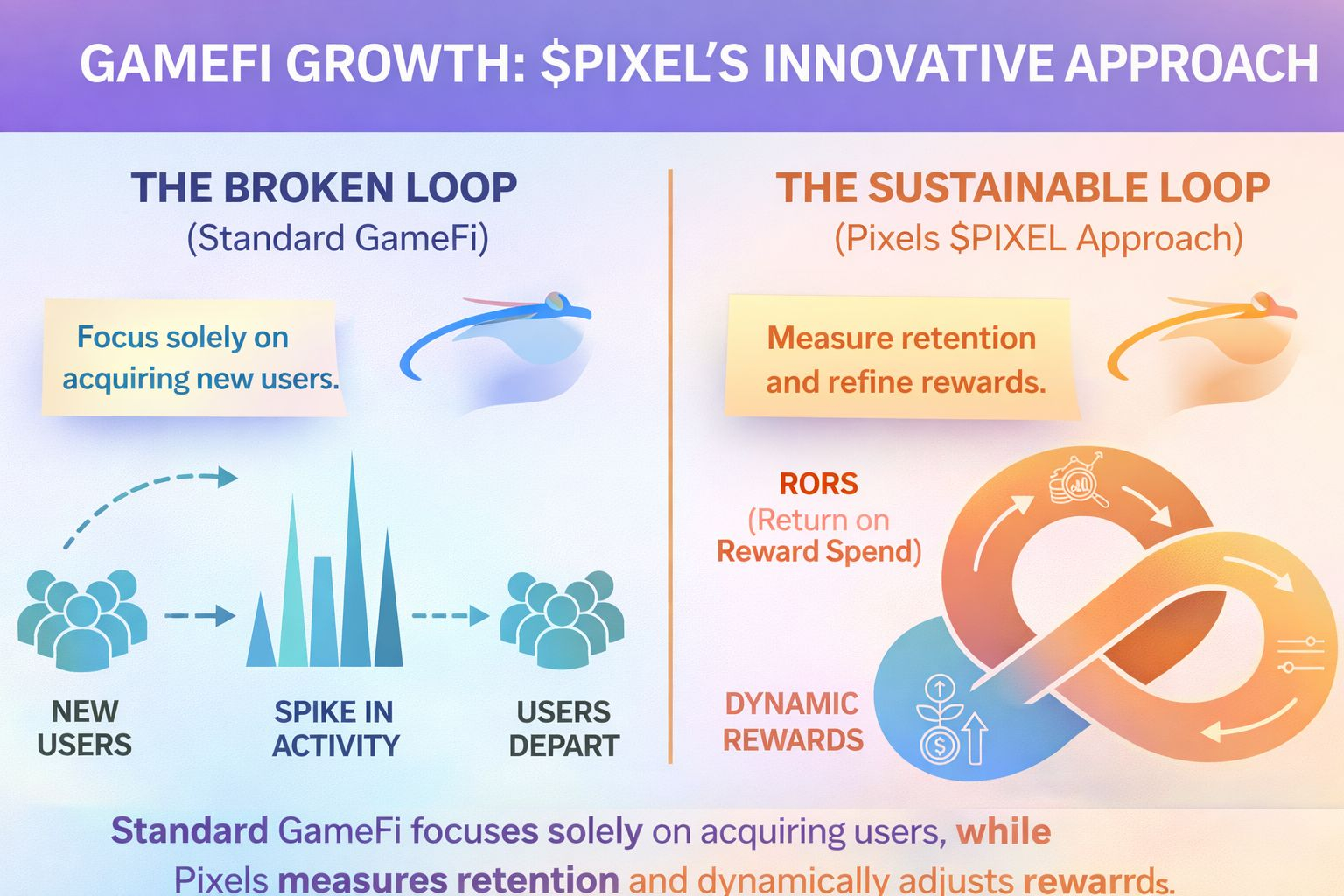
Is GameFi actually growing, or just constantly refreshing its user base?
This is where $PIXEL starts to feel different.
Instead of focusing only on bringing users into the ecosystem, Pixels seems to care more about what users actually do once they’re inside. That might sound simple, but in GameFi, it represents a meaningful shift in thinking.
Most projects rely heavily on rewards to drive activity. Users come in, complete tasks, earn tokens, and leave. The system creates movement, but not necessarily retention. Engagement becomes temporary, and over time, the model struggles to sustain itself.
Pixels, however, is experimenting with a concept that could change this dynamic: RORS — Return on Reward Spend.
Rather than just distributing rewards, the system tries to measure what those rewards actually produce. It looks at outcomes.
Did the player come back?
Did they spend more time in the game?
Did their behavior improve in a way that benefits the ecosystem?
This approach shifts the focus from raw activity to meaningful engagement.
Another key difference is how rewards are handled. In many GameFi projects, rewards are fixed and predictable. In Pixels, they appear to be more dynamic adjusting based on player behavior. This makes the system feel more responsive, almost as if it’s learning from how users interact with the game rather than following a rigid structure.
But this kind of system is not easy to maintain.
GameFi users are highly adaptive. They quickly identify patterns and optimize for rewards. If there’s a loophole, it won’t stay hidden for long. When that happens, genuine engagement can quickly turn into extraction — where users are no longer participating for the experience, but purely to maximize rewards.
On the flip side, if rewards become too restrictive or difficult to earn, users lose interest just as fast.
This creates a constant tension. The system has to walk a fine line between incentivizing activity and maintaining long-term sustainability.
At the same time, the market itself has evolved.
Simple metrics like user count or transaction volume are no longer enough to impress. Investors and communities are becoming more critical. They want to see whether engagement actually translates into long-term value not just short-term spikes.
This is where $PIXEL’s model will truly be tested.
If it can successfully build a stable loop one where rewards are continuously optimized and aligned with real user behavior it could quietly reshape how growth is measured in GameFi.
Because in that world, growth is no longer about how many users you attract…
It’s about how much value each user creates.
That’s a much harder metric to achieve — but also a much more meaningful one.
Whether Pixels can maintain this balance over time is still an open question. But the direction it’s exploring suggests a deeper understanding of the core problem.
So the real question is:
Is $PIXEL building a more sustainable future for GameFi or just a smarter version of the same cycle?