
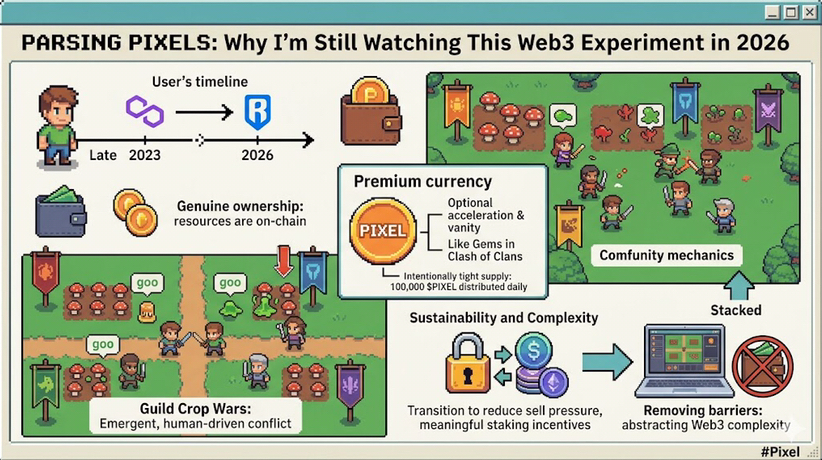
I have been wandering around the Pixels universe on and off since late 2023. That stretch of time has seen the project migrate from Polygon to the Ronin network, endure the inevitable volatility of a token launch, and somehow keep a sizable chunk of players logging in daily. I am not here to hand out financial advice or to whisper sweet nothings about exponential returns. I just want to untangle what this thing actually looks like in practice—beneath the pixel art and the task lists.
The first thing you notice if you actually play is that the game asks for patience. The core loop orbits around managing crops and raising animals on your own plot of virtual dirt. If you have spent any time with farming simulators, the rhythm feels familiar. You click, you wait, you harvest, you upgrade. However, the Web3 wrapper adds a layer of friction that either intrigues you or sends you running back to traditional games. There is a genuine sense of ownership here; the resources you gather aren't just numbers on a server owned by a faceless corporation. They exist on-chain, and that changes the psychological weight of every harvest.
The gaming’s premium currency is @Pixels . The whitepaper is unusually frank about its purpose. It is not a tool required for basic progression. You can play the core game, level up your skills, and manage your homestead without ever touching a single token. Instead, PIXEL acts as a layer of optional acceleration and vanity. It buys you time by speeding up build timers, or it buys you social clout through unique skins and cosmetics. The team draws a direct analogy to Gems in Clash of Clans—a currency you want but do not strictly need to enjoy the fundamental experience. The supply side of the equation is intentionally tight. The documentation states that 100,000 new $PIXEL enter circulation daily, distributed to players who engage in behaviors that strengthen the broader ecosystem.
Tokenomics are one thing;
community structure is another beast entirely. Pixels has leaned hard into social mechanics. The introduction of Guilds and, later, Unions—specifically the Wildgroves, Seedwrights, and Reapers—has pushed the experience beyond solo gardening. I have sat in the middle of a "Guild Crop Wars" event where the objective was ostensibly to grow mushrooms, but the real game was in the sabotage. You could purchase "goo" to ruin a rival's field while frantically defending your own. It sounds chaotic, and it is, but it is also the kind of emergent, human-driven conflict that keeps a game from feeling sterile. These events distribute significant amounts of $PIXEL as incentives, but the real product being sold here is the social friction and cooperation among the player base.
What I find most compelling right now is the team's willingness to talk openly about the messy business of sustainability. In a recent AMA from February 2026, the conversation turned to a long-term vision where pixels might transition into a stake-only token. The explicit goal mentioned was to "reduce sell pressure while creating meaningful staking incentives." That is a mature acknowledgement of the economic leaks that plague most play-to-earn ecosystems. They are also building out "Stacked," a layer designed to abstract the Web3 complexity so that a player could potentially access the game via traditional channels like Steam without wrestling with a crypto wallet. It feels like an experiment in removing barriers without abandoning the underlying blockchain spine.
It would be dishonest to paint a picture of frictionless fun. The game has rough edges that will grate on anyone expecting AAA polish. The clicking can be relentless. One player review I stumbled across from mid-2025 lamented the sheer number of clicks required to manage even a modest farm—hundreds of inputs just to plant and water. That feedback is valid. There are days when I open the browser window, see the list of pending tasks, and simply close it again. But I also find myself returning to check on my animals or to see what new nonsense the community is cooking up with user-generated content. The team has been transparent about the need to fix the "early grind friction" and improve the new player experience, especially within that crucial first week.
The numbers back up the fact that I am not the only one with this love-hate relationship. The project has surpassed over 3 million lifetime wallets registered on Ronin, with more than 1.1 million of those categorized as active players. That is a meaningful cohort for a browser-based Web3 title in a market that is often more focused on trading cards than on actually playing games. And while the focus of the development team—led by founder Luke Barwikowski—seems fixed on long-term durability rather than short-term price action, the token does have a clear home on major exchanges like Binance, providing the necessary liquidity for the in-game economy to function.
Ultimately, my interest in the project account @Pixels hinges on its stubborn refusal to be just another token farm. The team is experimenting with a multi-game staking system for 2026 and integrating AI tools internally to boost productivity, but the foundational bet remains the same: that a game economy can be both fun and durable if you design it with the same rigor you would a traditional free-to-play title. The integration of pets, the ongoing chapter updates, and the commitment to a weekly AMA cadence with the community all point toward a studio that is playing a long, quiet game.
I do not know if Pixels will ever become the cultural juggernaut of a mainstream farming sim. But as a case study in navigating the intersection of entertainment and decentralized economics, it remains one of the most interesting experiments I have on my browser bookmarks bar. If you are curious about the state of Web3 gaming beyond the speculation, I would suggest looking past the price charts and instead tagging the pixels token in your mind as a key to a specific, evolving digital society. Just be prepared to do a whole lot of clicking.
#pixel $BTC