


I didn’t expect PIXEL to make more sense to me by looking at how tasks are assigned rather than how rewards are distributed, but after going through how Stacked actually works, it feels like the real shift is happening earlier in the process than most people pay attention to.
In typical game systems, missions are fixed. The whole crowd is presented with identical sets of tasks, objectives and progression irrespective of the manner they play the game. Fair enough you may say, but it actually leads to a misalignment between players natural gaming actions and the system's demands. Engagement diminishes there stealthily as players either disregard the tasks or carry them out without any genuine willingness.
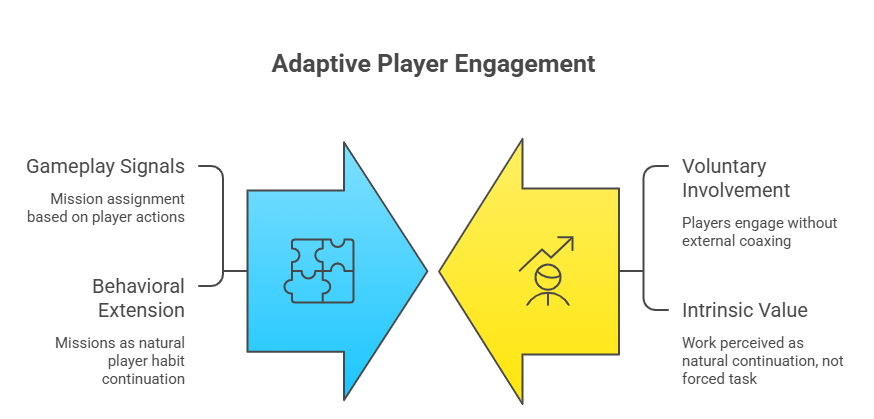
What stands out in Stacked is that missions are not treated as fixed content. They are assigned based on gameplay signals, meaning the system is not just pushing tasks outward, it is selecting them based on how a player is already behaving. That changes the entire role of missions inside the $PIXEL ecosystem because they stop being generic objectives and start acting more like extensions of existing behavior.
It's a very subtle change, but it is actually the most important thing in the whole piece. When gamers are assigned jobs closely related to their habits their work will no longer be seem as a task forcibly imposed on them. Work will just be regarded as a normal continuation of what they had been doing. This will make it more possible for them to get involved voluntarily without having to be coaxed into it through the use of external incentives and repeated game mechanics.
The difference becomes clearer when you compare it to traditional quest systems where players often scan through multiple irrelevant tasks before finding something worth doing. That friction is usually ignored, but over time it reduces how often players interact with the system at all. If most tasks feel disconnected from actual playstyle, they become background noise rather than meaningful opportunities.
Stacked seems to approach this by continuously interpreting gameplay patterns and mapping them to suitable missions. Rather than guess what players ought to do, it watches what they are actually doing and then builds on that; Doing so results in a more adaptive environment where tasks develop in line with player behavior instead of staying unchanged.
Inside PIXEL, this has a direct impact on how the ecosystem feels over time. Players are not forced into a quite limited number of predetermined paths. In fact, the system changes itself to fit the players, so that taking part is less like doing a duty and more like continuing. And that single factor could make a big difference in the time users remain engaged because the system is not making them change their behavior just for the purpose of interacting with it.
Another aspect that makes one think is how such a move (or change) significantly cuts down on the system-level inefficiency. Naturally, when the missions are more closely matched to the realistic activities, the rates of their accomplishment go up without the need to raise the incentives or complicate things even further. It becomes a cleaner loop where players engage because the tasks make sense within their existing flow, not because they are trying to optimize around external rewards.
What I like most about this is that the system seems to be working on the player's attention at the very first stage of interaction, long before other mechanisms begin to function. It is located at the doorway to the player's experience, determining the initial perception and selection of what the player decides to interact with. Moreover, things that happen next are so effectively influenced by this initial step, that it does not even have to remain con- scions or visible to the player.
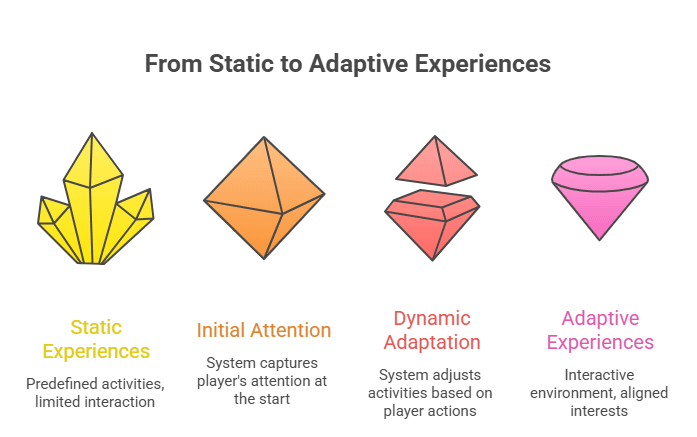
What is more, from this view it appears that we are witnessing a transition from designing static experiences to creating adaptive ones. Instead of gearing the player through a predefined set of activities, the system dynamically changes these based on the player's instant actions. The downside of this kind of systems is that they are difficult to build. But in reality, they do make the environment more interactive. More importantly, the player's engagement is a result of the alignment of the player's interests and the system's offers, not a persistent effort by the player.
If we look at PIXEL from this point of view, the focus is not on the external features but on how the system in a fundamental way structures interaction. The function of assigning missions may not be the most noticeable feature however it is very effective in impacting whether players get hooked in the game world or they lose interest gradually.
Besides, the more I think about it, the more I feel that this might be one of the reasons that platforms like Stacked can keep users engaged without the constant need for changes after the fact. If the initial mode of interaction is already in harmony with user conduct, then the remaining parts of the system have a substantially more robust base for development.
