
 I have noticed something about games that last.
At some point, players stop behaving like players.
They start behaving like contributors.
In most traditional games, participation is consumption. Players enter the world, complete tasks, progress through systems, and leave when the experience runs out. The relationship is clear.
The game provides.
The player consumes.
Web3 games change that relationship.
When economies are introduced, players are no longer just interacting with the system.
They are influencing it.
Pixels sits directly inside that shift.
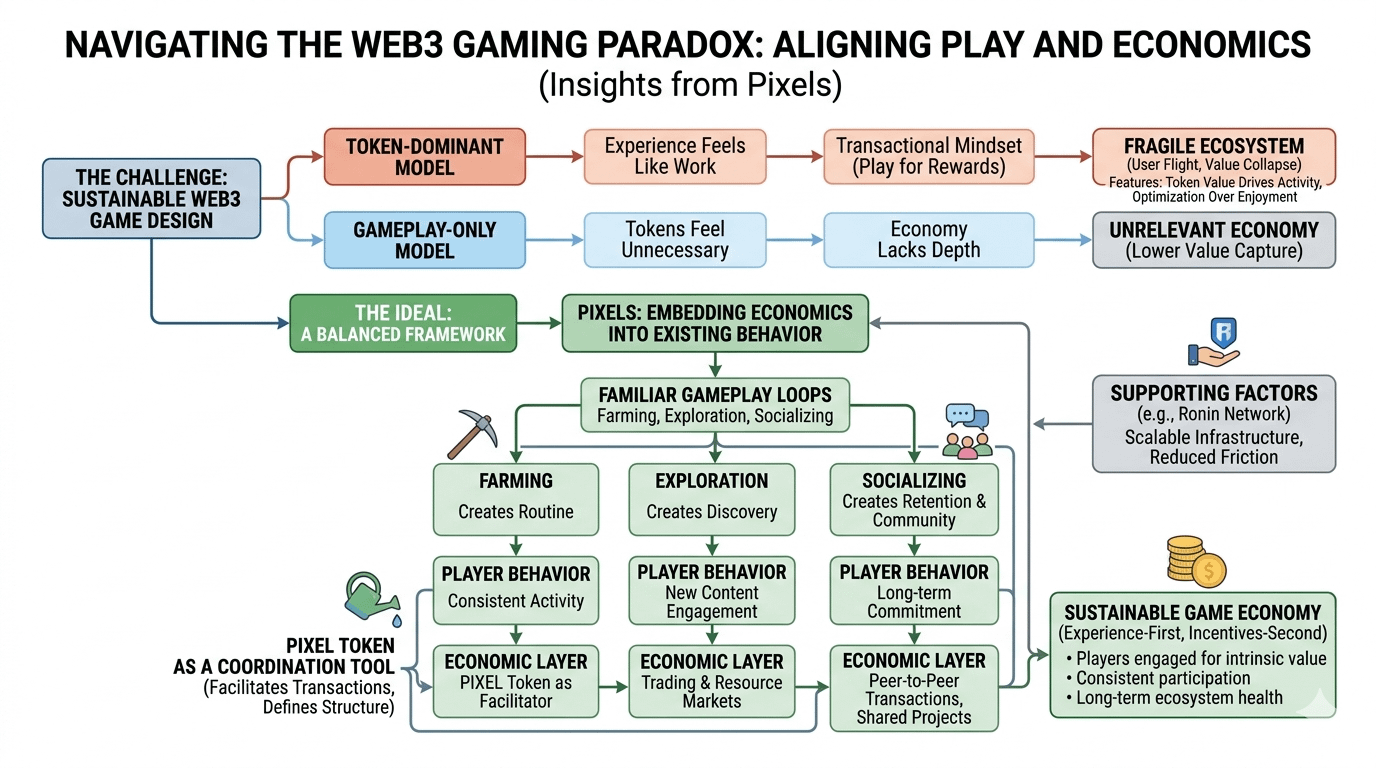
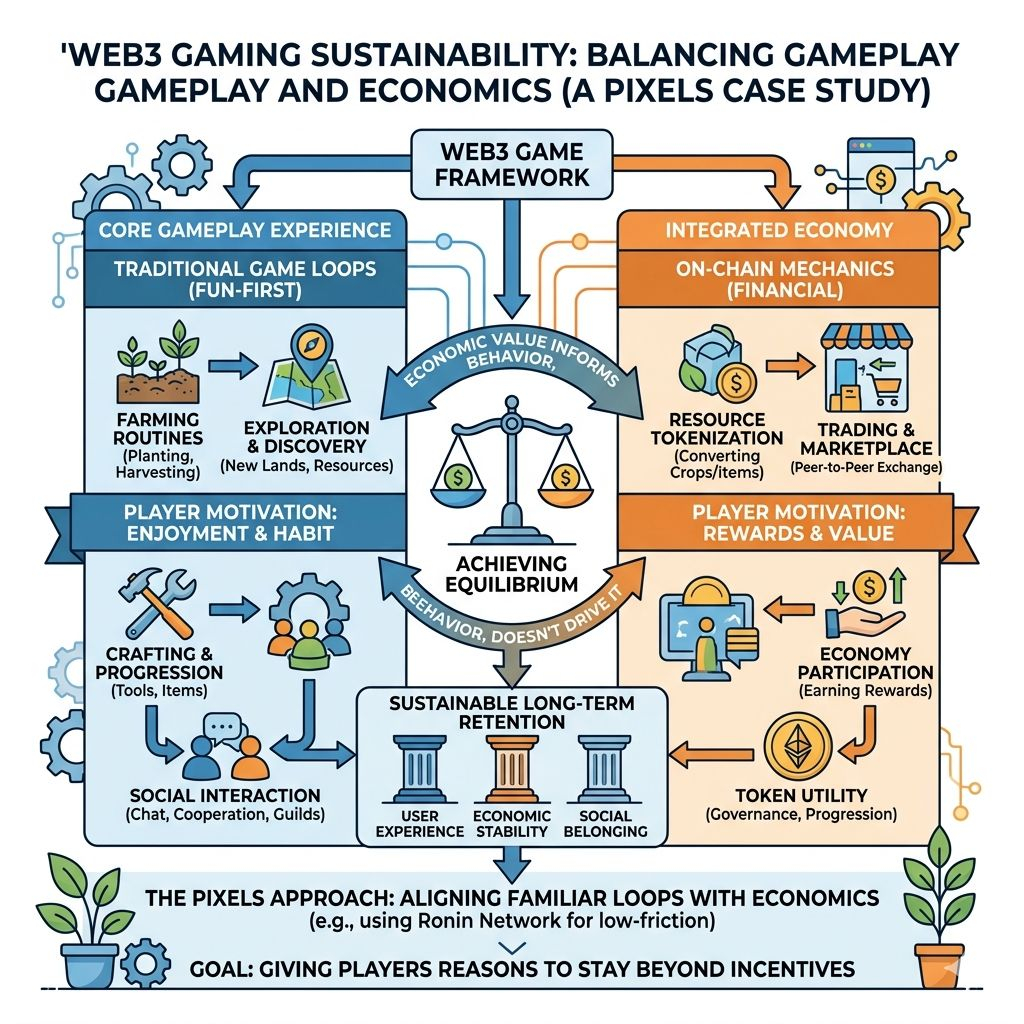
On the surface, it still looks like a familiar game. Farming, crafting, exploration, and social interaction. The mechanics are simple enough to feel accessible, but the structure underneath introduces something different.
Player activity begins to shape the environment itself.
This is where the distinction appears.
A player follows the system.
A contributor affects it.
In Pixels, the open economy built around $PIXEL allows player actions to carry weight beyond progression. Resource flows, trading patterns, and interaction loops are not just part of the experience.
They become part of the system’s structure.
That changes how participation evolves over time.
In early stages, players behave predictably.
They explore mechanics.
They test systems.
They learn how the game works.
But as familiarity increases, behavior shifts.
Players begin to specialize.
Some focus on resource generation.
Others focus on trading.
Some become deeply involved in optimizing specific parts of the system.
At that point, the game stops being a static environment.
It becomes a dynamic one shaped by its participants.
This is where Pixels becomes more than a game.
It becomes a system where players contribute to the way value moves.
That contribution is not always intentional.
It emerges from behavior.
When players choose where to farm, what to produce, and how to trade, they are indirectly influencing supply, demand, and interaction patterns within the game.
The economy begins to reflect collective behavior.
This creates a different kind of challenge.
The system is no longer controlled entirely by design.
It is influenced by the community.
That can be a strength.
Player-driven environments often feel more alive because they adapt over time. New patterns emerge. New strategies develop. The system evolves beyond its initial design.
But it also introduces risk.
When players act as contributors, their behavior can reshape the system in ways that were not expected. Certain activities may become dominant. Others may become irrelevant. The balance between gameplay and economy can shift depending on how participants engage.
This is where the role of design becomes critical.
Pixels needs to maintain an environment where contribution does not override experience.
If contribution becomes purely economic, the system can drift toward optimization at the expense of enjoyment.
If experience remains central, contribution becomes a natural extension of play.
The social layer plays an important role here.
Pixels is not just about individual progression.
It is a shared world.
Players interact, trade, and exist within the same environment. These interactions create patterns that extend beyond individual actions. Social systems often stabilize environments because they introduce behaviors that are not purely driven by efficiency.
People do not always optimize when they are part of a community.
They interact.
That interaction can preserve the balance between play and contribution.
Pixels is navigating this transition carefully.
It is not forcing players to become contributors.
It is allowing that role to emerge naturally.
The question is whether that emergence remains aligned with the experience.
If players contribute in ways that enhance the game, the system becomes stronger.
If contribution turns into extraction, the system can lose its identity as a game.
This is the long-term tension.
Pixels is not just building mechanics.
It is shaping how participation evolves.
From playing.
To influencing.
To contributing.
That progression is where Web3 games either become sustainable ecosystems or collapse into short-term systems driven by incentives.
For now, Pixels represents an environment where that transition is beginning to take place.
And the outcome will depend on how players choose to engage with the system over time.