
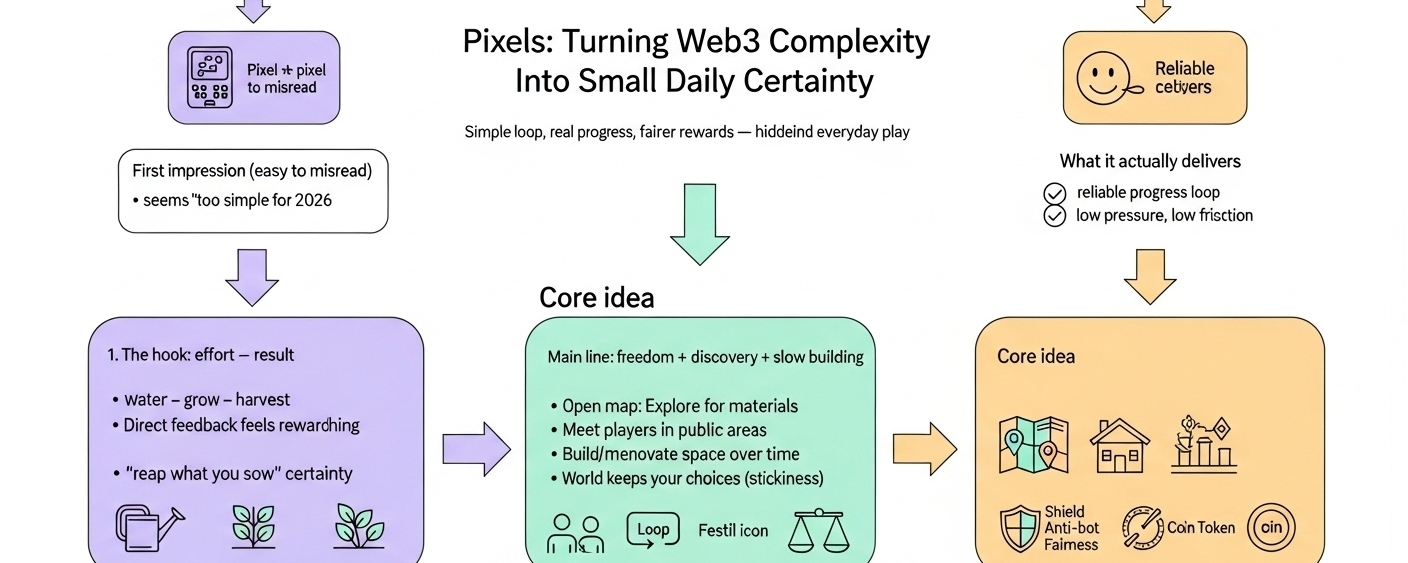


when i first saw Pixels, i almost wrote it off. the pixel look feels old-school, like a handheld game from years ago, and in 2026 that can seem kinda funny. but after spending time inside it, the “simple” style started to feel like the point, not a limitation.
the core loop is basic: you water crops, they grow, you harvest. and that direct feedback hits different if you’ve been dealing with real life stress where effort doesn’t always equal results. Pixels gives you a small space where time invested shows up as progress. it’s not trying to be deep, it’s trying to be reliable. that “you reap what you sow” feeling becomes the hook.
what surprised me more is how little it forces you. instead of pushing a heavy storyline and dragging you through tasks, it drops you into a character and a large map and basically says: go figure it out. you start with a few plots, learn what to plant and when, and if you want to grow bigger you explore. exploring isn’t just walking around; you find materials in corners and bump into other players in public areas. the discovery part feels genuine, and it makes the world feel alive without needing flashy graphics.
then there’s the building layer. you’re not only farming, you’re shaping your space over time—renovating plots, joining festival activities, even trying small automated production lines. that’s what creates long-term stickiness. you can leave for a bit, come back, and your world still carries your choices. it feels like you left real traces, not just completed a checklist.
Pixels also tries to avoid the classic web3 game trap where everyone shows up only to extract rewards and disappears when rewards slow down. instead, it keeps the entry threshold low with basic gameplay, then it starts distinguishing between “real” interaction and fake farming. it weights quality of actions more than just being online. people who plan land well and take advanced tasks get more weight, while repetitive simple actions from small accounts get limited. the idea is to keep rewards tied to authentic play, not bots.
the token side is woven into growth: upgrades, crafting items, special activities. in practice it doesn’t feel like tokens pile up with nothing to do, and it also doesn’t feel like you’re constantly blocked. it’s a loop: invest time and energy, produce value, consume value to keep growing. market swings still exist, but the game tries to keep the internal cycle smooth.
they also push anti-cheat with behavior recognition and address monitoring, using multiple filters to reduce bot survival. beginners still need time to learn rules, but at least it’s not instantly overrun by scripts.
overall, Pixels feels like it’s choosing slow accumulation and fairness over quick profit. if someone wants instant returns, it will feel too slow. but if you like learning a system and building gradually, it finds a rhythm. it takes big web3 concepts and hides them inside everyday tasks like watering and harvesting, which is honestly a smart way to make something complicated feel normal.