
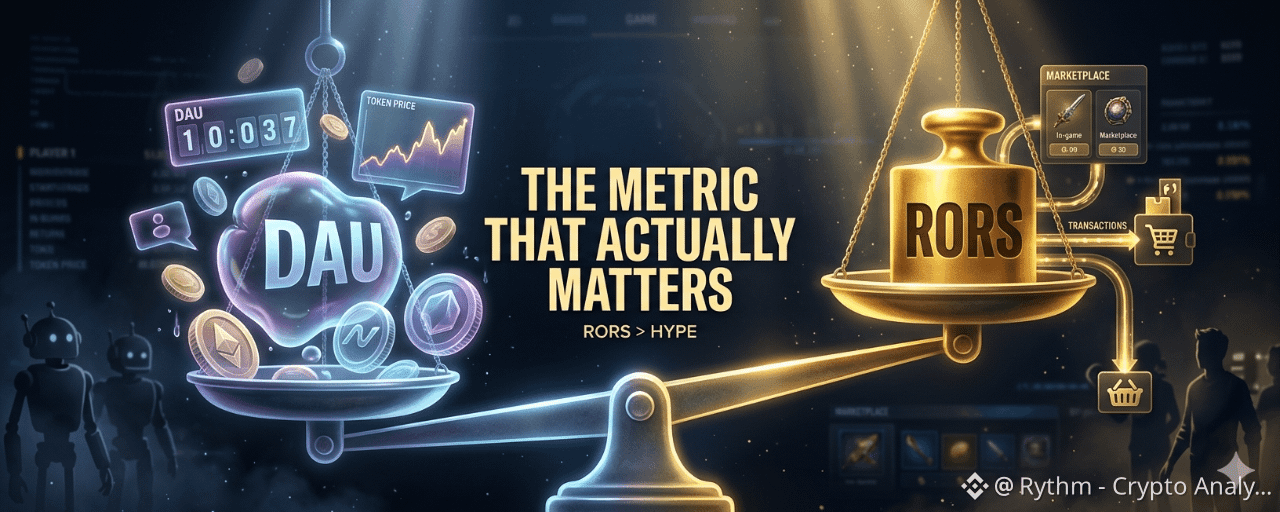
There's a detail in how the Pixels team talks about Stacked that I don't think gets enough attention. They don't lead with DAU. They don't mention token price. The metric they use to prove the system works is something they invented themselves: Return on Reward Spend.
RORS. Revenue generated divided by rewards distributed. That's it.
When a team has to invent a metric to measure their own product, it usually means one of two things. Either they're building something genuinely new and existing metrics don't fit. Or they're avoiding the standard ones because the numbers wouldn't look good. It took me a while to figure out which one this was.
Most Web3 games report DAU and token price as proof of success. Not because those are the best metrics — because they're the easiest to pump early and the easiest to sell to investors. DAU inflated by bots is still DAU. Token price driven by speculation is still token price going up. Neither one tells you whether your reward system is creating real value or just redistributing it from token buyers to farmers.
RORS asks a different question.
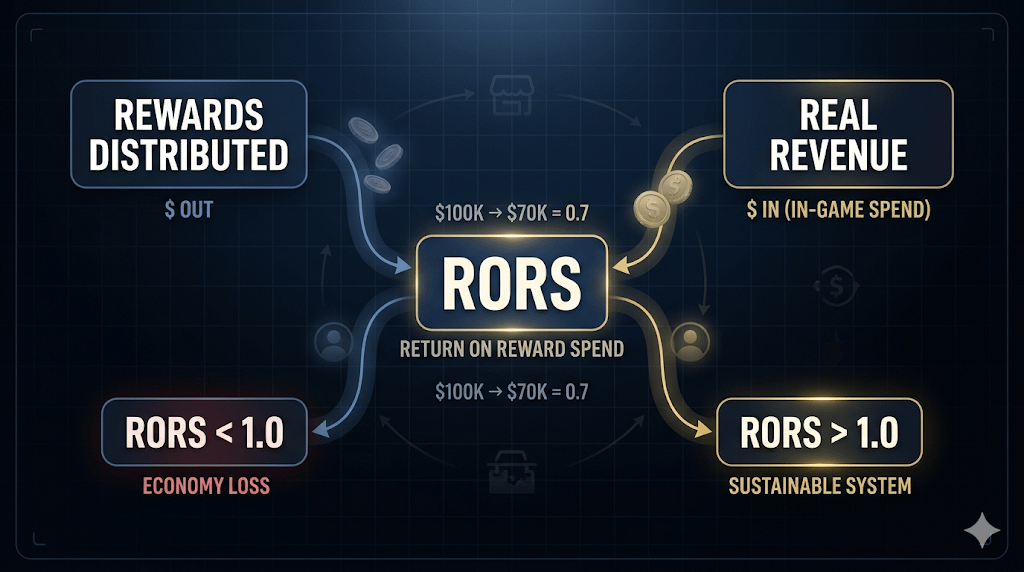
Not "how many people are playing." But: for every dollar of rewards you put out, how much revenue do you actually get back — specifically in-game purchases, VIP subscriptions, marketplace fees, the things real players pay for, not speculation. If you spend $100k on rewards in a month and bring in $70k in in-game revenue, your RORS is 0.7. The economy is running at a loss. It just doesn't look that way yet because the token price is covering it. By the time the token can't cover it anymore, the damage is already done.
There are legitimate reasons for RORS to sit below 1.0. Early user acquisition phases, one-off re-engagement campaigns, seeding a new mechanic before you have enough cohort data to measure conversion — all of these can justify a temporary deficit. But RORS below 1.0 across multiple measurement cycles with no clear trajectory isn't a phase. It's a structural problem.
That's what makes the $25M revenue figure from Pixels actually mean something.
It's not gross revenue from an NFT drop or a token launch event. It's revenue generated while RORS was positive and holding — meaning the rewards being distributed were retaining real players, driving real spend, and still returning more than they cost. The Pixels CEO said it plainly in a recent interview: play-to-earn inside Pixels became sustainable over the last three months. Not from the beginning. The last three months, after $BERRY was killed and the new model had time to stabilize.
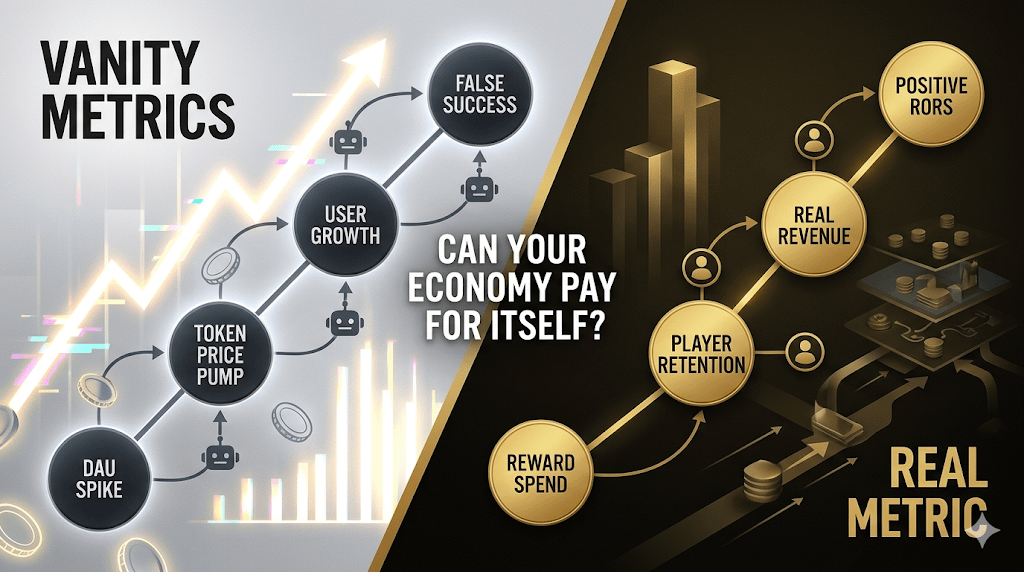
To me, that's more significant than the number itself.
Because it means Stacked wasn't built to prove P2E could generate large revenue. It was built to prove P2E could generate sustainable revenue — something the industry hadn't managed consistently before. The $25M is a byproduct of that process, not the goal.
So when a new game launches a reward system and calls it sustainable, the right questions aren't about daily token volume. It's whether they have any way to separate rewards that drive genuine retention from rewards that just attract bots and farmers. Whether they're measuring by cohort or just in aggregate. Whether they can tell you what their RORS was last month. If there are no real answers there, sustainable is just marketing.
Pixels needed almost four years to get to a positive, stable RORS.
Not because the team was slow. Because nobody in Web3 gaming had done it before — and more importantly, nobody had built the infrastructure to actually know when they'd done it.