

I was sitting on a worn-out bench near a small roadside tea stall, waiting for a friend who was already late as usual. The evening had that slow, dusty calm—nothing urgent, nothing demanding attention. Out of habit, I opened my phone, not really looking for anything specific, just scrolling through whatever came up.
That’s when Pixels showed up again.
Not in a loud way. No big announcement, no hype thread. Just a quiet reminder that it was still there, still running, still being played.
And for some reason, I didn’t scroll past it this time.
At first glance, it looks like something you’ve already seen. Pixel graphics, farming loops, simple mechanics. The kind of game you expect to try once and forget. Especially in Web3, that usually means a short cycle—early excitement, token rewards, then a slow drop when attention fades.
I’ve seen that pattern too many times to take it seriously right away.
But the more I looked into Pixels, the more it felt like it wasn’t trying to follow that path.
It wasn’t loud enough for that.
It felt… patient.
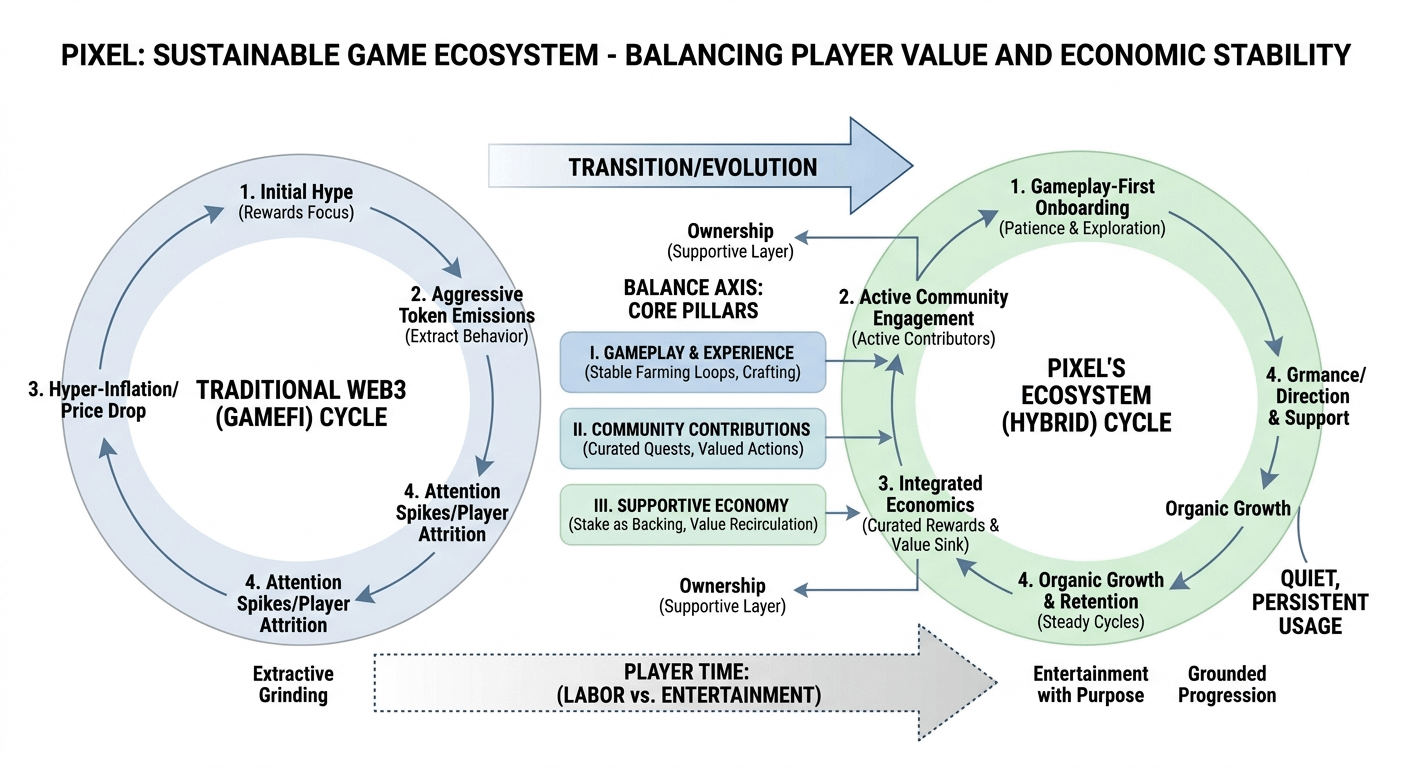
Most crypto games make the same mistake. They don’t start with gameplay—they start with rewards. Everything is built around earning. So naturally, players don’t ask if the game is enjoyable. They ask how much they can extract from it.
That changes behavior completely.
Playing turns into grinding. Efficiency replaces curiosity. And once rewards slow down or prices shift, people leave just as quickly as they came.
That cycle is predictable.
Pixels seems to understand that problem better than most.
Instead of pushing earnings to the front, it leans into the experience itself. The gameplay isn’t revolutionary, but it’s stable. It gives people something they don’t immediately burn through. Something they can return to without feeling like they’re repeating the same empty loop.
That alone changes the pace.
You don’t feel rushed.
You don’t feel like you’re missing out if you step away.
And that’s rare in this space.
As I spent more time looking at how the system works, another detail stood out. Rewards aren’t thrown around carelessly. In many games, everyone follows the same path—repeat simple tasks, collect tokens, move on. It’s efficient, but it breaks the system over time.
Pixels approaches it differently.
It nudges players toward actions that actually matter inside the ecosystem. Not just time spent, but how that time contributes. It’s a small shift, but it changes how people engage. You’re not just present—you’re involved.
That difference adds up over time.
The way it handles growth also feels different.
Most projects rely heavily on attention spikes. Big campaigns, influencer pushes, short bursts of visibility. It works for bringing people in, but not necessarily for keeping them.
Pixels feels slower.
More organic.
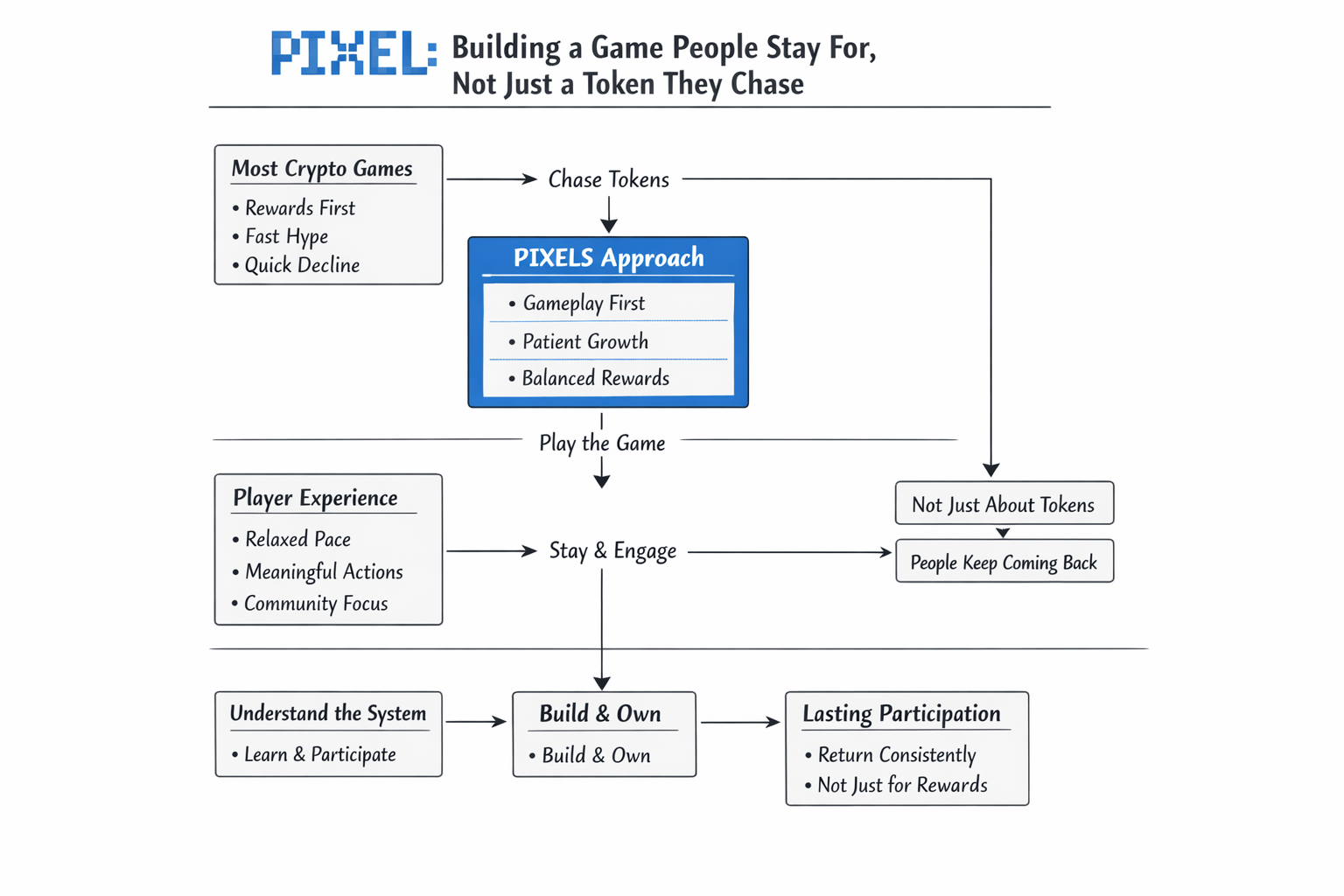
It doesn’t seem obsessed with pulling everyone in at once. Instead, it focuses on building something that people don’t mind staying in. And when people stay, they create patterns—real usage, real behavior, something the system can actually learn from.
That kind of growth doesn’t look impressive at first.
But it tends to last longer.
Ownership is another layer, but it’s not forced into the spotlight. What you build and earn has value beyond just the game, but it doesn’t replace the experience itself. It supports it.
That balance matters.
Because ownership alone isn’t enough. We’ve already seen what happens when that becomes the only selling point. Things look valuable on paper, but feel empty in practice.
Pixels doesn’t lean too heavily on that idea.
It keeps it in the background, where it belongs.
The token side—where things usually get unstable—is handled more carefully than expected. Instead of pushing rewards aggressively, the system tries to circulate value in a way that doesn’t collapse under pressure.
It’s not perfect.
But it feels considered.
Even staking, which is usually passive and forgettable, takes on a slightly different role. It’s less about locking tokens and waiting, and more about where you choose to place your support. It connects players to the direction of the system in a subtle way.
You’re not just holding something.
You’re backing something.
And that creates a different kind of attachment.
While I was sitting there, still waiting, one thought kept coming back to me.
Pixels treats time differently.
Not like something to exploit.
Not like something to ignore.
But something to balance.
In traditional games, time is entertainment. In most Web3 games, time becomes labor. Pixels seems to sit somewhere in between. You play because it’s enjoyable, but there’s also a quiet sense that what you’re doing isn’t wasted.
That balance is difficult to get right.
Too much focus on rewards, and it turns into work.
Too little, and it loses its edge.
Pixels doesn’t solve that perfectly—but it’s trying to.
And that effort shows.
It’s not relying on one strong idea to carry everything. Not just tokens, not just ownership, not just gameplay. It’s trying to make all of them work together without one overpowering the others.
That approach feels more grounded.
Less dependent on hype.
More dependent on whether people actually want to come back.
And right now, they do.
Not because they have to.
Because they don’t mind being there.
If you look at PIXEL only through price movements, you’ll probably miss what’s happening. It won’t behave the way you expect. It won’t always react to the same signals.
But if you look at how people are spending their time inside it—how they play, how they stay, how they return—it starts to make more sense.
Because in the end, the strongest systems aren’t the ones people rush into.
They’re the ones people quietly keep coming back to, without needing a reason every time.