
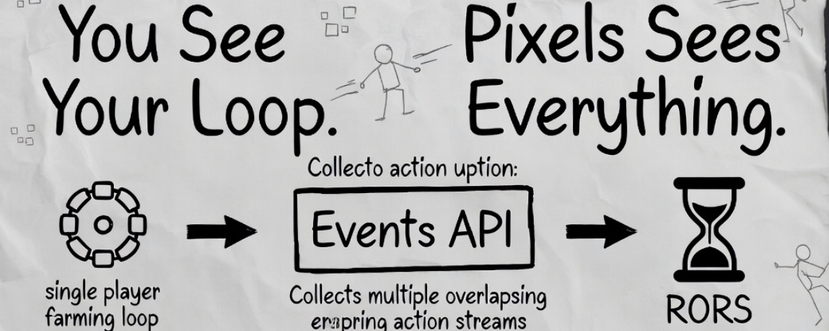
I didn’t notice the data layer in Pixels at first.
Everything felt immediate. You plant, harvest, craft, move on. Actions disappear as soon as you finish them. Like most games, it looks like the system only cares about what you’re doing right now.
But after some time, a pattern starts forming.
Not in the UI. Not in obvious stats.
In how the system reacts to you.
Same actions, different outcomes. Same routines, but the system responds like something larger is already in motion.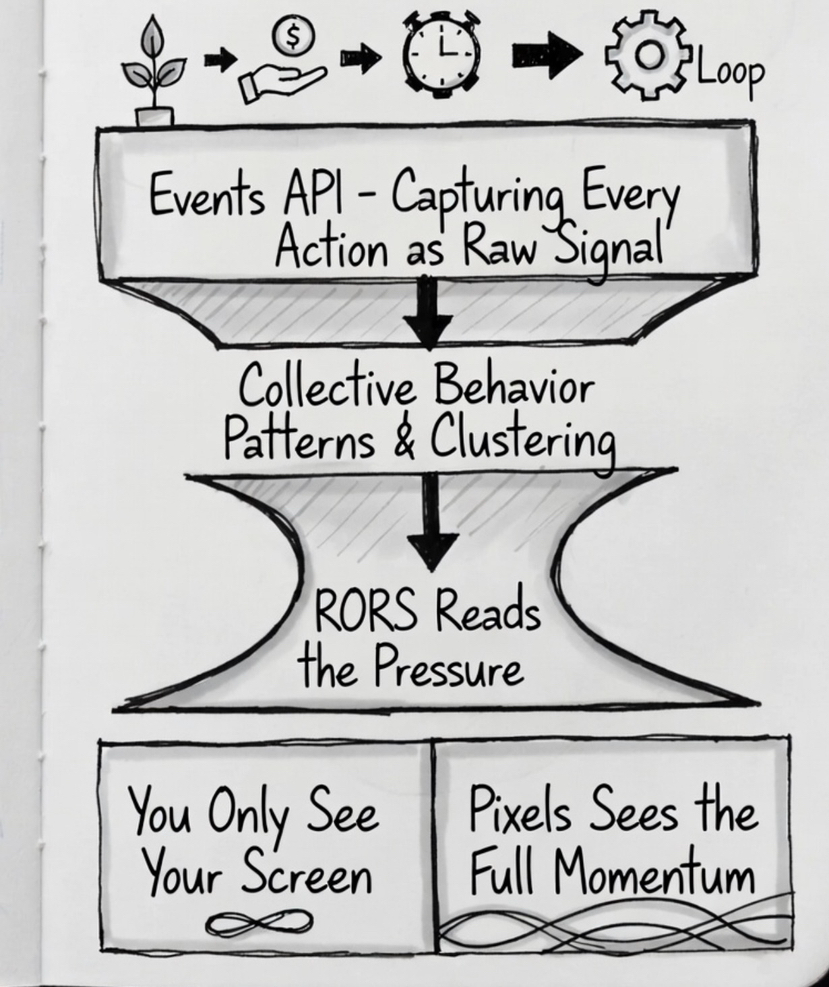
That’s when it clicked.
Pixels is not just processing actions. It’s reading behavior as it accumulates.
And the Events API is where that layer comes from.
Most people think of APIs as tools for developers. Something external, something technical.
But in Pixels, the Events API is not just a feed of actions.
Every harvest, every craft, every movement is captured as an event. Not as a summary, but as raw input into the system.
That changes what the system can actually do.
Because now it doesn’t rely on snapshots like inventory or balances.
It reads sequences.
What you’ve been repeating. What thousands of others are doing at the same time. Where activity is clustering before it becomes visible anywhere else.
The system doesn’t just react to outcomes.
It reads pressure forming inside behaviour itself.
I started noticing this when my usual loops stopped behaving predictably.
Same crops. Same timing. Same sequence.
But the outcome would shift depending on when I was doing it.
At first, it felt like noise.
But it wasn’t random.
It was timing.
Too many players were running similar loops at the same moment. The system was already saturated at the behavior level, even before it showed up anywhere else.
So even though I was repeating the same actions, I wasn’t operating in the same conditions.
Not because my setup changed.
Because the environment already had momentum.
This is where the Events API starts acting less like infrastructure and more like a signal layer.
Your actions don’t just produce rewards.
They become inputs.
Every loop you run adds to a collective pattern. And that pattern feeds into how the system adjusts things like efficiency, output and flow.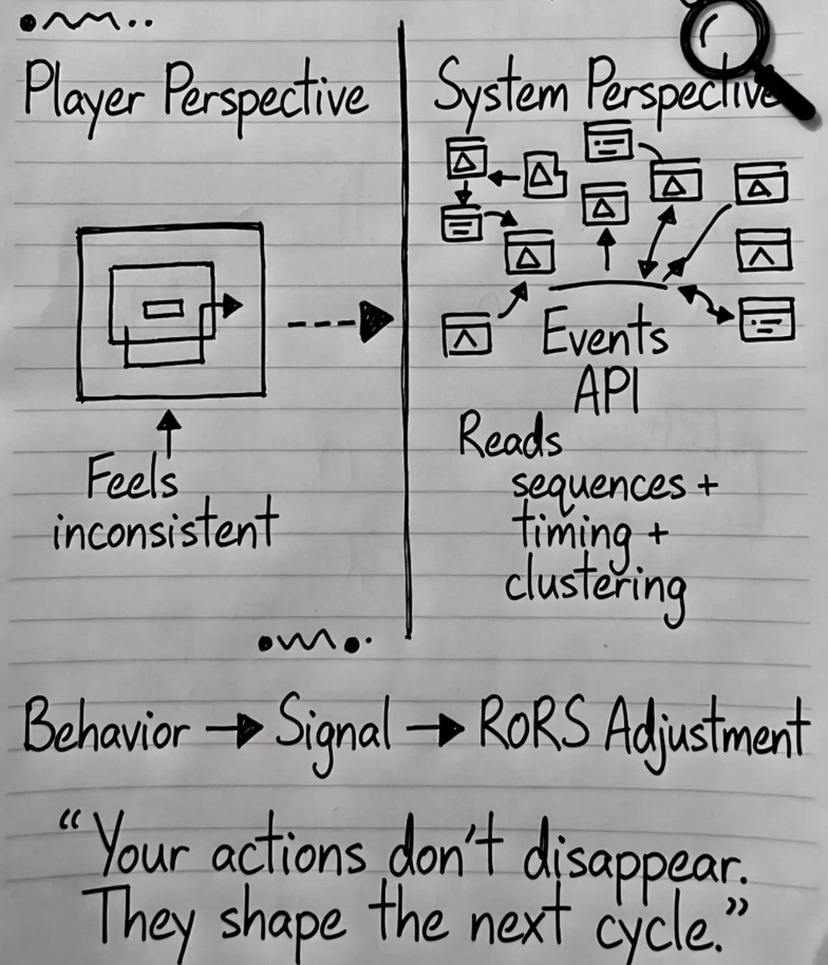
You’re not just playing inside the economy.
You’re constantly shaping it, even if you don’t see it.
There’s an imbalance here that’s easy to miss.
The system has access to the full picture. It sees aggregated behavior across everyone.
You don’t.
You only see your own loop.
So when something shifts, it feels inconsistent from your side. But from the system’s side, it’s responding to a much larger signal.
That gap creates asymmetry.
And that asymmetry is intentional.
This also explains why RORS doesn’t feel random once you connect it to this layer.
RORS needs input to adjust.
It needs to know when activity is clustering, when extraction is accelerating, when patterns are repeating too aggressively.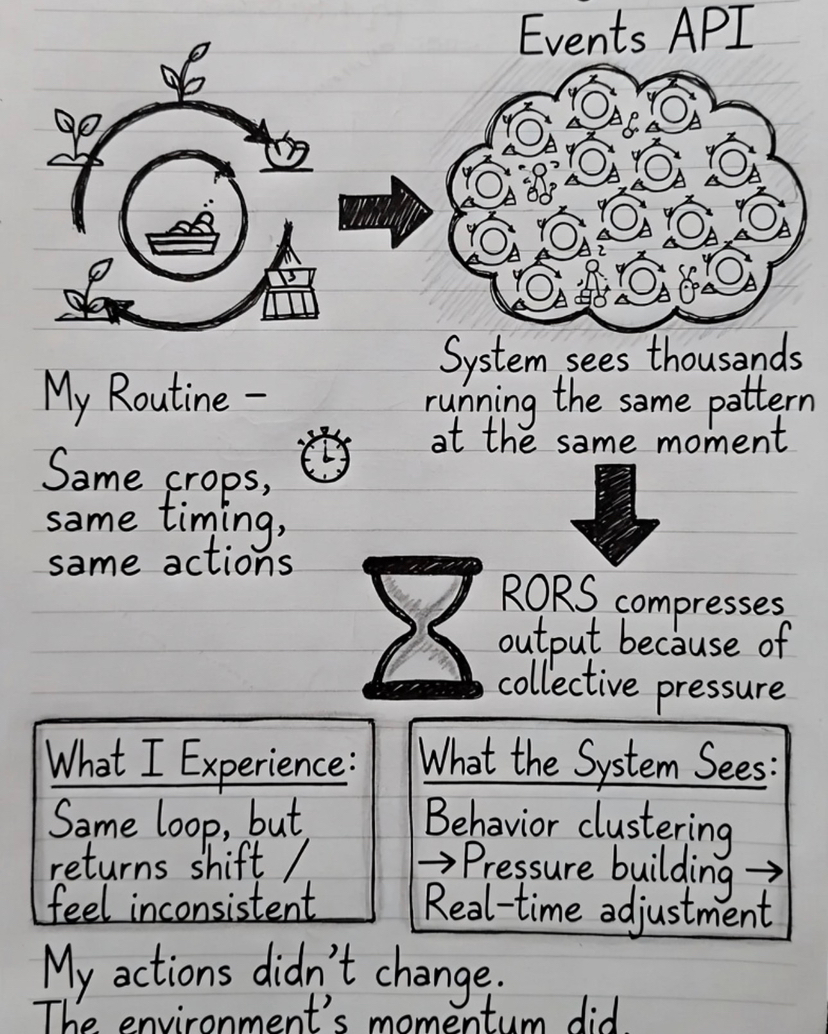
That signal doesn’t come from balances.
It comes from events.
Without this layer, RORS would lag behind real activity.
With it, RORS can compress output while the behavior is still forming.
Another shift happens at the strategy level.
If the system reads behavior, then repeating the same loop blindly stops being optimal.
Not because the loop is bad.
Because the system has already absorbed too much of that pattern at that moment.
So efficiency drops.
That changes how you think about playing.
It’s not just about what works.
It’s about when it works.
There’s also a deeper implication for how the economy is maintained.
Most systems rely on developers to step in and rebalance things after problems show up.
Here, the system doesn’t need to wait for visible damage.
It reads behavior directly and adjusts earlier.
Not perfectly, but early enough to reduce extremes.
That reduces the need for constant manual intervention.
What makes this different is not the existence of data.
It’s how the data is used.
This is not passive tracking.
It’s active input into the system’s decisions.
Your actions don’t just disappear after you complete them.
They accumulate into signals that influence what happens next.
I didn’t expect the data layer to matter this much.
It’s not something you interact with directly.
But it quietly shapes outcomes in ways that are easy to misread if you’re only looking at your own screen.
Without it, systems rely on delayed signals like price or supply.
With it, Pixels can respond at the behavior level.
Most people look at Pixels and see farming, crafting, progression.
But under that, there’s a system that is constantly reading patterns as they form and adjusting around them.
Not based on static rules.
Based on what players are actually doing in real time.
That’s the shift.
You’re not just interacting with a game.
You’re operating inside a system that is watching behaviour, turning it into signals and using those signals to shape the economy around you.
