
The Web3 gaming landscape is shifting. For years, "Play-to-Earn" (P2E) was the industry's buzzword, but the model often fell into a trap of unsustainable inflation and "extract-only" player behavior. Pixels is now leading a transition toward a more resilient economic framework centered around a single, vital metric: Return on Reward Spend (RORS)
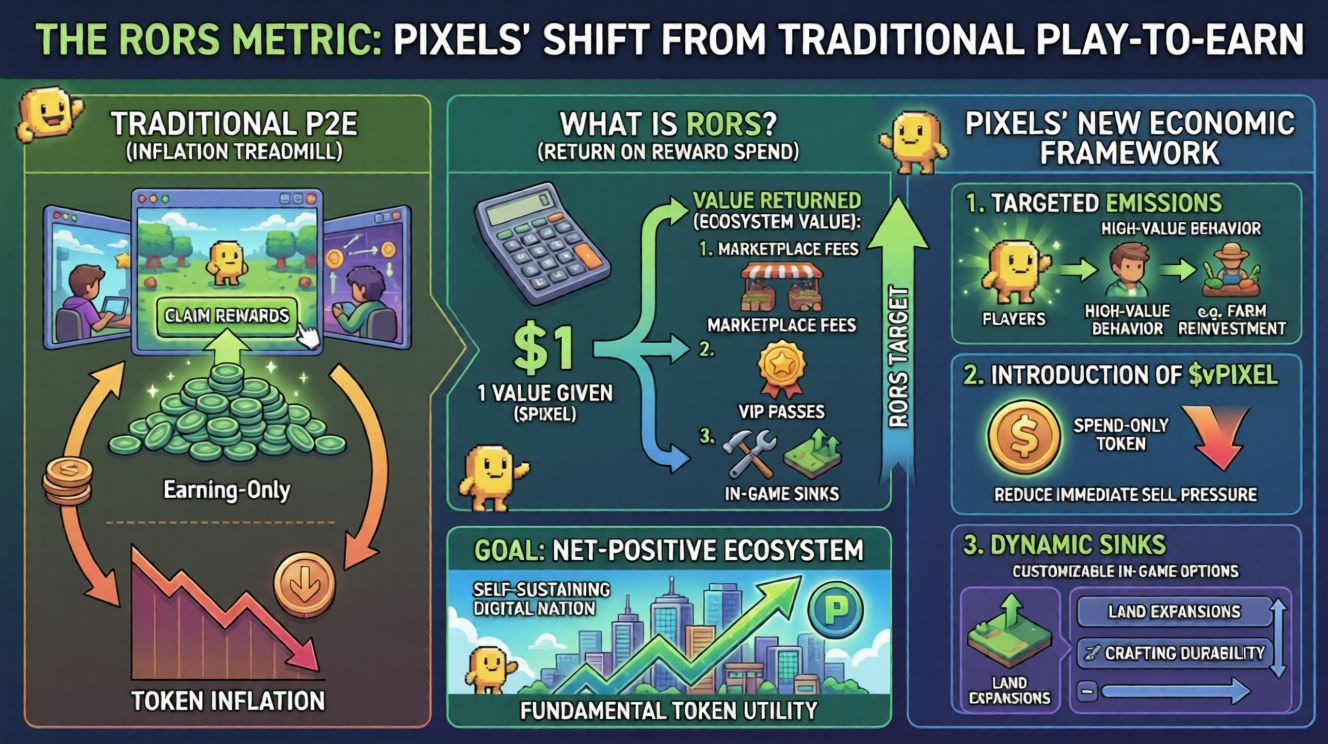
What is RORS?
Traditional gaming uses ROAS (Return on Ad Spend) to measure how much revenue a marketing campaign generates. Pixels has adapted this into RORS. It measures the economic impact of every token distributed as a reward.
In simple terms: For every $1 worth of $PIXEL given to a player, how much value—in the form of marketplace fees, VIP passes, or in-game sinks—is returned to the ecosystem?
The Failure of Traditional P2P
Most early Web3 games functioned like a "treadmill." New players provided the liquidity for old players to exit. Once the influx of new capital slowed, the token value plummeted because there wasn't enough "sinking" (spending) to offset the "minting" (earning).
Traditional P2E rewarded presence (simply being there). Pixels’ RORS model rewards contribution and reinvestment.
How RORS Changes the Game
By focusing on a RORS target (currently aiming to move from 0.8 toward 1.0 and beyond), the developers can make data-driven decisions:
Targeted Emissions: Rewards are directed toward players who demonstrate "high-value" behavior—those who reinvest in their farms, participate in the community, and keep liquidity within the game.
The Introduction of $vPIXEL: This "spend-only" token allows the team to reward players without creating immediate sell pressure on the secondary market.
Dynamic Sinks: If the RORS dips, the game can introduce new utility for tokens—such as land expansions or crafting durability—to bring the economy back into balance.
The Goal: A Net-Positive Ecosystem
The ultimate objective of moving toward a RORS-based model is to create a "net-positive" game. This means the game generates more value than it gives away.
When a game is net-positive, it no longer relies on constant new user growth to survive. It becomes a self-sustaining digital nation where the $PIXEL token has fundamental utility, and players are rewarded for being part of a stable, growing economy rather than just being the first to cash out.
Why This Matters for Players
For the average player, this shift means a more stable game. You don't have to worry about your rewards losing 90% of their value overnight. While the "easy money" of early P2E might be gone, it is replaced by a professional, long-term ecosystem where your time and effort have lasting, predictable value.
Pixels is no longer just a game about farming crops; it is a live experiment in building a sustainable decentralized economy. By prioritizing RORS over hype, Pixels is setting the blueprint for the next generation of Web3 gaming.$PIXEL #pixel @Pixels
