
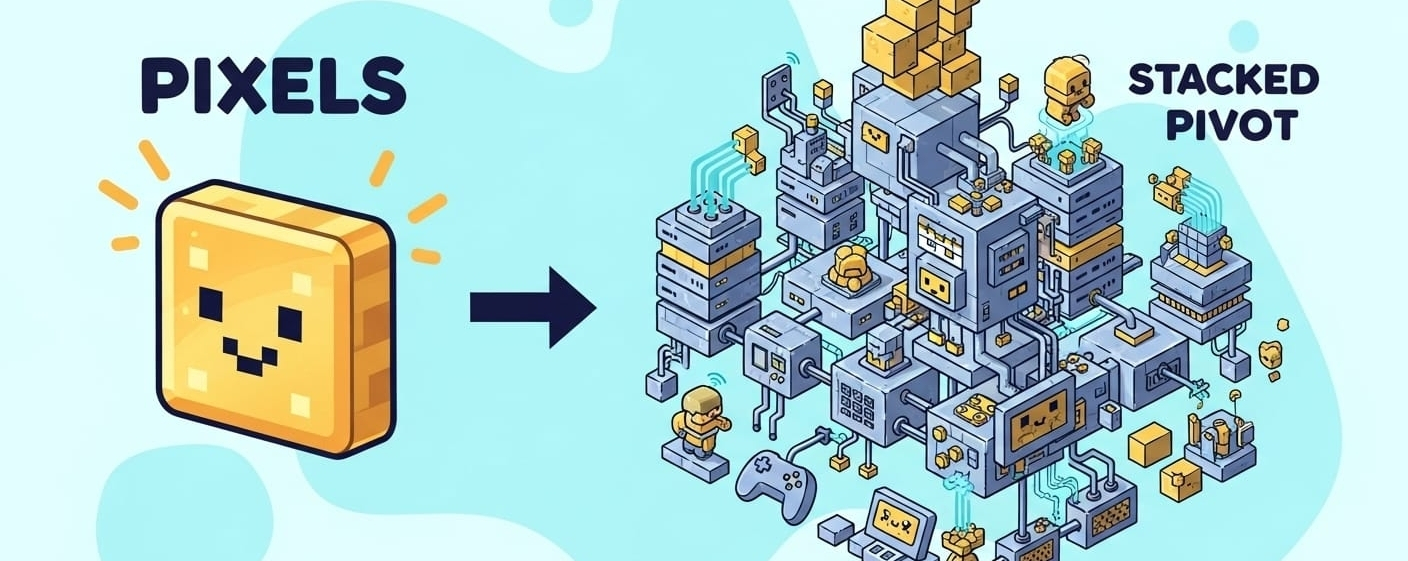
bro the last few days market been giving headache, and while that creation event is running april 15 to april 30, i been looking at Pixels from a more cold logic side. chain games right now are in a weak bottleneck. most projects still do the same trick: drop a token, pull traffic with ponzi-ish vibes, then die fast. but Pixels looks like it quietly switched tracks. like, instead of fighting for gold with everyone, they started selling the mining shovels.
the big clue is the Stacked engine. it’s not being pushed like some small feature only for Pixels game. it’s positioned like game infrastructure for enterprises. thats a huge shift in business logic, and it changes how you even think about $PIXEL. because if Stacked is the engine used across games, then PIXEL is not just “one game coin”, it becomes fuel for an incentive + experiment system that can spread beyond one title.
what makes this more believable is they didn’t build it in powerpoint. they built it inside a production environment, inside their own game, after falling into many traps. they know how exploiters and script studios drain game economies like locusts. and the numbers they claim are not small: Stacked already processed over 200 million reward distributions, and still stayed robust, plus it helped generate $25 million revenue. that’s not theory, that’s a performance record. most competitors only write “anti-bot” in a whitepaper and never survive a full cycle.
another part is the “AI game economists” angle. game studios often don’t even know why players leave. traditional blockchain game ops is kinda blind, dashboards are basic, and teams guess. Stacked adds an AI analysis layer on top of data, so studios can ask real-time questions like: why high-retention players behave in month one, or which mechanics correlate with long-term retention. that level of granular insight changes where budgets go, because now you can link spending to retention, not vibes.
and here’s the wild logic: redirect ad budgets to players. big studios spend crazy money on acquisition channels, but conversion is often trash. Pixels is saying: take that money, convert it into $PIXEL, and pay active players directly who actually engage. so instead of middlemen taking big margins, the benefits go to the people building the ecosystem (players). this is deeper redistribution, not “like and retweet” tasks. and since Pixels controls anti-cheat plus real player behavior data, the pitch is that money spent can map to real retention and conversion, not fake bot numbers.
now, will this instantly pump coin price? i don’t know. short term market doesn’t always reward infra pivots. but if you want to judge long term, the key signals are: retention data after external studios get access, and the circulation speed of $PIXEL across a cross-game network. if more games admit their own economies can’t handle malicious attacks and integrate Stacked’s defense + incentive system, then PIXEL stops being just a game token. it becomes more like an attention pricing certificate inside web3 gaming.
in bear market, this is the kind of thing worth watching. not because it’s loud, but because it’s built on real commercial demand and a data moat that most projects simply don’t have.