

Web3 gaming has gone through a lot of noise over the past few years. Every new project used to arrive with big promises, strong hype, and the idea that players could earn while they play. For a while, it felt exciting. People joined quickly, tokens moved fast, and everything looked like the start of something huge.
But after spending enough time in this space, you start noticing a pattern.
Most of these games don’t really last because they were never built around one simple thing: fun.
Once the rewards slow down or the hype fades, the experience often feels empty. Players realize they weren’t really playing a game—they were just interacting with a system built around incentives.
And that’s exactly where things are slowly starting to change.
A Quiet Shift Instead of Loud Hype
The newer wave of Web3 games doesn’t feel as loud or aggressive anymore. Instead of trying to sell a dream of instant earnings, they are focusing on something much simpler and honestly more important—making games that people actually enjoy returning to.
Games like Pixels sit right in the middle of this shift.
What stands out is that it doesn’t try too hard to impress you. There’s no overwhelming complexity when you first enter. No pressure to immediately understand token mechanics or financial systems. You just… start playing.
And that feeling is rare in Web3.
Simple Gameplay That Feels Natural
Pixels is built around very simple actions. You farm, you gather resources, you upgrade small things, and you interact with other players. That’s it on the surface.
But the interesting part is not what you do—it’s how it feels while doing it.
Nothing feels rushed. Nothing feels like it’s forcing you into a grind mindset. You can log in, spend a few minutes, do a few tasks, and log out without feeling drained.
It’s almost like the game respects your time instead of trying to consume it.
And because of that, it slowly becomes part of your routine instead of just another “crypto game you tried once.”
When Rewards Stop Being the Only Reason
In earlier Web3 games, rewards were everything. If you were earning, you stayed. If you weren’t, you left. It was that simple.
But that approach has a problem—it doesn’t create real attachment.
Pixels feels like it understands this better than most.
Yes, there is an economy, and yes, there are rewards, but they don’t sit on top of everything like a spotlight. They feel more like a background layer. The actual focus stays on playing, building, and casually progressing inside the world.
That small shift changes how people think while playing.
Instead of asking “how much can I earn today?”, players slowly start thinking “what can I build or improve next time I come back?”
That’s a very different mindset.
A Softer, More Social Experience
Another thing that makes Pixels feel different is the social side of it.
You’re not just playing alone in a system. You’re in a shared space where other players are doing their own thing—farming, moving around, building, talking.
It creates a light sense of presence. Not forced community engagement, just a natural feeling that you’re not alone in the world.
That’s something many Web3 games miss. They focus so heavily on systems and economics that the “human side” disappears.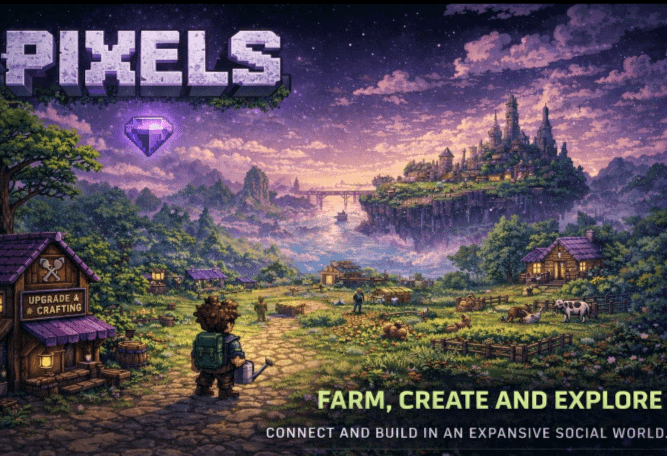
Pixels brings that back in a very simple way.
Easier Entry, Less Friction
One of the biggest problems in Web3 gaming has always been how complicated it feels to start.
Wallets, tokens, setup steps, confusing interfaces—sometimes you need motivation just to begin.
Pixels lowers that barrier. It feels more like a normal game you would just open and try, without needing to understand everything in advance.
And that matters a lot, because most players don’t want to study a game before playing it. They just want to play.
The Economy Is There, But It Doesn’t Dominate
Of course, the Web3 part still exists. There is a token layer, there are rewards, and there is ownership built into the system.
But what’s different is that it doesn’t feel like the whole identity of the game.
The economy supports the gameplay instead of replacing it.
That balance is actually what makes Pixels feel more stable compared to many earlier projects where everything revolved around token price and speculation.
Why Players Actually Stay
At the end of the day, players don’t stay in games because of promises. They stay because something about the experience feels easy to return to.
With Pixels, that “something” is not loud or dramatic. It’s subtle:
The gameplay is simple
The world is calm and familiar
The social presence feels light
Progress happens slowly but steadily
And together, these things create a comfortable loop.
Not addictive in a forced way—but habitual in a natural way.
A More Honest Direction for Web3 Gaming
Web3 gaming is slowly learning a basic truth: if a game is not enjoyable without rewards, it won’t survive because of rewards alone.
Pixels feels like part of that learning phase. It doesn’t try to be revolutionary. It doesn’t try to be the biggest or loudest project. It just tries to be something people can actually spend time in without feeling like they’re interacting with a financial experiment.
And maybe that’s the real shift happening right now.
Not more hype. Not more complexity.
Just games that feel like games again.
