
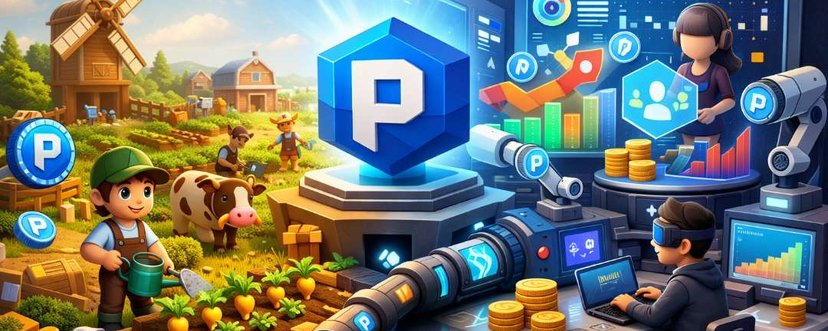
A lot of people still look at Pixels and see a farming game with token rewards attached. I think that view is outdated.
What makes Pixels interesting now is not the farming, not the land, and not even the token incentives. It is the fact that the team seems to be shifting from simply running a Web3 game to building a system that learns how players behave and then adjusts rewards around that behavior.
That may sound subtle, but it changes how the whole project should be viewed.
Most crypto games use rewards in the simplest way possible: give users tokens, attract activity, and hope enough people stick around. The problem is that this usually creates shallow engagement. Players come for yield, optimize the loop, and leave the moment the rewards no longer justify the time.
Pixels appears to understand that now.
Its newer updates suggest the team is trying to move beyond that old formula by designing systems that reward deeper engagement rather than passive farming. The recent gameplay expansions are not just content for the sake of content. They look more like an attempt to create stronger reasons for players to return that are tied to coordination, competition, and progression instead of pure extraction.
That matters because in games, social commitment keeps people around longer than rewards ever do. If someone logs in because their team needs them, because an event is progressing, or because they are competing for something scarce, their motivation becomes emotional instead of purely financial. That kind of retention is far healthier than a player base built only on farming efficiency.
To me, this is where Pixels starts becoming more than another Web3 title chasing retention. It feels like the project is experimenting with how to make incentives smarter.
Every player action inside the game generates useful data. Who spends more after certain quests. Who returns after seasonal events. Who disappears when rewards are reduced. Who converts from casual player into committed user. Over time, that data allows Pixels to improve how it distributes rewards and shape behavior more intentionally.
That is a much bigger idea than most people realize.
If Pixels can keep improving its ability to target incentives efficiently, then the project’s long-term value may come less from being a successful farming game and more from becoming very good at understanding what actually drives retention and monetization in Web3 gaming.
In that scenario, the game itself becomes a testing ground.
The farm, the pets, the quests, the crafting systems, all of it becomes part of a broader machine designed to answer one question: how do you turn token incentives into real user loyalty instead of temporary traffic?
That is why I think many people still underestimate Pixels. They are evaluating it like a game, when it may be evolving into something closer to a live behavioral engine wrapped inside a game.
Of course, this strategy still has to prove itself. Plenty of projects talk about sustainable economies and smarter incentives but fail when real market pressure hits. Pixels still needs to show that its systems can create lasting retention without depending on constant reward inflation.
But if it succeeds, then Pixels may end up being remembered less for its farming mechanics and more for proving that Web3 rewards can be used strategically rather than wastefully.
My view is simple: Pixels is no longer just trying to make farming fun on-chain. It is trying to figure out how to turn gameplay into a smarter distribution model.
And if that works, the most valuable thing Pixels builds may not be the game itself, but the system behind it.
