
Look, I’ve seen this movie before.
A new project shows up. Friendly interface. Simple idea. Big promise hiding underneath. This time it’s Pixels (Web3 game), dressed up as a cozy farming simulator where you plant crops, chat with other players, and—this is the important part—earn real value while doing it. It sounds tidy. On paper, at least.
But when you sit with it for a minute, really sit with it, the cracks start to show.
Let’s start with the pitch. Pixels claims to fix something that has annoyed gamers for years: you spend time in a game, you build assets, and you walk away with nothing. The publisher owns everything. Your effort stays locked inside their servers. That part is true. It’s been true since the early days of online games.
So Pixels offers a cleaner story. Own your assets. Trade them freely. Participate in the economy. It leans on the Ronin Network to make that ownership feel real, persistent, portable.
And here’s where I lean back a bit.
Because the “problem” they’re fixing isn’t as broken as they make it sound. Most players aren’t asking for a financial system when they log into a game. They want entertainment, progression, maybe a bit of competition. The lack of ownership hasn’t stopped the gaming industry from becoming one of the most profitable entertainment sectors on the planet.
So Pixels isn’t just solving a problem. It’s reframing one to justify a new layer.
And that layer is where things get complicated.
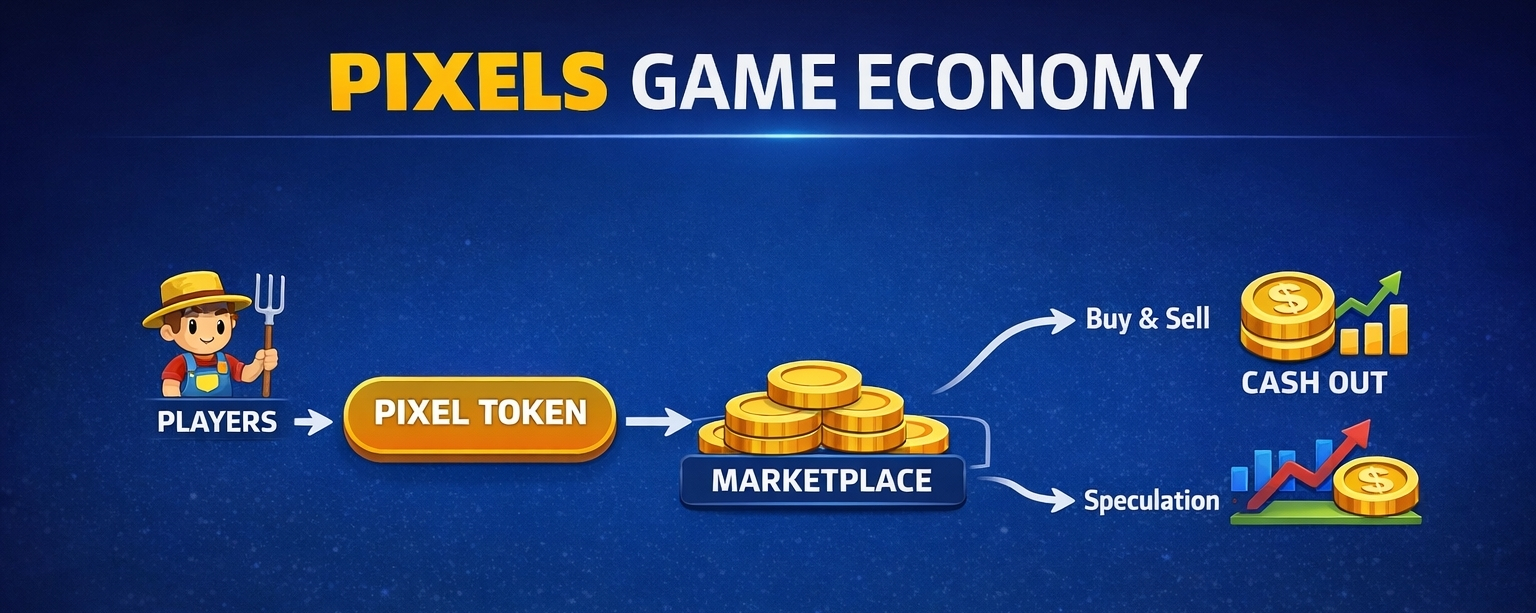
Let’s be honest. This is not really about farming. It’s about financializing activity. Every action you take—planting, harvesting, crafting—feeds into a token economy. You’re not just playing; you’re producing. That production is measured, priced, and ultimately tied to a market outside the game.
It sounds clever. Maybe even fair.
But now you’ve taken a simple system and added volatility, speculation, and external dependency. You’ve turned a closed game loop into something that behaves more like a small, fragile economy. And small, fragile economies tend to break.
The token—PIXEL—is the heart of it. It’s reward, currency, and speculative asset all rolled into one. That’s convenient. It’s also a structural problem. Because now the value of your in-game activity depends on forces you don’t control. Crypto markets move. Sentiment shifts. Liquidity dries up.
And suddenly your “farming rewards” don’t look so rewarding anymore.
I’ve seen this exact pattern play out. Early users come in, accumulate assets, benefit from rising token prices. It feels like momentum. Then growth slows. New money stops flowing in at the same rate. Rewards get diluted. People start cashing out instead of reinvesting.
That’s when things get quiet. And not in a good way.
Pixels tries to soften this with mechanics—land ownership, resource sharing, production loops—but those are patches, not solutions. The core dependency is still there. The system needs ongoing participation, and more importantly, it needs belief. Once belief cracks, everything else follows.
Now let’s talk about decentralization, because this is where the marketing tends to stretch the truth.
Yes, assets are on-chain. Yes, you hold them in a wallet. But the game itself—the thing that gives those assets meaning—is still controlled by the developers. If they change the rules, tweak the economy, or simply lose relevance, your “owned” assets don’t do much on their own.
Ownership without context isn’t power. It’s just data.
And then there’s the infrastructure risk. Pixels runs on Ronin, which is fast and cheap, and that’s why it works at all. But this is also the same network that suffered the Ronin Network hack 2022. Hundreds of millions gone. Just like that.
People tend to wave this off as old news. “They’ve improved security.” Maybe they have. Maybe they haven’t improved it enough. The point is, the risk is real, and it sits underneath everything.
Now ask yourself a simpler question.
What happens when this breaks?
Not if. When.
What happens when the token drops 60 percent. Or 80. What happens when players realize the time they’re investing isn’t translating into meaningful returns anymore. Do they keep farming digital crops for fun?
Maybe a few do. Most don’t.
And that’s the part the marketing avoids. These systems don’t fail dramatically at first. They fade. Activity slows. Markets thin out. Prices slip. The exit doors get crowded at exactly the wrong moment.
Look, I’m not saying Pixels doesn’t work. It does. That’s what makes it interesting. It’s functional. It’s live. People are using it.
But working is not the same as lasting.
The real question isn’t whether you can build a game with a token economy. Clearly, you can. The question is whether you can build one that doesn’t quietly depend on the next wave of users to keep the whole thing upright.
And after watching this space for two decades, that’s the part that never quite adds up.
