
I remember the first time I actually earned something inside a game that felt like it belonged to me. Not just a skin or a badge locked inside a publisher’s server but something tradable, visible, and tied to a real market. That moment changed how I look at gaming entirely. And lately, I’ve been seeing that same shift play out again with PIXEL.
At first glance, PIXEL looks like just another gaming token trying to ride the Web3 wave. But when I dug deeper, I noticed something different. It’s not just about play-to-earn mechanics anymore, it’s about creative ownership. That distinction matters more than most people realize.
Right now, PIXEL is trading at $0.008141, with a +8.30% 24-hour increase, which already signals short-term momentum. The 24-hour trading volume sits at $33.67 million, a healthy figure that suggests active participation rather than passive holding. With a circulating supply of 3.38 billion tokens out of a maximum of 5 billion, the implied market cap is hovering around the $27–28 million range. That puts it in a zone where it’s still early but not invisible.
What caught my attention wasn’t just the numbers, though. It was how those numbers connect to behavior inside the ecosystem.
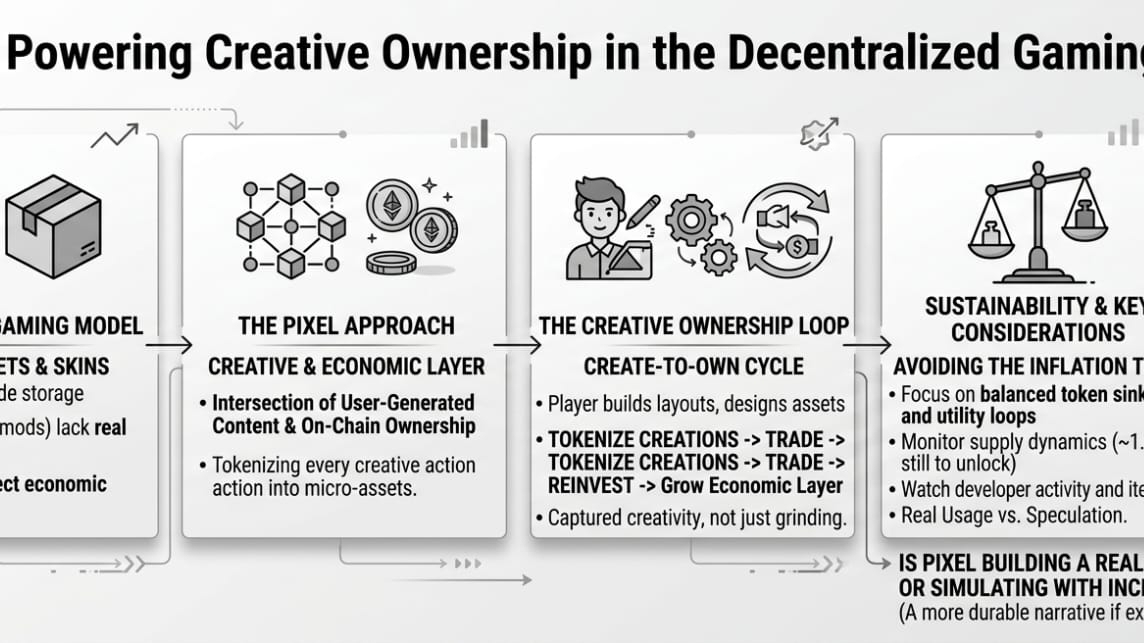
I tried to imagine a scenario so I created one in my head based on how these systems usually evolve. Let’s say someone call him Arif starts playing a decentralized farming-style game powered by PIXEL. At first, he’s just grinding, planting, harvesting, doing the usual loop. But then something interesting happens. Instead of just earning tokens, he starts designing layouts, optimizing land use, maybe even creating assets that other players want.
Now here’s the twist: those creations aren’t locked. They’re tokenized. Tradable. Valuable.
I’ve seen this pattern before in traditional games people building entire economies inside Minecraft servers or modding communities. But they never truly owned the upside. With PIXEL, that changes. The token becomes the economic layer that captures creativity, not just time spent.
That’s where the real thesis begins to form.
From a fundamentals perspective, PIXEL sits at the intersection of user-generated content (UGC) and on-chain ownership. Think of it like turning every creative action into a potential micro-asset. Instead of grinding for rewards, you’re building something that can circulate within an economy.
But here’s where I paused and I think it’s important.
Not every system that promises ownership actually delivers sustainable value.
I’ve noticed that many Web3 gaming tokens struggle with inflation. If rewards are too easy to earn, the token supply floods the market. Price drops. Engagement fades. It’s a cycle we’ve seen repeatedly. So the key question I kept asking myself was: Does PIXEL have mechanisms to avoid that trap?
From what I’ve observed, recent updates and development direction suggest a stronger focus on balanced token sinks and in-game utility loops. That means tokens are not just earned they’re spent meaningfully. Whether it’s upgrading assets, accessing features, or participating in governance layers, utility is being reinforced.
Still, I remain cautiously optimistic.
Because tokenomics on paper and tokenomics in practice are two very different things.
Another layer worth analyzing is community behavior. A $33M daily trading volume at this stage indicates that PIXEL isn’t just sitting idle. There’s active speculation, yes but also likely real usage. Volume without context can be misleading, but in gaming ecosystems, it often correlates with player engagement cycles.
I also started comparing PIXEL to earlier gaming tokens I’ve tracked. Many of them leaned heavily into hype cycles mass onboarding followed by rapid drop-offs. PIXEL feels like it’s trying a slower burn approach. Less noise, more infrastructure.
That said, it’s not without risk.
If user growth stagnates, the entire creative economy thesis weakens. If too much value is extracted without reinvestment into gameplay, players will leave. And if the broader crypto market turns bearish, smaller-cap tokens like PIXEL tend to feel it first.
So what would I actually do if I were approaching PIXEL today?
First, I wouldn’t treat it purely as a speculative trade. I’d spend time inside the ecosystem understand how value flows. Tokens tied to real usage behave very differently from narrative-driven pumps.
Second, I’d monitor supply dynamics closely. With about 1.6 billion tokens yet to be unlocked, future emissions matter. Timing matters.
Third, I’d watch developer activity. Are updates consistent? Are new features driving retention? In decentralized gaming, momentum isn’t built on marketing it’s built on iteration.
Coming back to that imagined scenario Arif doesn’t just play anymore. He starts earning from his designs. Other players use his layouts. He reinvests into better assets. Slowly, he becomes part of an economy rather than just a participant in a game.
That’s the promise PIXEL is trying to capture.
Not just play-to-earn.
But create-to-own.
And honestly, I think that’s a more durable narrative if executed correctly.
Still, I keep asking myself:
Is PIXEL building a real creative economy or just simulating one with token incentives?
Will players stay when rewards stabilize or only when they’re high?
And most importantly are we early to a sustainable model, or just early to another cycle?
Curious to hear your take would you actually use a system like PIXEL, or just trade around it?
