


There’s something unusual happening inside Pixels right now.
On the surface, everything looks like expansion.
New regions. Industrial loops. Procedural worlds. Guild-level coordination.
More players than ever, with over 1.1 million daily active users and millions of wallets already interacting through Ronin.
But none of that is the real shift.
The real shift is quieter.
And it sits inside how players get paid.
For a long time, the logic was simple.
Play the game, earn the token.
That model didn’t fail because players stopped playing.
It failed because the reward itself became the exit.
Every token distributed was a potential sell.
Every reward carried its own pressure.
And eventually, the system started leaking faster than it could sustain itself.
What’s happening now feels like a direct response to that flaw.
Stacked introduces something that doesn’t immediately look disruptive, but changes the entire flow of value:
Rewards are being paid in USDC.
At first glance, that sounds like stability.
Less volatility. Less exposure. More predictable earnings.
But structurally, it does something else.
It separates participation from sell pressure.
Players can now extract value without directly impacting the token that represents the system itself.
That alone reshapes incentives.
Because now, staying in the game and exiting the game are no longer the same action.
And that creates a strange tension.
Especially with a token unlock approaching.
On April 19, more $PIXEL will enter circulation.
Under normal conditions, that would be a straightforward scenario:
more supply → more potential selling → downward pressure.
But the system isn’t operating under normal conditions anymore.
Inside the game, tokens are now being auto-staked by default.
Holding is no longer passive.
It’s an active economic position.
And leaving the system has a cost.
Withdrawal penalties don’t just discourage exits.
They redistribute value to those who remain.
So now there are two parallel flows:
Stable rewards being paid externally in $USDC .
And internal value being reinforced through staking mechanics tied to $PIXEL.
One reduces the need to sell.
The other increases the cost of leaving.
This is where things stop looking like a typical game economy.
And start looking more like a controlled financial environment.
Even the expansion into industrial gameplay loops starts to make more sense under this lens.
More complex production chains mean longer engagement cycles.
Longer cycles mean more data.
More data means better targeting of rewards.
And better targeting reinforces the system without inflating it blindly.
The introduction of cross-game delegation pushes this even further.
Now the token isn’t just tied to one loop.
It’s tied to the performance of multiple environments competing for attention and capital.
Which means PIXEL is no longer just a reward.
It’s becoming a coordination layer.
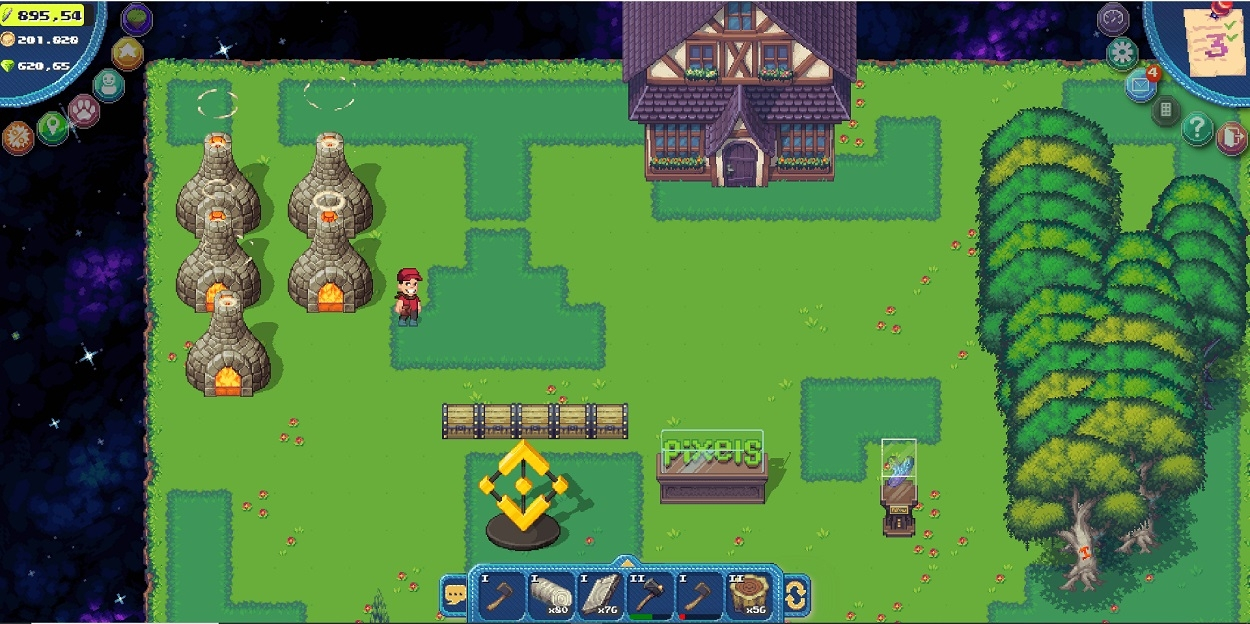
Coming back into the game after some time, that shift is noticeable.
Not because something obvious changed.
But because the system feels tighter.
Less noisy.
Less random.
Holding tokens inside the game no longer feels like waiting.
It feels like being positioned inside something that is actively redistributing value in the background.
And that raises a question that doesn’t have an immediate answer.
If players are rewarded in stable assets…
and the token is increasingly tied to staying rather than earning…
then what exactly determines the value of $PIXEL going forward?