


What keeps bothering me on Pixels isn't bots.
It's how easy the game is to enter... and how quickly it shows you where the better economy actually lives.
I logged in on @Pixels one night planning to do nothing serious. Speck plot. Small board tasks. Gather a bit. Craft something basic. Burn time. Fine. That version of Pixels works. It feels open. You show up, do the loop, get something back, move on.
Then the board wanted an output my setup produces badly.
Not impossible. Worse. Just inefficient enough to take the night away from me.
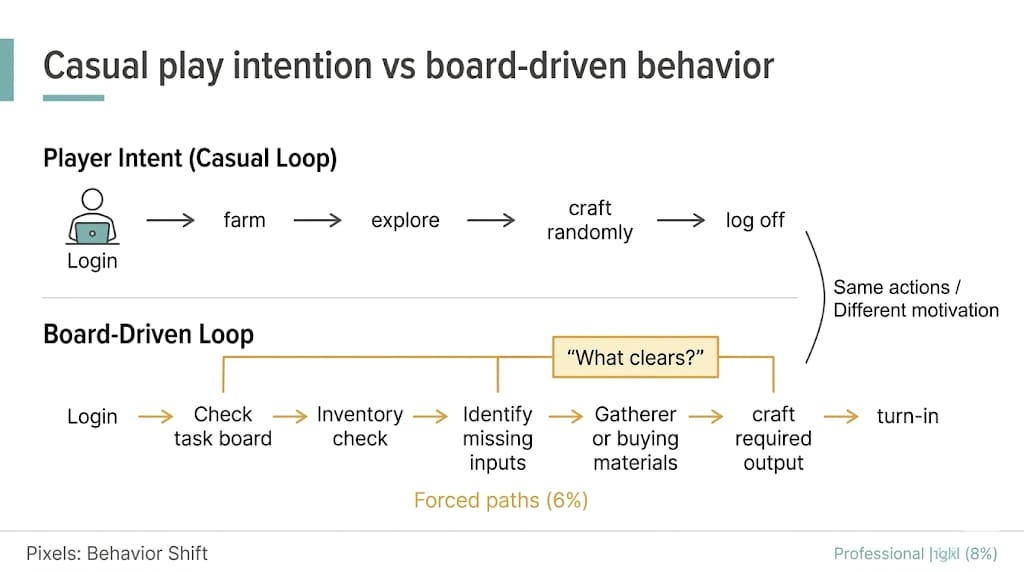
So I did the usual little repair work. Checked the bag. Counted what I had. Counted what I didn’t. What I could gather myself. What I'd have to buy. Thought I'd just patch the gap through the market and be done with it.
So I checked the market anyway.
Price made the whole task pointless.
Still did part of it anyway.
That was worse.
Because once I'd already started building toward it, dropping the task felt stupid in one way and continuing felt stupid in another. Very elegant design. Really humane. So now the session wasn’t about farming anymore. It was about whether I wanted to spend the next hour fixing a shortage the board had turned into my problem.
Thats where the shift happens.
Same map. Same board. Same little cheerful world. Different cost.
The player with real land on Pixels farms doesnt feel that moment the same way.
They clear it.
I build around it.
Then rebuild again because the board wants something else five minutes later.
That’s the split.
And it doesn’t show up at the door. Pixels is genuinely free to enter. Specks exist. You can farm, craft, walk around, run the board, hang around the world, do the whole soft loop. That part is real. The bruise shows up later, when participation turns into production and production starts getting judged by how cleanly your setup can feed the system what it wants.
Maybe that’s just bad routing.
No.
Happens too often for that.
The board doesn’t care if you can produce it.
It cares how clean it looks when you do.
That’s the difference.
I kept trying to explain it away because of course land should matter. Pixels is not hiding that. Better yields. Better industries. Better access. Fine. Ownership should mean something. I’m not asking for decorative NFTs and fake equality. That’s not the issue.
The issue is what the difference feels like once the board starts pulling on it.
A stronger plot turns the same request into a turn-in. Maybe a quick craft. Maybe one missing input. Done.
A weaker one turns it into a chain of little corrections. Extra gathering. Extra movement. Extra market patching. Extra time. Extra points where the reward starts looking thinner than the path required to get there.
Tried a second task.
Looked safer.
Same problem, just slower this time. Okay.
Thats when free-to-play stops feeling like the whole story. Not because the game lied about access. It didn’t. It just left out where the richer version of the economy actually sits once the work starts mattering.
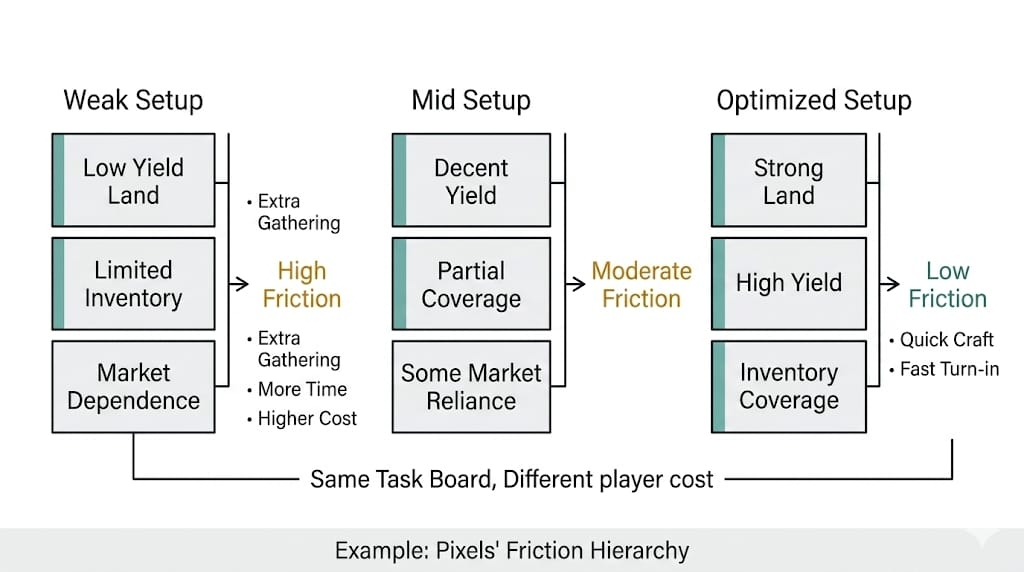
And on Pixels it all folds together. The board keeps asking for outputs that look simple until your plot fights you. Land decides how often that happens. Faucets decide whether the fix is nearby or a walk. VIP smooths some of it out if you have it. Then the system still checks how clean your result looks before it really pays you. Same farm. Not the same night.
You feel it when you’re two resources short and the nearest faucet that matters isn’t yours.
So you walk.
Or you buy.
Or you drop the task and pretend you chose that.
That’s not just game texture.
That’s the system deciding what your setup is good for.
And it keeps deciding it again every time the board refreshes.
A player on stronger land already feels less pain moving through the same board. Better yield. Cleaner sourcing. Fewer stupid little shortages. Less of the session disappearing into patchwork. The land owner still plays Pixels, obviously. They’re not in another game. That’s the ugly part. Same crops. Same board. Same map.
The night just bends less for them.
And once I started seeing it that way, I couldn’t really go back to the friendly version of the story. The board was no longer just a task layer. It was a machine that kept exposing how uneven the production lanes already were.
One player converts.
The other just keeps busy.
That line sat there longer than I wanted it to.
Because the Speck player is still doing the work. Still hitting the board. Still producing. Still learning the loops. Still useful. Pixels never fully blocks that player. It just keeps charging them more friction for the same kind of recognition. More detours. More patching. More nights spent making a task barely make sense.
Lost maybe 40 minutes fixing a task that shouldn’t have needed fixing.
Didn’t even notice until I closed the tab.
It doesn’t even feel like a land problem after a while.
Feels like the board already knows which setups it prefers.
You learn the economy from the outside first.
That part is easy.
Then the part that actually converts sits somewhere else.
Near ownership. Near cleaner production. Near tighter access to the inputs that stop a board request from turning into a scavenger hunt with accounting attached.
The market makes this sharper. A land-rich player patches a missing resource and moves on. A weaker setup keeps paying to correct the same structural problem. Small difference once. Annoying difference over a week. Then it becomes the shape of your relationship to the whole system.
One route converts.
The other just keeps you busy.
I almost dropped it.
Then didn’t.
Which is probably the part the system relies on.
Because players will keep trying to compensate. We always do. Give us a lopsided loop and we’ll solve around it until the solving starts feeling normal.
Doesn’t make it neutral.
Just makes it harder to notice once you’re used to it.
Thatss the part of Pixels I don't love.. really. The game doesn’t need every hour to be equal because it’s clearly shaping what gets paid upstream. The board is already picking outputs that fit cleaner production. Better land just happens to match that shape more often. So the system stays stable. Fine. The tradeoff is you learn the economy from the outside while the version that actually converts cleanly keeps sitting a few layers in.
Not broken. Just not neutral.
Cheap chain, cheap actions.
Same problem.
Friction doesn’t go away. It just shows up somewhere else.
And the habit is very Pixels-native. Check the board. See what counts. See what your setup can realistically produce. See what has to be patched through the market. See whether the reward still holds after the corrections. Then either run the longer route again or pivot into the smaller set of tasks your current lane handles better.
It’s open at the entrance.
Then it tightens.
You can still wander. Sure.
You can still farm random things, decorate, burn time, do half-useless little chores because they feel nice and not because the board is paying them.
It just stops feeling like the serious part of the game.
That’s the bruise.
Not that freedom disappears.
That the richer layer keeps answering from somewhere else.
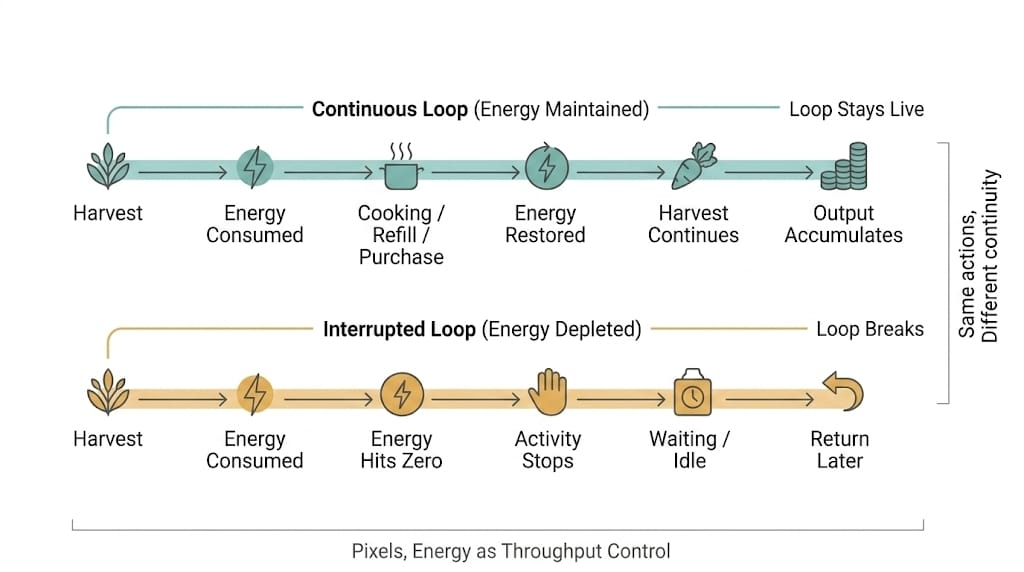
And after enough sessions you stop asking whether you’re inside the economy. You are. Clearly. You start asking which part of it keeps answering you back. The part near ownership. The part with cleaner yields. The part that doesn’t make every second task turn into a repair job. The part where the board feels like demand for one player and conversion for another.
Same world.
Longer route.
You can still farm. Still run the board. Still tell yourself the system is open because you’re inside it. Fine.
Then the next task shows up wrong for your setup again.
Same map.
Same... tools.
Longer route.
And at some point it stops feeling like you’re playing the system
and starts feeling like the system already picked where you get to stand.