
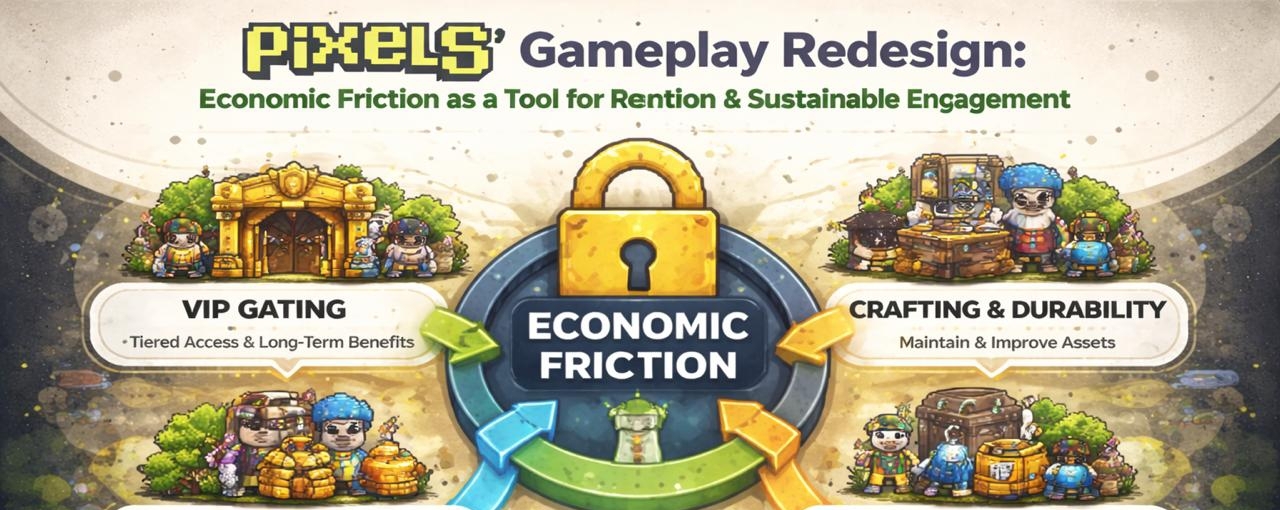
the game design has been guided by a simple assumption for years…the easier it is to enter, move and extract value, the better the experience. That logic makes sense at first glance. Lower friction usually means faster acquisition, smoother onboarding, and less resistance between curiosity and action. In both Web2 and Web3, the instinct has often been the same: remove barriers, accelerate participation, and let convenience do the rest.
But ikeep coming back to a more uncomfortable truth. Not all friction is bad. In fact, in the right place, friction can be the difference between shallow engagement and lasting commitment. That is what makes Pixels interesting. Rather than treating every obstacle as a flaw to be eliminated, it appears to treat certain forms of economic friction as part of the design itself. The result is not a system that simply pushes players to act faster. It is a system that asks them to think longer.
That shift matters more than it first appears.
The traditional model of game growth is built around reducing resistance. Make signup easy. Make rewards visible. Make progression fast. Make withdrawal simple. In Web3 especially, there has been a strong tendency to strip away anything that feels inconvenient, under the assumption that liquidity and freedom are always positive forces.If players can move assets instantly, harvest rewards immediately, and exit whenever they choose, the system seems more open, more efficient,and more attractive.
Yet this approach has a weakness. It often creates behavior that is optimized for extraction rather than participation. When the path from entry to reward is too direct, players may engage like opportunists instead of participants. They test the system, claim what they can, and leave before meaningful attachment forms. The design looks efficient, but the ecosystem becomes fragile.
Pixels seems to challenge that assumption by introducing deliberate friction into its economy. Features such as withdrawal limits, VIP gating, and crafting-related constraints do not simply slow players down for the sake of complication.They shape how players relate to the game. They turn short-term opportunism into longer-term investment. They make economic behavior more deliberate.
i think that is the real design move here. Pixels is not asking, “How do we make value more accessible?” It is asking, “How do we make value more meaningful once access exists?”
That is a far more interesting question.
VIP gating is one of the clearest examples of this philosophy. In many systems, premium access is used primarily as a monetization layer: pay more, get more, move faster. But in a game economy, VIP status can serve a different function. It can act as a filter, separating casual curiosity from deeper commitment. It can also alter the player’s time horizon.
When everything is instantly available, players tend to behave in the present tense. They chase the nearest gain, the quickest upgrade, the fastest exit. There is little reason to think structurally when the system rewards immediacy. But when access is tiere and when certain features are reserved for those who stay engaged longer or invest more meaningfully, the psychological frame changes. Players begin to weigh timing, status, and utility. They stop thinking only about what they can take now and start thinking about what they can sustain later.
That is not a minor shift. It changes the texture of participation.
VIP features introduce a form of discipline into a market that is usually dominated by instant gratification. They create a reason to remain inside the system rather than constantly trying to pull value out of it. They also reward patience, which is one of the most underrated qualities in digital economies. A player who expects immediate conversion behaves differently from a player who expects gradual advantage.
I see this pattern in many systems: when access is too flat, behavior becomes too liquid. Everything moves, but nothing settles. vip gating pushes against that. It slows the reflex to extract and encourages a more strategic stance. Not everyone will like that. Some will see it as a barrier. Others will see it as a signal that the game is built for depth, not just traffic.
And that distinction matters.
The same logic appears in crafting and inventory systems. These mechanics may look ordinary on the surface, but in practice they do something important: they make ownership feel active rather than passive. A player is not simply collecting assets and waiting for them to appreciate. They are managing durability, replacing items, making decisions about scarcity, and balancing immediate use against future value.
That kind of design creates a stronger relationship between effort and outcome. When items degrade, when inventory space is limited, or when crafting requires repeated engagement, value becomes tied to maintenance. The player must care for the system, not just enter it. And care changes behavior.
This is where Pixels becomes especially interesting from an economic design perspective.
Maintenance based systems also help preserve meaning. If every item is infinitely durable, endlessly transferable, and instantly liquid, then ownership starts to feel abstract. But when systems impose wear, scarcity, or operational trade-offs, the player has to make judgments. What should i keep? What should I upgrade? What should i repair? What should i
risk? Those choices produce engagement not because they are easy, but because they are consequential.
That is a deeper form of retention than simple repetition.
Withdrawal limits are likely the most controversial part of Pixels’ approach, because they directly confront the expectation that digital assets should always be instantly redeemable. In many Web3 environments, unrestricted liquidity is treated as a feature of trust. The user should be free to leave with value at any time. That principle is understandable, and in some contexts essential. But it can also create a pattern where the game economy becomes too dependent on withdrawal behavior rather than sustained internal circulation.
Pixels’ use of limits suggests a different theory. By making extraction less immediate, the system encourages more of the economy to remain active inside the game. Value is not simply accumulated and removed. It is cycled, used, and re-embedded in play. That does not eliminate liquidity, but it shapes its timing. Timing is everything in a game economy.
This is where economic friction becomes a retention tool. If value can be pulled out too easily, players may optimize around exit. If value is easier to keep working inside the system than to remove from it, players are more likely to reinvest. That reinvestment can support healthier in-game activity, stronger markets, and more stable long-term participation.
Of course, this approach is not without trade-offs. Friction can frustrate users who want full control. It can also create suspicion if not communicated clearly. Any system that restricts movement must justify itself through visible design logic, not vague appeals to balance. Players are usually willing to accept friction when they understand what it is doing. They resist it when it feels arbitrary.
That is why this kind of design requires maturity. Friction cannot simply be imposed. It has to be legible.
to me most about Pixels is that it seems to treat the game economy not as a distribution engine, but as a behavioral system. That distinction is crucial. A distribution engine focuses on getting value to users quickly. A behavioral system focuses on how users interact with value over time.
Those are not the same thing.
Pixels’ friction points suggest a belief that sustainable engagement comes from structured participation, not maximum ease. VIP features slow the rush toward immediate reward. Crafting and inventory systems create obligations that deepen ownership. Withdrawal limits reduce the temptation to treat the game as a temporary extraction layer. Together, these mechanisms do something that most digital products struggle to achieve: they make value feel lived in rather than merely collected.
That is not just a game design choice. It is an economic philosophy.
The deeper lesson here is that sustainability rarely comes from removing every barrier. Sometimes it comes from choosing the right barriers and placing them with intention. Friction, when used carefully, can preserve attention, reinforce commitment, and prevent a system from collapsing into short-term behavior. It can make a player pause. Reflect. Reinvest. Stay.
And in game economies, staying is often more valuable than arriving.
Pixels appears to understand that. Whether the model ultimately proves durable will depend on execution, balance, and player trust. But the idea itself is worth taking seriously. In a landscape obsessed with instant movement, Pixels is betting that controlled resistance can create a stronger center of gravity. That is a more demanding design path. It is also, in many ways, a more honest one.