
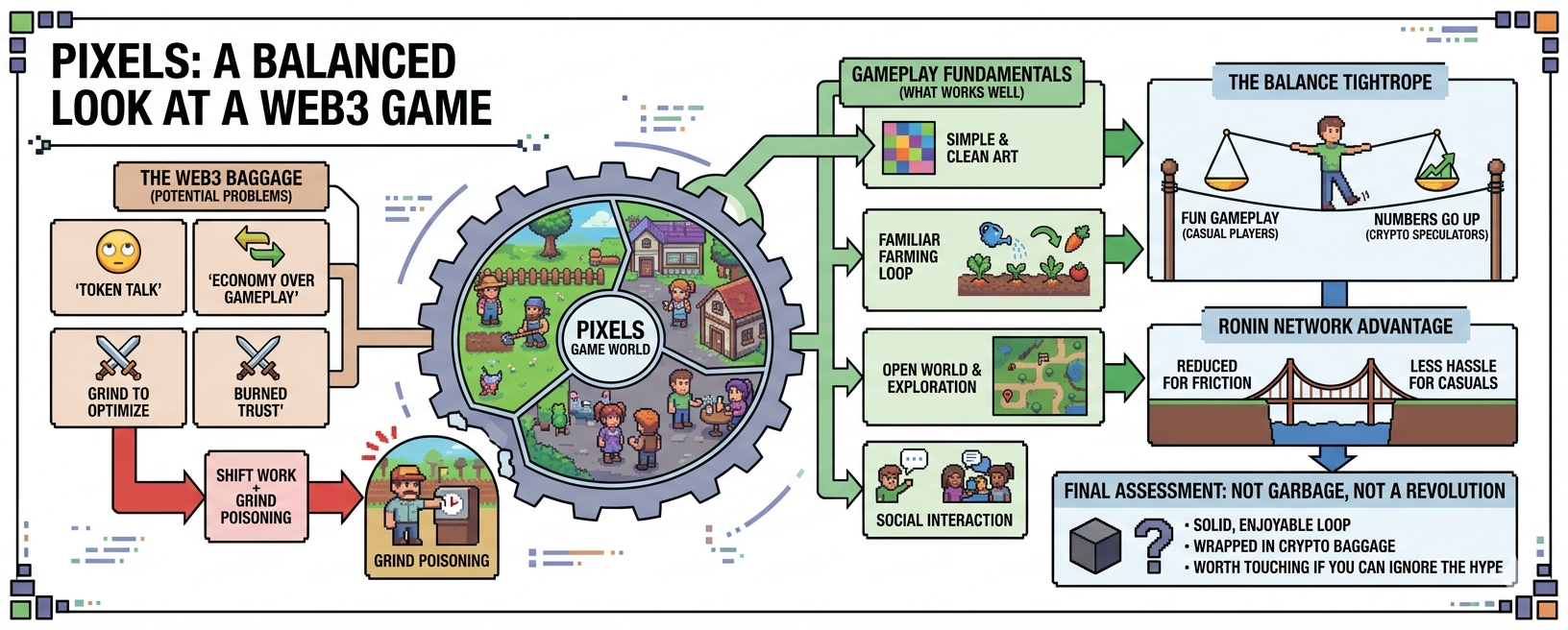
The first problem is obvious. It’s a Web3 game. So right away you’ve got the usual baggage. Token talk. Economy talk. Ownership talk. People acting like planting digital carrots is some huge shift in gaming history. Most of that stuff is noise. Most people do not care about “digital ownership” when the actual game feels like a chore. They just want the thing to work. They want to log in, play, not fight with wallets, not sit through a bunch of crypto nonsense, and not feel like every click is secretly part of somebody else’s market strategy.
That’s the wall Pixels runs into before it even gets a fair shot. Web3 games have burned so much trust that the second anyone hears “blockchain farming game,” the eyes start rolling. Fair enough. A lot of these projects spent years promising the future and delivering dead worlds, bad art, boring grind, and communities full of people who cared more about flipping assets than actually playing. So when Pixels shows up with farming, exploration, and crafting on the Ronin Network, the first reaction is not excitement. It’s suspicion. It should be.
And honestly, some of that suspicion still sticks. Because even when Pixels is doing things right, you can still feel that crypto layer sitting under everything like a loose floorboard. You know it’s there. You know somebody is looking at the game as a system to optimize, not a world to enjoy. That changes the mood. It always does. The second a game starts tying itself to tokens and market logic, a chunk of the player base stops acting like players and starts acting like middle managers with crops. That’s where a lot of the fun goes to die.
The grind can get ugly fast in games like this. That’s just reality. Once people figure out the best routes, the best tasks, the best ways to squeeze value out of every minute, the whole cozy vibe starts falling apart. Suddenly it’s not a chill farming game anymore. It’s shift work with cute graphics. That’s the big danger with Pixels. Not that it looks bad. Not that it has no ideas. The danger is that all the soft, social, low-pressure stuff can get eaten alive by the economic side if the balance slips even a little.
And balance in these games is always shaky. Always. Because Pixels is trying to please two different groups at the same time. One group wants a fun game. The other wants numbers to go up. Those groups overlap a bit, sure, but not enough to pretend this is easy. If the game leans too hard into the crypto crowd, normal players get pushed out by grind, speculation, and people treating the whole thing like a business model. If it leans too hard into just being a cozy farming game, the Web3 crowd starts whining that the economy is weak or the assets are not doing enough. So the whole thing is stuck walking a tightrope.
That said, Pixels is not garbage. That’s the part people miss when they either hype it like crazy or dismiss it instantly. It actually does a few important things right. First, it looks like a real game. That should not be rare, but in Web3 it kind of is. A lot of blockchain games look like someone made a marketplace first and then remembered they needed gameplay. Pixels at least feels like it was built by people who understood that players need a world, not just a token with chores attached. The art is simple, clean, colorful, and easy to read. It feels welcoming. Not cold. Not dead. Not like a finance app wearing a farmer costume.
The farming loop works too. Not in some mind-blowing way. Let’s not get stupid. It’s not reinventing anything. You plant stuff, gather stuff, craft stuff, and keep the cycle moving. Basic. Familiar. But that’s fine. It does not need to reinvent farming games. It just needs to make the loop feel smooth enough that people do not hate doing it. And for the most part, it manages that. There’s a rhythm to it. You log in, do a few tasks, move around, check progress, and before you know it you’ve burned more time than you meant to. That kind of loop is old for a reason. It works when it’s handled well.
The open-world side helps a lot. If Pixels was just menus and fields, it would get stale fast. The fact that you can move around, explore, and exist in a shared space gives it more life than a lot of similar games. You do not feel completely boxed in. There’s some room to wander. Some room to get distracted. Some room to see other players doing their own thing. That matters more than people think. A game like this lives and dies on atmosphere. If the world feels flat, the grind becomes impossible to ignore. If the world feels alive, the same tasks are easier to stomach.
That’s probably one of Pixels’ biggest strengths. It feels alive enough. Not perfect. Not magical. But alive enough that you can see why people stick around. The social part is doing a lot of heavy lifting here. Seeing other players running around, working on their own stuff, filling the world with movement, that helps. It makes the game feel less like a lonely resource machine. Even if you are mostly doing your own routine, the shared space gives it some warmth. That’s important because without that warmth, Web3 logic takes over way too easily.
The creation side matters too. Building, crafting, shaping your little part of the world, that stuff gives players a reason to care beyond pure efficiency. The more a game lets you make something feel like yours, the harder it is to reduce everything to raw output. That’s where Pixels has some real value as a game, not just a crypto project. When people feel attached to what they’re building, they stop thinking only in terms of extraction. At least some of them do. That kind of attachment is what gives the game a pulse.
Ronin helps too. Again, let’s keep it real. Most players do not care about the chain unless it makes the game annoying. Then they care a lot. Ronin has a better shot than most because it’s actually tied to gaming and not just pretending to be. That means less friction, less nonsense, and a smoother path into the game. And that matters because casual games cannot survive extra hassle. Nobody wants to jump through hoops just to water fake crops. If the setup feels like homework, people leave. Simple as that.
Still, none of this fixes the big question. Is Pixels fun because it’s actually fun, or because the Web3 crowd keeps pumping attention into anything that looks halfway playable? That question hangs over the whole thing. And no, there is no clean answer. Some people clearly like the game for the game. You can see that. The loops are decent. The world is pleasant. The social side works. But there’s also no point pretending the crypto angle is not a huge part of why it gets so much noise. In another context, without the token talk and the Web3 crowd orbiting around it, would Pixels hit this hard? Maybe. Maybe not. Hard to say.
What is fair to say is that it handles itself better than most of the junk in this space. That’s not a huge compliment, because the bar is in hell, but still. Pixels feels more grounded. More playable. Less desperate. It is not screaming at you every five seconds about how it will change gaming forever. At least the game itself doesn’t feel that way. It feels smaller. More practical. More like it understands that if people are going to put up with blockchain baggage, the actual game had better be decent. That alone puts it ahead of a lot of its competition.
The problem is that Web3 games never get judged only as games. They get judged as economies, as experiments, as investments, as social spaces, as proof that some bigger idea can work. That’s a lot of weight to dump on something that mostly asks you to farm, explore, and craft. Pixels carries that weight better than expected, but you can still feel it bending under the pressure. Every nice little gameplay loop has this shadow hanging over it. Will the economy mess this up? Will the grinders take over? Will the casual players get drowned out? Will the game still feel worth touching once the hype cools off? Those are not side questions. Those are the real questions.
And that’s why Pixels is interesting, even if you’re tired of crypto talk. Not because it solved anything. It didn’t. Not because it proves Web3 gaming is the future. Please. Calm down. It’s interesting because it’s one of the few games in that whole mess that feels like it at least understands what a game is supposed to do. It gives people a place to be. A routine. A loop that works. A world that has some charm. That should be normal. In Web3, it still feels weirdly rare.
So yeah, Pixels has problems. Big ones. The crypto baggage is real. The risk of grind poisoning the whole thing is real. The split between players who want fun and players who want profit is real. The fear that it could all turn into optimized digital labor is real. But under all that, there is also an actual game here. A simple one. A sometimes repetitive one. A game that leans hard on farming, exploration, social activity, and creation to keep people around. And somehow, against the odds, that part mostly works.
That’s probably the most honest way to put it. Pixels is not some revolution. It’s not trash either. It’s a decent, sometimes genuinely enjoyable farming MMO thing wrapped in all the usual Web3 baggage that makes people tired before they even start. If you can ignore the hype, ignore the buzzwords, ignore the people treating it like the second coming of online economies, there’s something solid in there. Not amazing. Not world-changing. Just solid. And right now, for a blockchain game, that already feels like more than expected.
