
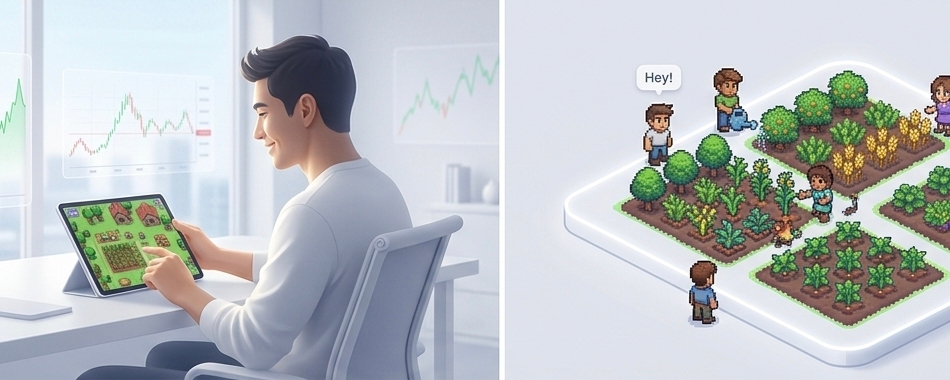

Lately I’ve been noticing something shift in the market. It’s subtle, but it’s there. The loud narratives aren’t hitting the same way they used to. Memecoins still run, sure, but the conviction behind them feels thinner. People are rotating faster, staying lighter, almost like nobody wants to get caught holding the wrong story too long. And in the middle of all that, I stumbled into Pixels almost by accident.
At first glance, it didn’t look like something that should matter. A farming game. Pixel graphics. Casual vibe. Nothing about it screams “next big crypto narrative.” But the more I looked, the more I started paying attention to the behavior around it, not just the surface.
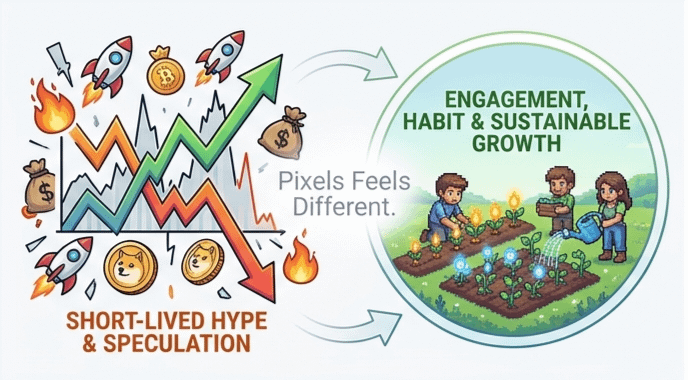
What caught me off guard is how naturally it fits into what this cycle seems to be demanding. People aren’t just chasing tokens anymore. They’re looking for something they can actually do while they wait. Something that doesn’t feel like staring at charts all day. Pixels leans right into that. It’s not trying to be a complex AAA metaverse. It’s simple on purpose. You log in, you farm, you explore, you interact. It feels closer to a habit than a “play-to-earn” grind.
And that’s important, because if we’re being honest, most GameFi experiments before this didn’t fail because of tech. They failed because they felt like work disguised as games. The moment rewards dropped, users disappeared. I’ve seen that cycle repeat too many times to ignore it.
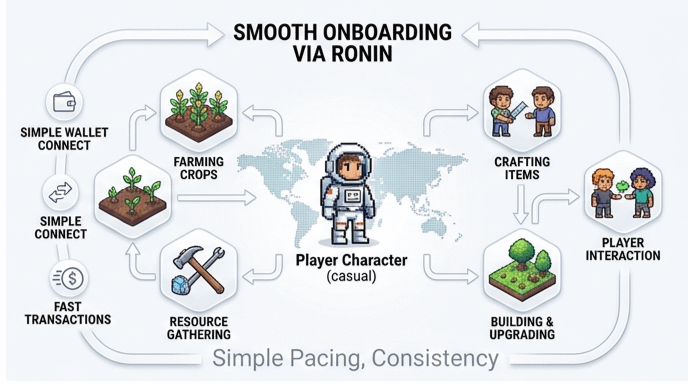
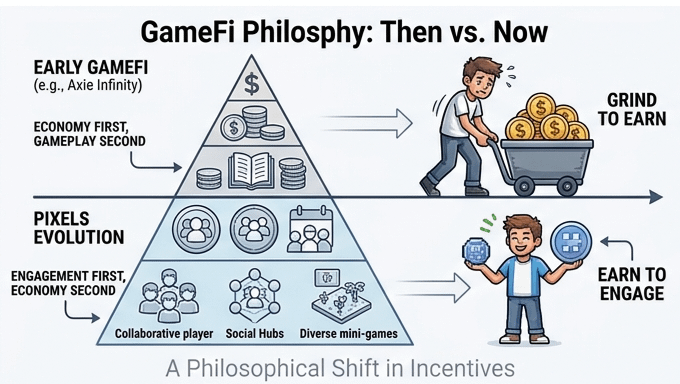
Pixels seems to be approaching that problem differently. Instead of building the economy first and the gameplay second, it feels like they’re prioritizing engagement and letting the economy layer in more gradually. It’s running on the Ronin Network, which already has a history with gaming through Axie Infinity, but this feels like a quieter evolution rather than a repeat attempt.
From what I’m seeing, the core loop is intentionally simple. You gather resources, grow crops, craft items, and interact with a shared world. Nothing revolutionary on paper. But the key difference is how it’s structured socially. There’s a sense of presence. Other players matter. Land matters. Time spent inside the game compounds in a way that doesn’t immediately translate to token extraction.
The PIXEL token itself plays into this ecosystem more as a utility layer than a pure reward faucet. It’s used for in-game actions, upgrades, and progression. That might sound standard, but the difference is in pacing. They’re not flooding users with tokens upfront. Rewards feel more tied to consistent activity rather than short bursts of optimization. I didn’t expect this, but it actually creates a slower, more sustainable loop, at least in theory.
Still, I can’t ignore the elephant in the room. Sustainability in GameFi has always looked good in the early phase. The real test comes when growth slows down. When new users stop arriving at the same rate, does the economy hold up? Or does it start depending on fresh liquidity like everything before it?
What gives Pixels a bit of an edge right now is timing. The market is in that awkward middle phase where people are active, but not fully euphoric. That’s actually a great environment for games like this. Users are willing to explore, experiment, and stick around longer. It’s not peak mania where everything becomes purely speculative.
I’ve also noticed that onboarding feels smoother compared to older Web3 games. Ronin has been refining this for a while, and it shows. Less friction means more casual users can actually stick around, which is critical if the goal is to build something beyond a short-term farm.
When I compare Pixels to earlier projects like Axie Infinity, the difference feels philosophical. Axie was heavily financialized from the start. Pixels feels like it’s trying to earn engagement first and monetize later. That doesn’t guarantee success, but it does change the trajectory.
There’s also competition heating up again. Web3 gaming isn’t dead, despite what people were saying last year. New projects are coming in with better funding, better graphics, and stronger narratives. Pixels doesn’t compete on visual complexity. It competes on accessibility and retention. That’s a different game entirely.
One thing I keep coming back to is how it feels to actually spend time in it. That sounds obvious, but it’s something crypto often forgets. Most projects optimize for token movement, not user experience. Pixels seems to be testing whether a simple, consistent experience can hold attention longer than high-intensity reward cycles.
Of course, there are risks. Token dynamics can shift quickly. If incentives get misaligned, users will leave. If the team pushes monetization too aggressively, it could break the balance they’re trying to build. And like any game, it lives or dies by whether people actually enjoy being there.
I also wonder how scalable this model really is. Can a casual farming game maintain long-term engagement in a space that constantly demands novelty? Or does it eventually hit a ceiling where users move on to the next thing?
What I find interesting, though, is that Pixels isn’t trying to be everything. It’s not positioning itself as the future of gaming. It feels more like an experiment in behavior. What happens if you give people a low-pressure, persistent world with light incentives and just let them exist in it?
I keep thinking about that while watching the broader market. Maybe the next wave in crypto isn’t about bigger promises or more complex systems. Maybe it’s about creating environments people don’t want to leave.
I’m still figuring out where Pixels lands in all of this. It could quietly build something durable, or it could end up as another short-lived cycle that looked promising early on. But I can’t ignore the fact that it made me stop and look twice, and that doesn’t happen often anymore.
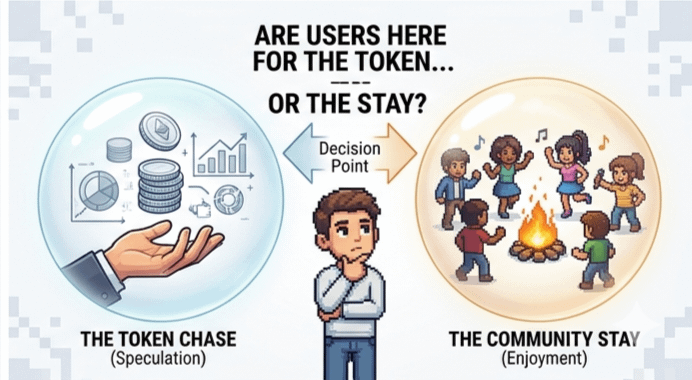
So the real question I’m left with is simple. Are people here because of the token… or because they actually enjoy staying?
