
Pixels is one of those Web3 games that stands out because it doesn’t try to overwhelm users with complexity. The experience is straightforward: you enter the game, start doing farming activities, move around different areas, complete small tasks, and gradually understand how the entire system connects. Nothing feels forced or overly technical, which is rare in the GameFi space.
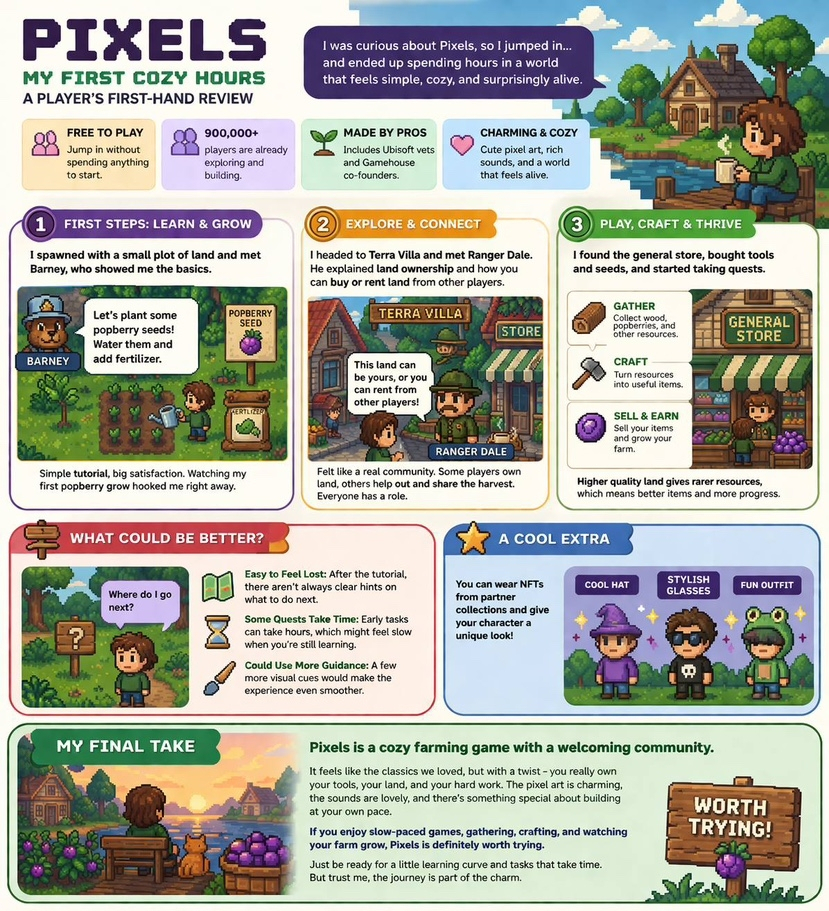
The game runs on the Ronin network, which helps keep performance smooth and accessible for a wide range of players. This matters a lot because many blockchain games struggle with speed, usability, or onboarding. Pixels avoids most of these issues by keeping the design simple and focused on interaction rather than complexity.
Inside the ecosystem, the $PIXEL token has clear in-game use cases. It is used for upgrades, guild participation, NFTs, and other progression systems. Instead of existing only for trading purposes, it is integrated into actual gameplay mechanics. This gives the token a practical role within the environment rather than just being external market value.
The social aspect is another important part of Pixels. Players can interact, cooperate, and participate in shared activities. Over time, this creates a sense of ongoing engagement rather than isolated gameplay sessions. The structure supports long-term participation rather than short-term activity bursts.
The official project account @Pixels also plays a role in maintaining communication with users. Regular updates, ecosystem changes, and community interaction help keep the project active and transparent. In Web3 gaming, consistent communication is often a key factor in whether users continue engaging or move on.
What makes Pixels interesting is not hype or aggressive promotion, but the steady approach to building a functional GameFi environment. It focuses on usability first, then slowly expands features and economy around player activity. This approach may not create sudden excitement, but it supports gradual ecosystem growth.
The farming and progression system is designed in a way that rewards regular participation without making it stressful or overly competitive. Players can progress at their own pace, which helps keep the experience more stable and accessible for casual users.
Overall, Pixels represents a direction in Web3 gaming where simplicity and consistency are prioritized over complexity and hype cycles. The integration of $PIXEL within gameplay, combined with a smooth user experience on Ronin, gives it a practical foundation that continues to develop over time.
