
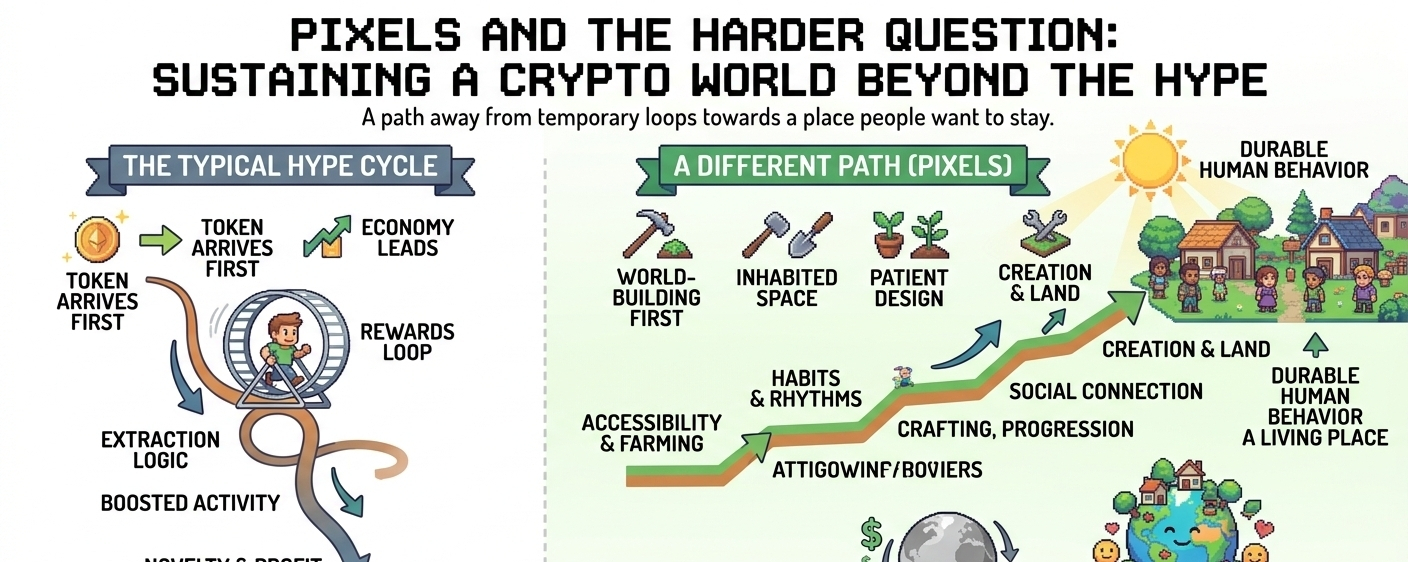

There is a certain kind of tiredness that shows up whenever a new crypto game starts getting attention. Not because games on-chain are a bad idea by default, but because too many of them have treated play like a costume. You enter expecting a world, and what you actually find is a rewards loop wearing borrowed game mechanics. The token arrives first, the economy arrives first, the extraction logic arrives first, and everything else is asked to justify it afterward. That pattern has made people cautious for a reason.
That is why Pixels stands out a little differently.
Not because it feels flawless, and not because farming suddenly becomes some revolutionary idea, but because Pixels gives off the feeling that the world mattered before the monetization logic fully settled around it. When I look at it, I do not get the usual sense that the whole thing was designed backwards from a token chart. I get the sense of a project that understood, at least better than most, that people need somewhere to stay before they need something to farm.
Farming is the obvious surface. It is the soft, inviting layer. It is easy to understand, easy to enter, and probably the least threatening way to bring someone into a Web3 world. But Pixels does not really stop there. The more interesting part is everything growing around that softness: exploration, progression, crafting, land, social movement, routines, small goals, shared spaces, the quiet feeling that a place is being inhabited rather than merely used. That is a very different energy from the usual crypto game cycle where every mechanic seems to exist only to push you toward extraction faster.
And that difference matters because accessibility on its own is not enough. A game can be easy to enter and still be empty. A low-friction experience means very little if there is no reason to build a habit inside it. Pixels seems to understand that the easy entry point has to open into something deeper, otherwise it becomes just another polished funnel. The real challenge is not getting people in. It is giving them enough texture, enough rhythm, enough personal attachment that they keep returning when nobody is waving a promise in front of them.
That is also where the project becomes worth taking seriously, but only carefully.
What makes Pixels feel more alive than most crypto-native games is not just the feature set. It is the behavior it appears to be trying to hold. Social activity matters here. Presence matters. A world starts to feel real when it is not only functional, but inhabited. When people are not simply grinding through it, but leaving traces in it. Visiting, building, arranging, progressing, showing up again. That sense of an inhabited world is difficult to fake, and even harder to sustain. But it is one of the few things that can actually separate a game from a speculative loop.
Its visual identity helps more than people sometimes admit. Pixels does not feel desperate to look important. It is soft, comfortable, readable. There is no exhausting need to scream futurism or financial significance through every screen. That restraint gives it a different emotional tone. It feels approachable without feeling empty, simple without feeling disposable. In a space where so many projects try to look massive before they have earned any real cultural weight, that softness is surprisingly effective.
Still, none of this removes the harder questions.
Crypto games do not usually fail because they lacked features. They fail because they never found durable human behavior underneath the incentives. Novelty can create motion. Rewards can create bursts of participation. Even social energy can be temporarily manufactured when the market is generous. But eventually the market asks more serious questions. What remains when the novelty thins out? What remains when people are no longer here because something is early, profitable, or fashionable? Does the world still have enough pull to keep routines alive?
That is the real test for Pixels.
Can it hold habits, not just attention? Can it create attachment, not just activity? Can land, creation, progression, and social presence become meaningful enough that ownership supports the experience instead of suffocating it? Because ownership only works in a game when it stays inside the world and serves the world. The moment it becomes too visible, too heavy, too central, it starts flattening the very thing it was supposed to strengthen.
Pixels feels different because, unlike many crypto games, it does not immediately feel built to be consumed and drained. It feels more patient than that. More interested in environment, rhythm, and player behavior. That does not mean it is safe from the same traps. It only means it may understand them better.
And for now, that is probably enough to keep watching.
Not with blind optimism. Not with the usual Web3 excitement that confuses motion for permanence. But with the kind of attention you give to a world that might actually survive long enough to become a place, if it can keep people there after the easier reasons for showing up are gone.