

$PIXEL protocol as state machine for composable identity and economic reputation systems
Good Morning Binancians Let me tell you what I noticed something that,,, Most on-chain identity systems feel like they’re trying to freeze people in time. You do a few things, collect some badges, maybe a score, and that becomes “you.” But that’s not how people actually behave. We change, we recover, we mess up, we build again. The weird part is crypto knows this, yet most systems still reduce identity to a static snapshot.
That’s where things quietly start breaking.
Right now, reputation online is fragmented and context blind. Your DeFi activity doesn’t talk to your gaming behavior. Your governance participation doesn’t influence how protocols treat you elsewhere. It’s like having five resumes for five different jobs, none of which acknowledge the others. Imagine a freelancer who delivers high quality work consistently on one platform but looks like a complete beginner everywhere else. That disconnect isn’t just inefficient it’s misleading.
The deeper issue is that most systems treat identity as a storage problem. Store actions, store scores, store credentials. But identity isn’t just data,,it’s state. It evolves based on transitions, not just records. And once you see it that way, the architecture starts to look very different.
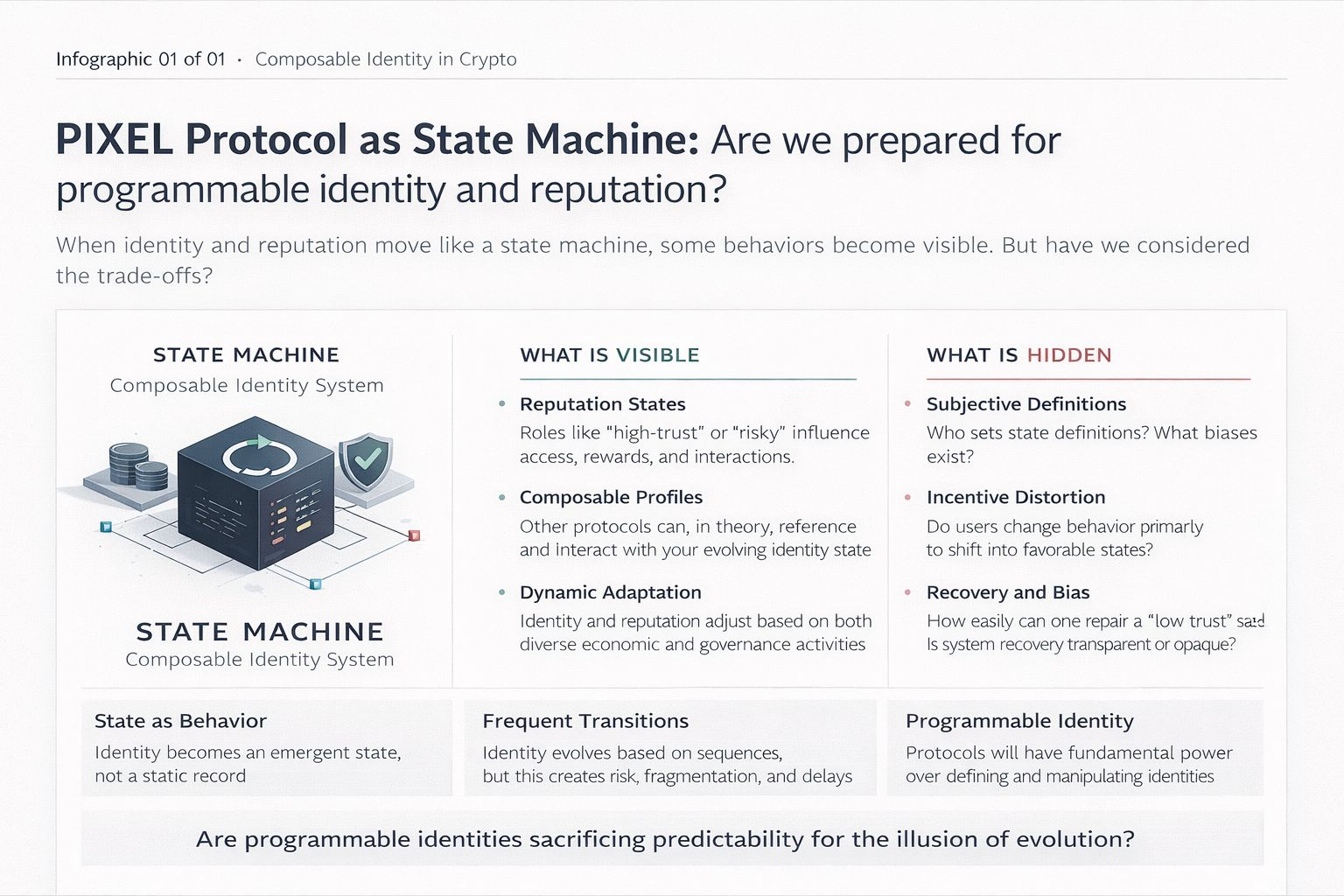
What @Pixels token is doing at least in how I interpret it is shifting identity into something closer to a state machine. Not in a buzzword sense, but literally: your identity isn’t what you’ve done, it’s the current state resulting from what you’ve done and how systems interpret those actions.
That sounds abstract, but here’s where it gets concrete.
Instead of assigning fixed reputation points, $PIXEL like systems can define transitions. For example:
– Completing a high-risk economic action (like providing liquidity during volatility) might transition your identity into a “resilient actor” state
– Repeated short-term exploitative behavior could shift you into a “low-trust” state, even if your raw metrics look strong
It’s not about scoring higher it’s about moving between states based on behavior patterns.
And this becomes composable.
That’s the second mechanism that actually matters. These states aren’t locked into one app. They can be read, interpreted, even challenged by other systems. So a game, a marketplace, and a governance protocol could all reference the same underlying identity state but apply their own logic on top.

It’s kind of like how your credit score works across banks, except here it’s not a single number it’s a dynamic profile that changes based on how systems observe you.
This is where it gets interesting.
Because once identity becomes stateful and composable, reputation stops being something you accumulate and starts becoming something you navigate. You’re not trying to “maximize points” anymore you’re managing how your actions move you across states.
That’s a subtle but important shift.
It reminds me of RPG games where your character alignment changes based on choices not just good vs bad, but nuanced paths that unlock or restrict certain interactions. Except here, the “game” is economic behavior, and the consequences are real.
But this isn’t clean.
State machines introduce complexity that most users won’t see, but will definitely feel. If your identity is constantly transitioning, then predictability drops. One protocol might treat you as high-trust, another might flag you as risky based on the same actions. Composability sounds great until interpretations diverge.
There’s also the question of who defines these transitions.
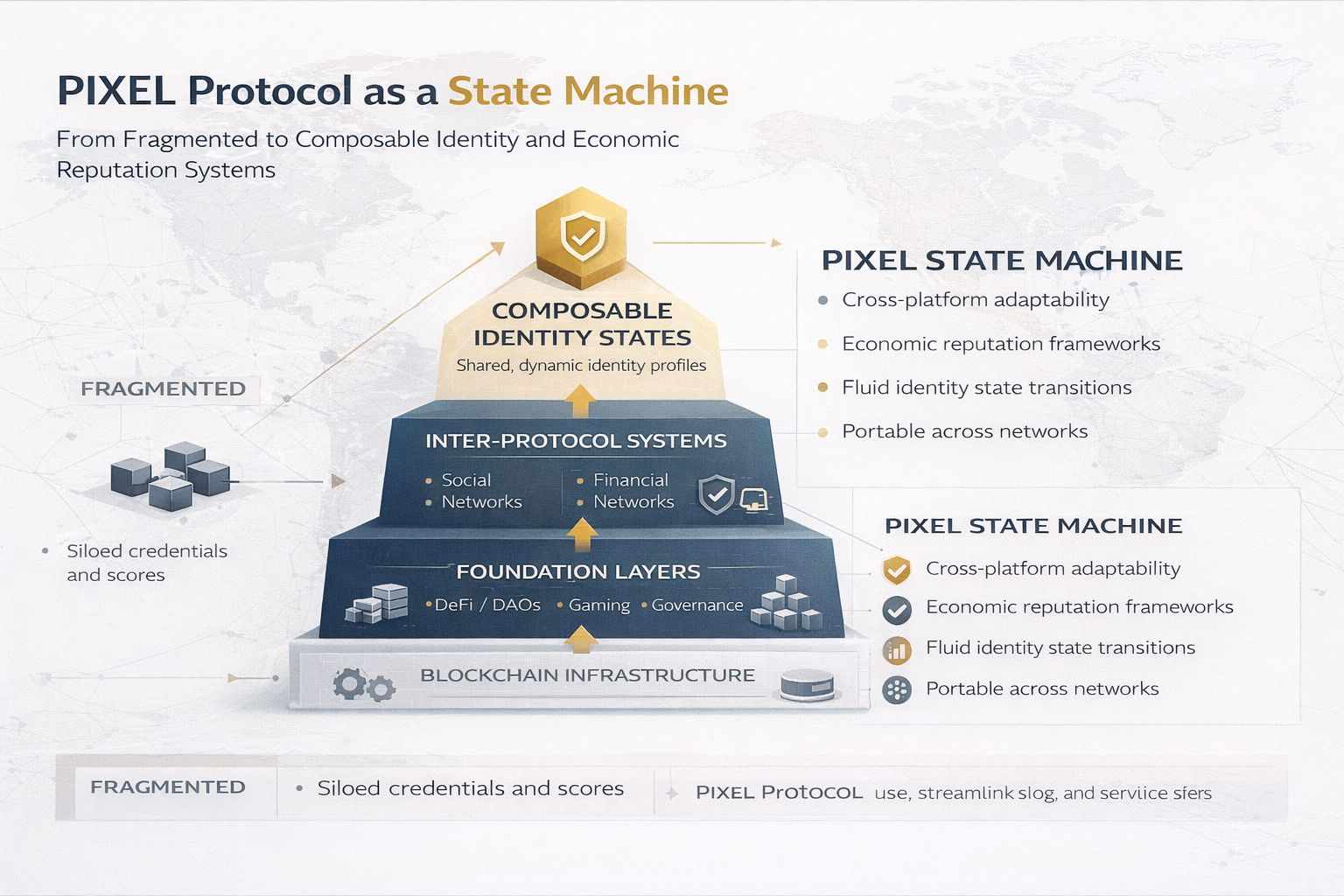
If protocols control state definitions, then identity becomes programmable but also manipulable. A system could quietly bias transitions to favor certain behaviors that benefit its own economy. Users might think they’re building reputation, while actually being nudged into specific economic roles.
And then there’s recovery.
If identity is state-based, how do you move out of a “bad” state? Is it gradual? Is it gated? Or do some states become effectively permanent? Traditional systems already struggle with this blockchain just makes it harder to ignore.
One thing people aren’t talking about enough is how this affects incentives.
If users know their actions shift identity states that are visible across systems, behavior will change. Not necessarily in a good way. Some will optimize for state transitions rather than genuine participation. Others might avoid risk entirely to preserve a favorable identity profile.
So you end up with a strange loop: systems trying to model real behavior, and users adapting behavior to fit the model.
Still, there’s something compelling here.
Treating identity as a state machine acknowledges that reputation isn’t static it’s emergent. It’s shaped by sequences, not snapshots. And in a composable environment, that sequence becomes portable.
The question is whether people are ready to live inside systems that remember not just what they did but how those actions changed who they are.
