while scanning the chain last night
While digging through the Ronin explorer around 2 a.m. during this CreatorPad stretch, something small but telling caught me off guard. I wasn’t hunting for hype or price action—just tracing how $PIXEL actually moves these days in the Pixels ecosystem. The project has been pushing Token Utility 2.0 hard, positioning Pixel as this cross-game rewards engine rather than the single-game currency it started as. Yet there it was, a fresh claimRewards call on the token contract earlier today.
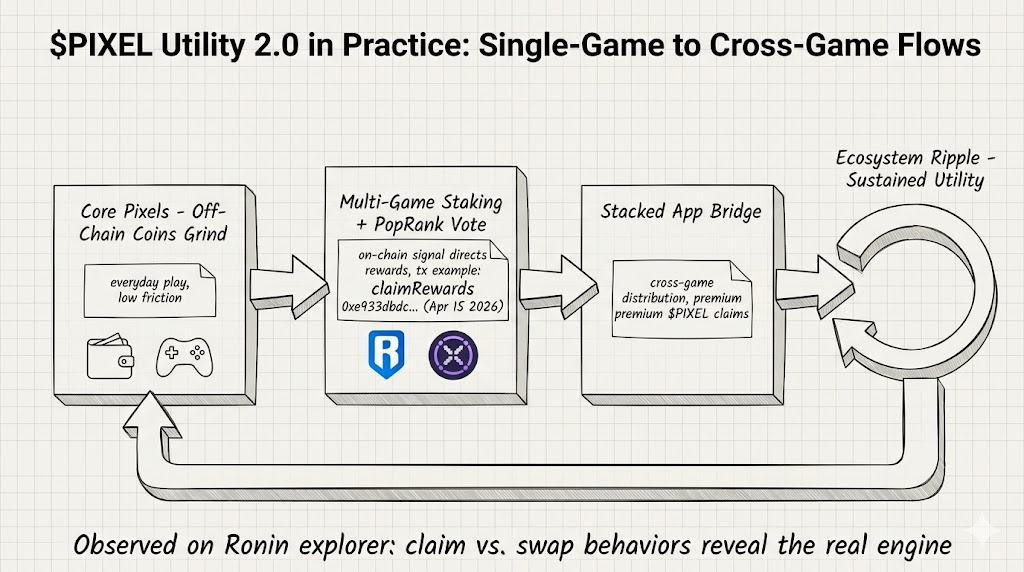
The transaction hit at 10:23:24 on April 15, 2026, pulling just over 2,094 Pixel into a wallet. Nothing flashy. No massive governance wave. Just a quiet on-chain confirmation that someone had staked, played across the ecosystem, and cashed in the premium layer. It lingered with me because it mirrored exactly what I’d been mulling since the challenge kicked off: the utility shift isn’t loud. It’s layered.
I remember my first real dive into Pixels back when Pixel was mostly about minting pets and claiming land plots inside one world. Late nights like this used to feel simpler—pure in-game flows. Now the cross-game angle via staking and the Stacked app adds this quiet complexity. You stake Pixel not just for core Pixels yields but to vote on which partner games get visibility and rewards. It’s one of those mechanics that sounds straightforward until you watch the actual token flows settle.
the contrast that stuck with me
The contrast that stuck with me is how Token Utility 2.0 promises this seamless cross-game engine, yet the on-chain reality still orbits heavily around the original Pixels core. Take the Stacked app rollout earlier this year—it’s designed as the shared rewards layer, letting players earn across titles like Forgotten Runiverse or Pixel Dungeons without juggling separate wallets every time. In theory, $PIXEL comes the connective tissue. In practice, though, most daily activity still funnels through off-chain Coins for the grind, with Pixel reserved for the high-signal moves: staking to influence PopRank, claiming rewards, or swapping on Katana.
I caught another transfer just minutes after that claim, a modest 67 Pixel handoff between two wallets. Small behaviors like these add up. They show players treating Pixel as the strategic reserve, not the everyday fuel. It’s efficient, actually—keeps gas low and focus on play—but it quietly undercuts the “engine” narrative if you’re expecting every interaction to light up the chain.
This isn’t a flaw, exactly. It’s a refinement. The multi-game staking system lets holders direct ecosystem resources toward new projects, creating a feedback loop where successful games pull more Pixel stakes and in turn distribute more rewards. I sketched it out on a notepad at 3 a.m.: three interconnected layers—core gameplay (off-chain heavy), staking governance (on-chain signal), and Stacked distribution (the bridge). The whole thing feels less like a revolution and more like a careful evolution to avoid the inflation traps that killed earlier GameFi cycles.
hmm... this mechanic in practice
Hmm… this mechanic in practice reveals a subtlety I didn’t fully appreciate until the late-session scroll. The CreatorPad running right now—15 million Pixel allocated from April 14 to 28—ties directly into this utility shift. It’s not just creator incentives; it funnels real on-chain value toward builders who integrate with the broader ecosystem. Yet watching the flows, I noticed how many claims still trace back to single-game participation before branching out. The on-chain data doesn’t lie: reward claims spike around key events, but the volume stays measured.
One timely example hit close to home. A few days back, the market saw a brief uptick in Pixel swaps tied to Stacked reward distributions—nothing like the wild 192% pumps from earlier in the year, but steady, purposeful activity. It reminded me of how Axie Infinity once dominated Ronin with pure play-to-earn, only for the ecosystem to mature into something more sustainable. Pixels seems to be following a similar path, just smarter about layering off-chain accessibility on top of on-chain ownership.
Another example: the ongoing token unlocks scheduled for April 19 aren’t causing panic dumps because the utility 2.0 framing gives holders a reason to keep skin in the game. Stake it, direct it, claim it across games. Still, I caught myself reevaluating my own assumptions here. I’d gone in expecting the cross-game engine to feel more decentralized by now, with visible governance votes lighting up the explorer daily. Instead, the real power sits in these smaller, consistent claimRewards calls and stake-to-vote mechanics. It works. But it’s subtler than the docs suggest.
Actually—there’s an honest skepticism creeping in. Is this truly scaling into a platform-level rewards engine, or is it still Pixels carrying the weight while Stacked handles the polish? The on-chain behaviors I tracked last night suggest the latter for now, with Pixel acting as the premium glue rather than the full engine block.
still pondering the ripple
Still pondering the ripple, I keep coming back to how these small on-chain moments compound into ecosystem effects. The personal story that keeps resurfacing is from my early days monitoring Ronin during the initial launchpool era—watching wallets flood in for quick flips, then trickle out when utility felt thin. Tonight’s dive felt different. There was depth in the restraint: players staking thoughtfully, claiming precisely, using Pixel to bridge games without forcing every mechanic on-chain.
The hidden feedback loop here is elegant in its quiet way. Successful cross-game participation boosts a player’s PopRank, which funnels more rewards back through Stacked, encouraging further staking. It’s not flashy, but it creates stickiness that single-game currencies rarely managed. Two market examples stand out as proof points—the measured activity around the current CreatorPad and the way Stacked has absorbed reward logic without bloating the chain.
Yet I sit here at the end of the session with more questions than closure. The shift feels genuine, the mechanics thoughtful, but the long-term ecosystem effects will hinge on how many partner games actually plug in and sustain that staking momentum. Forward-looking, it makes me reflect on whether this model could quietly redefine how Web3 games retain players—not through endless token emissions, but through targeted, cross-title utility that rewards consistency over hype.
I’m left wondering, though: if the real test of Token Utility 2.0 is whether $PIXEL pull new players into the broader ecosystem without them ever noticing the on-chain plumbing, how long until that bridge feels invisible to everyone except the ones watching the explorer at 2 a.m.?