

I’ve spent enough time around Web3 games to notice a pattern that keeps repeating. A new project launches, rewards look attractive, users rush in, tokens get farmed, and slowly the system starts breaking under its own weight. It’s not because people lose interest. It’s because the economics were never designed to last.
That’s the context you need before looking at @Pixels.
At first glance, Pixels doesn’t look very different. It’s a farming-style game where you plant, harvest, explore, and interact with other players. But once you spend some real time inside it, you start noticing something subtle. The game isn’t aggressively pushing you toward extraction.
You’re not constantly thinking about how to farm and dump rewards. You’re just playing.
That shift in behavior is not accidental. It’s designed.
Most Web3 games start with the token and try to build gameplay around it. Pixels flipped that approach. It built a game first and then layered the economy on top in a way that doesn’t interrupt the experience. That alone already changes how long players stay and how they interact with the system.
But the real difference shows up when you look at what’s happening behind the scenes.
This is where the Stacked ecosystem comes in.
Stacked is essentially the reward engine that powers Pixels, but calling it just a “feature” would be underselling it. It’s more like an economic control layer that continuously adjusts how incentives are distributed based on real player behavior.
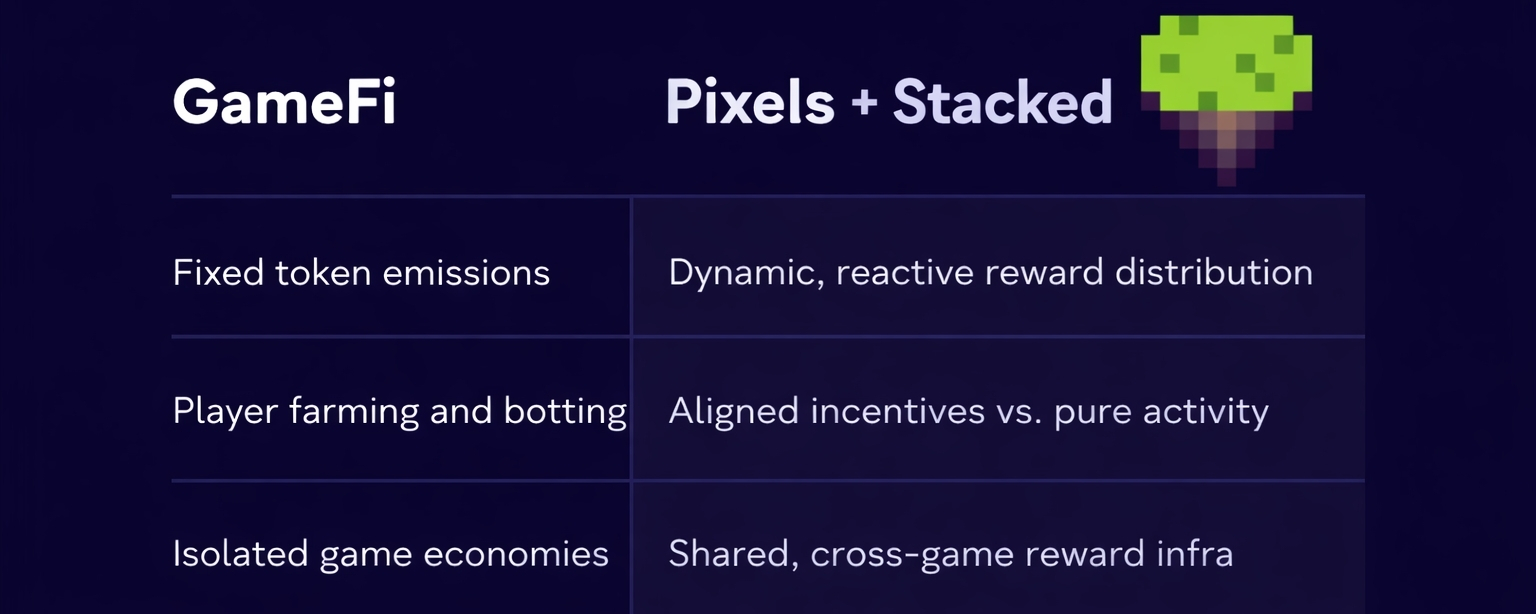
Traditional GameFi systems usually work on fixed emissions. Everyone who participates gets rewarded in a similar way, regardless of how they play. That sounds fair on paper, but in reality it leads to farming, bot activity, and eventually inflation.
Stacked takes a completely different route.
Instead of distributing rewards blindly, it analyzes how players behave inside the game. Who is contributing value, who is just looping actions, who is progressing, and who is actually engaging with the ecosystem. Based on that, rewards are adjusted dynamically.
So the system is not static. It reacts.
That might sound like a small detail, but it changes the entire structure of the economy. When rewards are tied to meaningful participation instead of pure activity, you reduce waste and increase retention at the same time.
This is also where Pixels starts moving beyond being just one game.
With Stacked, the vision is clearly shifting toward a multi-game ecosystem. Instead of each game building its own isolated economy, different experiences can plug into the same reward infrastructure.
That means player value doesn’t reset every time you switch games. Progress, engagement, and rewards can carry across different environments. It’s closer to how real digital ecosystems work, where identity and value persist instead of restarting from zero.
And this is exactly where most Web3 games fail. They treat each game as a closed loop, which makes long-term retention difficult.
Pixels is trying to solve that by turning the economy itself into a shared layer.
There are also some real performance signals behind this model. The ecosystem has already processed hundreds of millions of in-game reward events and generated tens of millions of dollars in revenue. That matters because it shows the system isn’t theoretical. It’s already being stress-tested in a live environment.
That gives more weight to the idea that this approach can actually scale.
Now if you look at $PIXEL in this context, its role starts to change.
It’s no longer just an in-game currency tied to one experience. It’s becoming a coordination layer across the ecosystem. As more systems plug into Stacked, the token starts connecting different games, reward flows, and user participation models.
That naturally expands its utility.
Instead of relying purely on speculation, demand can come from actual usage across multiple environments. And that’s a much stronger foundation for any token.
Another thing worth paying attention to is how the system affects player psychology.
When rewards are not immediate or easily exploitable, players stop trying to game the system. They start focusing more on progression, strategy, and long-term engagement. That creates a healthier environment where the economy is supported by behavior rather than drained by it.
You can feel that difference while playing.
You’re not rushing to extract value. You’re building toward something.
And over time, that kind of engagement compounds.
From a broader perspective, Pixels is slowly positioning itself less as a single game and more as infrastructure for Web3 gaming. A system where developers can plug in, where economies are actively managed, and where incentives are aligned with real participation.
Of course, execution still matters. Scaling a system like this across multiple games is not easy. Balancing rewards, maintaining fairness, and avoiding centralization in decision-making will be ongoing challenges.
But the direction is clear.
Web3 gaming doesn’t need more hype cycles. It needs systems that can survive beyond them.
$PIXEL is one of the few projects actually working on that problem at the root level. Not by increasing rewards, but by redesigning how rewards function in the first place.
That’s why Stacked matters.
And that’s why the Pixel ecosystem feels like it’s moving toward something more durable than the usual play-to-earn cycle.