To be honest, Built on Ronin. Open world. Farming, exploration, creation. All of that is true. But those descriptions still leave out the part that actually matters when you spend time with it.
What really stands out is how carefully the game avoids feeling like a constant argument.
That might sound strange, but web3 games often carry an argument inside them. An argument about value. About time. About ownership. About whether players are there to play, earn, build, trade, speculate, or just pass through. You can usually feel that tension almost immediately. Even when no one says it out loud, it’s there in the design. Every action seems to ask: is this game trying to be a world, or is it trying to be a system?
Pixels feels different because it does not rush to answer that.
Instead, it lets you do small things first.
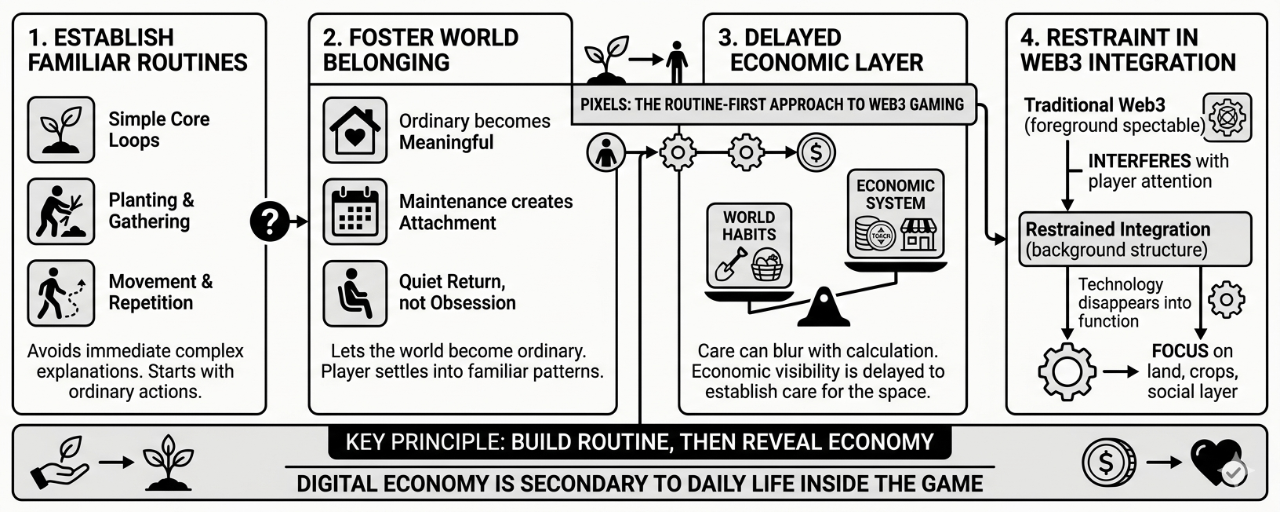
You plant crops. You gather materials. You move from one area to another. You complete little tasks. You notice what other players are doing. Nothing in that opening rhythm feels especially loud. That’s important. The game does not begin by demanding that you think in big abstract terms. It begins with chores, movement, repetition, and light curiosity.
And honestly, that may be the smartest thing about it.
Because most players do not enter a game wanting to think about infrastructure. They want to feel where the world’s weight is. They want to know what kind of attention the game asks for. They want to know whether checking in feels pleasant or draining. Pixels seems to understand that the answer to those questions matters more, at first, than any larger promise sitting behind the game.
That’s where the tone of Pixels starts to matter.
It does not feel built around pressure in the usual sense. It feels built around maintenance. That may sound less exciting, but maintenance is not a small thing. In online worlds, maintenance is often what creates attachment. Not spectacular moments. Not one-time rewards. Just the quiet fact that something needs your attention again tomorrow. A crop has grown. A task can be finished. A route makes sense now because you walked it yesterday too.
After a while, that repetition stops feeling empty. It starts feeling like familiarity.
And familiarity is powerful in games like this. Maybe more powerful than novelty. A player does not always stay because something is surprising. Sometimes they stay because something is settling into place. Pixels seems to lean into that. It lets the world become ordinary before it tries to become meaningful. That’s where things get interesting, because the question changes from “what is special about this game?” to “why does this routine keep pulling people back?”
That second question is usually the better one.
A lot of social games survive on that kind of pull. Not obsession exactly. Just return. And return has its own emotional texture. It is softer than excitement. Less dramatic. More durable, maybe. You come back because your space is still there. Your progress is still there. Other people are still moving through the same world. The game has not frozen in your absence. It has simply waited.
That waiting matters more than it seems.
Pixels is built around farming, and farming games have always understood something very old about attention: people are willing to repeat simple actions if those actions suggest continuity. Planting and harvesting are basic mechanics, but they carry a quiet promise. Time passed. Your action mattered. Something changed while you were gone. That loop is simple, but it rarely stays simple in the player’s mind. It turns into a pattern of care.
And care is where web3 usually gets complicated.
Because once ownership enters the picture, care can start to blur with calculation. The thing you like is also the thing you can trade. The world you spend time in is also a system of assets and tokens. That can make a game feel thinner if it is handled badly. It can make every object feel like a price tag. Every action feel like a transaction. Every player feel like they are measuring the room.
Pixels does not erase that risk. It just seems to delay it.
Or maybe redirect it.
The game’s structure allows the player to first understand the world as a place of habits. Only later does the economic layer become more visible. That order matters. It makes the world feel less like an interface for value extraction and more like a setting where value happens to exist. That difference is subtle, but it changes the mood of everything.
You can usually tell when a game wants you to think about scarcity before belonging. Pixels seems to prefer belonging first.
Not in some sentimental way. Just in a practical design sense. A player who has already built a routine is easier to keep than a player who was only curious about the economy for a week. A player who recognizes spaces, timing, and social patterns is already attached to something beyond reward. The attachment may be light, but it is real. And once that happens, the economy feels less like the whole structure and more like one layer resting on top of a lived-in world.
That may be why Pixels feels more legible than many games in the same space.
It is not trying to invent a new human instinct. It is using old ones. Care for a space. Return to a routine. Interest in gradual progress. Light social awareness. Quiet competition. A sense that your time leaves some trace behind. None of these are new ideas. But maybe that is exactly why they work. The game does not depend on the player becoming someone entirely different. It just gives familiar instincts a new frame.
That frame being web3 changes things, of course, but maybe not in the most obvious way.
People sometimes talk about blockchain games as if the technology should immediately transform the entire feeling of play. But with Pixels, the more noticeable effect is actually restraint. The technology matters most when it stops interrupting the player’s attention. When it becomes background instead of foreground. When the player can focus on land, crops, materials, movement, and people rather than on the machinery underneath.
That sounds almost backwards. A technology becomes useful by becoming less visible.
Still, that seems to be part of the point.
Pixels feels strongest when it treats the chain as structure, not spectacle. As support, not personality. The world itself carries the emotional load. The farming loop carries the pacing. The social layer carries the sense of life. The economy stays present, but it does not always have to announce itself. And that balance, even if imperfect, makes the game easier to stay with.
Because staying with a game is different from merely trying it.
That difference gets overlooked all the time. Many projects can attract attention once. Fewer can become part of someone’s ordinary day. Pixels seems more interested in the second thing. Not in overwhelming the player, but in becoming familiar enough that leaving feels slightly more noticeable than before.
And maybe that is the real angle here.
Not that Pixels is a farming game with web3 features. Not that it is a blockchain world with a social economy. Those descriptions are fine, but they still sound too fixed. It feels more accurate to say Pixels is an experiment in making a digital economy feel secondary to daily life inside a game.
Whether that balance fully holds is probably something players keep testing as they go. But the design choice is still easy to notice. The game starts with routine, not theory. With attention, not abstraction. With ordinary acts repeated long enough that they begin to carry meaning.
And from there, everything else sort of grows around it, slowly, the way these things usually do.
@Pixels #pixel $PIXEL

Artykuł
Pixels is often described in a very functional way. A social casual web3 game.
Zastrzeżenie: zawiera opinie stron trzecich. To nie jest porada finansowa. Może zawierać treści sponsorowane. Zobacz Regulamin