
Crypto has a habit of running the same play over and over.
A new cycle starts, everyone finds a fresh buzzword, and suddenly the whole market is pretending it discovered religion again. First it was DeFi, then NFTs, now AI is being taped onto anything that can still raise money.
After a while, it all blends together.
That’s probably why Pixels stood out to me a bit. Not because it looks like some massive breakthrough, and not because I think Web3 gaming has suddenly figured itself out. Mostly because it seems to be trying something simpler, and honestly, more realistic.
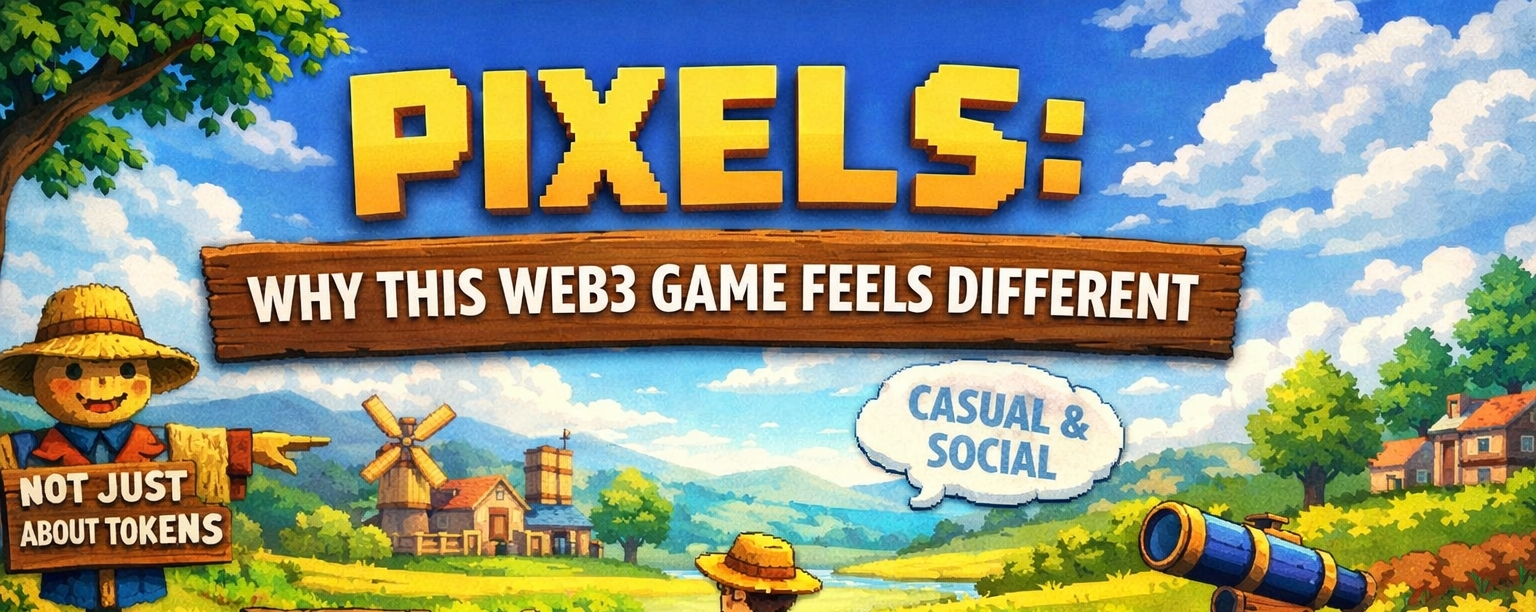
At its core, Pixels is just a social farming game.
You grow things, gather materials, explore, build, and spend time in a world that feels light and accessible. That doesn’t sound radical, and maybe that’s the point. In crypto, too many projects try to sound important before they’ve built something people actually enjoy using.
Pixels feels a little different because it starts with a familiar behavior instead of a grand promise.
That matters.
One of the biggest problems with Web3 gaming has always been friction. Not just technical friction, although there’s plenty of that too. Wallets, bridging, transaction costs, security concerns — all of that already creates enough distance between curiosity and actual participation.
But there’s also a more basic kind of friction: most of these games just don’t feel fun enough to justify the effort.
That’s been the real issue for years.
A lot of so-called Web3 games were really just token systems wearing a game costume. The economy came first, the gameplay came second, and users could feel that almost immediately. People stayed as long as the incentives made sense, then left when they didn’t.
We’ve seen that story already.
Pixels seems to be pushing against that pattern, at least a little. It leans into simple game loops that people already understand — farming, crafting, progression, social interaction. Nothing about that is new, but not everything needs to be new.
Sometimes it’s enough to remove the awkwardness.
And I think that’s the more interesting thing here. Pixels isn’t really trying to solve some abstract blockchain problem. It’s trying to answer a more practical question: can crypto disappear enough into the background that normal people stop feeling like they’re “using crypto” at all?
That’s a much better question than most projects ask.
Because the truth is, most people do not care about infrastructure. They do not care about decentralization as a daily user experience. They care about whether something is easy, enjoyable, and worth coming back to.
That’s where Web3 has usually failed.
Being on Ronin helps, at least in theory. Ronin is one of the few networks that actually has some real history with gaming users. It’s not entering this conversation from zero. There’s already an audience there, already some understanding of how game-based economies work on-chain.
But that history cuts both ways.
Ronin also carries the memory of Axie Infinity, and Axie was probably the clearest example of what happens when financial motivation overwhelms the game itself. For a while, it looked unstoppable. Then the economic pressure showed up, the illusion broke, and it became obvious that a lot of users were there for the payout more than the product.
That’s the shadow hanging over almost every Web3 game now.
So when I look at Pixels, I don’t really ask whether it has a token or a community or a roadmap. Every project has those. The real question is whether the game still works when the market gets quiet.
Does it still feel worth opening when prices are down?
Does it still hold attention when nobody is posting screenshots of gains?
That’s where the test is.
To be fair, Pixels seems more aware of this than many of the projects that came before it. The pace feels slower. The design feels more routine-based than extraction-based. It looks like it wants players to build habits, not just chase upside.
That’s healthier, if it holds.
But that “if” matters.
There’s also the challenge of audience. Crypto users often want incentives. Traditional gamers often get turned off the second they hear the word token. Trying to sit in the middle of those two groups is tricky. Lean too far one way, and it becomes another financialized game loop. Lean too far the other way, and people start asking what the blockchain part is even doing there.
Pixels hasn’t fully escaped that tension.
Maybe no Web3 game can.
Still, I can at least say this: it feels less desperate than most. Less like it’s trying to sell me a future, and more like it’s trying to make something people might casually return to. In crypto, that alone is unusual.
Will it work? Maybe. Maybe not.
Web3 gaming still has more failed narratives than lasting products, and it’s smart to keep that in mind. But Pixels is at least pointed at a real problem — the gap between crypto’s ideas and normal user behavior.
That doesn’t guarantee anything.
But it does make it worth watching, even if cautiously.
