
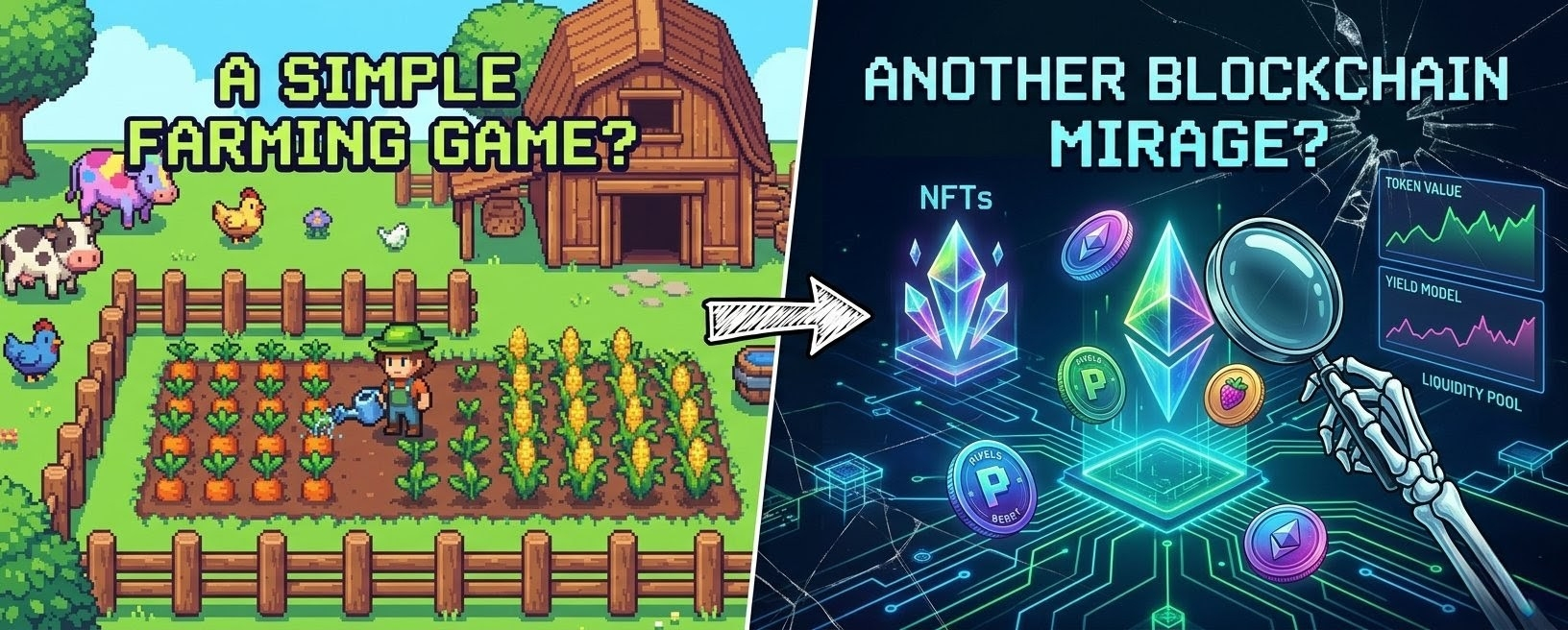

It’s late, and I've been down the rabbit hole again. Another whitepaper, another game claiming it’ll "revolutionize" the industry. I’d be lying if I said I wasn’t curious, but at this point, I’m skeptical. The promises? Familiar. The mechanics? Predictable. But, after all the talk of DeFi, GameFi, AI-powered ecosystems, and modular chains—maybe this one actually has something worth looking at? Or maybe it’s just another iteration of a tired narrative.
The game? Pixels. A farming game, of all things. Yeah, I know. A farming game. But stick with me here. This one’s wrapped in Web3, like the dozens of others, but it feels... different. At least under the surface.
The Crypto Tangle
Let’s be real. The second you slap a blockchain on something, it’s no longer just a game. It’s an investment, a token, a yield model, a liquidity pool, a smart contract—it’s never just about "playing" anymore. And I hate to say it, but I can already feel that Pixels will be no different.
The crypto crowd is loud. And when it’s loud, it’s hard to hear the game beneath the noise. All the discussions about tokenomics, rewards, supply-demand mechanics—it’s like everyone forgot about the actual experience. But that’s the thing. If you strip the crypto from Pixels, at its core, it’s just a farming game. You plant, you grow, you craft, you collect. That’s it. Basic loop stuff. The kind of thing that’s been working for decades in casual games.
But here’s the catch: it works.
And that’s why this is even a conversation. Because for all the noise about Web3, it’s still... kind of fun. A lot more fun than I expected.
Is the Loop Actually Solid?
The core loop, the thing I always look at first, is simple: you check in, plant crops, gather resources, craft stuff, repeat. It’s relaxing, rhythmic. You could do it on autopilot after a while. And it’s actually kinda... soothing? It reminds me of old-school farming games, like Farmville or Stardew Valley, but with blockchain. And I’ll admit, it feels like the game gets a little more real because of the Web3 layer—there’s something about ownership that makes even simple tasks feel different. You’re not just grinding for digital things; you own them. You can trade them. You can craft something that has a token value behind it.
Still, I keep thinking, How much of this is just a thinly veiled economy?
The crypto layer doesn’t always ruin things, but it always makes me question whether the game is actually good or if it’s just an excuse for an economy to exist. And that’s where the fatigue kicks in. I’ve seen this pattern too many times: "play-to-earn" loops, "tokenized rewards," "play-to-own" nonsense that barely scratches the surface of real gameplay. So, yeah, there’s a game under here. But does that really matter in the age of endless hype cycles?
The Social Element
Okay, so the farming loop is solid. But what about the community? Pixels has a low-pressure social layer. You’re not getting forced into complex guilds or co-op missions. You’re just there, farming, existing in a shared world. There’s no constant pressure to perform or optimize with others. And that’s refreshing, honestly.
It’s subtle, but it works. You see players pass by, working on their own stuff, trading occasionally. The world doesn’t feel dead. It feels lived-in. It’s a small thing, but in the chaos of a thousand multiplayer games demanding your attention, it stands out. Still, I can’t help but wonder if this will remain sustainable. Because when I look at Pixels, I don’t see a game that’s about social interaction at its core. I see a game where players are tolerating the social element. Just enough interaction to feel like the world isn’t a ghost town, but not enough to make it feel important.
The Crypto Trap
And here it is, the thing that always ruins it—crypto. The minute you start talking about NFTs, tokens, and rewards, you lose me. The game’s mechanics? Decent. The world? Nice enough. But once the economy steps in, the game shifts. It’s no longer just a place where you farm, craft, and relax. It’s a place where people optimize. Where every crop planted is calculated for its yield. Where every trade is made with one eye on the market. The community stops being a community and becomes a bunch of people trying to extract value. And that’s exactly what happens to all of these games. Even the ones that start with good intentions.
The game can be fun, sure. But the second the tokenomics take center stage, it’s not about building a farm anymore. It’s about yield management. And that’s the problem with the whole Web3 space: fun takes a backseat to value extraction. Once a game becomes a "play-to-earn" machine, it’s hard to shake the feeling that you’re not playing a game—you’re just participating in a financial system with a pixelated facade.
Ronin and the Path of Least Resistance
Pixels is on Ronin, which is probably the smartest move here. At least Ronin’s blockchain doesn’t come with the usual friction. The game’s mechanics don’t get bogged down with convoluted setup or gas fees. That’s a relief. But—come on—it’s still blockchain. Even if it’s easy to use, it’s still... crypto. And even with Ronin smoothing out the technical details, I can’t shake the feeling that Pixels will inevitably run into the same problem every other Web3 game faces: the community will lose sight of the game and focus entirely on how to game the system.
Fragility of the Routine
Here’s what worries me: Pixels is designed around a routine. You’re supposed to drop in daily, complete small tasks, and feel a sense of progress. That works until it doesn’t. Games like this are fragile. They rely on that daily rhythm, but when the updates slow down, when the rewards stop feeling rewarding, when the mechanics become stale—it all crumbles. I’ve seen this happen before. A cozy game slowly fades into maintenance mode, and that’s where Pixels could easily end up. It’s too dependent on routine, on the same tasks, on the same loop. What happens when that loop becomes predictable? What happens when people stop logging in, because there’s no more excitement left?
So, What’s the Verdict?
Look, I’m not going to pretend Pixels is the next big thing in gaming. I’m not convinced it’ll change anything. But here’s the thing: Pixels is solid. In a sea of gimmicks and half-baked projects, it does what it says on the tin—it’s a farming game with a Web3 layer. It’s a relaxing experience that doesn’t try to be revolutionary. And in the end, maybe that’s enough. For now.
But let’s not kid ourselves. The crypto elements are always lurking, and I can already see where this could go off the rails. So I’ll stay cautious. I’ll keep watching. But in this market full of hype cycles, at least Pixels isn’t pretending to be something it’s not. And that’s more than I can say for most Web3 projects