
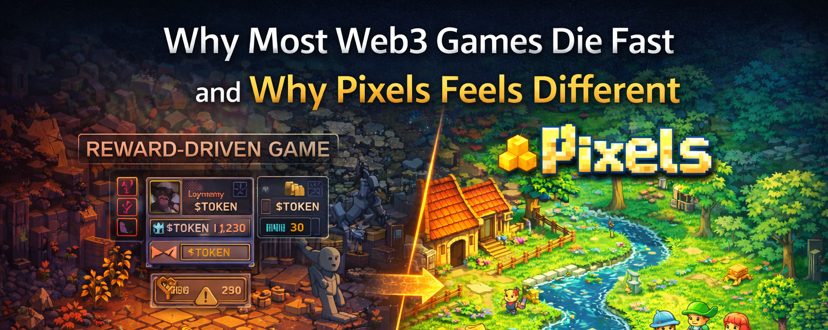
If you look at the history of Web3 gaming, a pattern becomes obvious very quickly.
Most projects don’t fail because of bad graphics or weak funding.
They fail because they misunderstand what makes a game work.
They start from the wrong placed
Instead of building something people enjoy, they build systems around rewards. Tokens come first, mechanics come second, and gameplay becomes just a way to distribute value.
At the beginning, this works.
Users join, attracted by incentives. Activity spikes, metrics look strong, and everything feels like it’s growing. But over time, something breaks.
People stop caring Because once rewards slow down or become less attractive, there’s nothing left to keep them engaged. The core experience was never strong enough to stand on its own.
This is where Pixels takes a noticeably different approach.
It doesn’t try to reinvent gaming with complex systems or aggressive token mechanics. Instead, it focuses on something much simpler, but much harder to get right.
A game that people actually enjoy playing.
The loop is straightforward. Farming, exploring, gathering, interacting. Nothing feels forced. You don’t need to overthink your moves or optimize every step. You just log in and play.
That simplicity is not a weakness.
It’s what makes the experience sustainable.
Another factor that sets Pixels apart is its social layer.
The game world isn’t empty. It feels alive. Players interact, move around the same environment, and create a shared experience. That sense of presence changes how people engage.
You’re not just farming tokens.
You’re part of a world.
And that matters more than most token models.
There’s also a technical side that often gets overlooked.
Running on Ronin Network reduces friction significantly. Transactions are smoother, costs are lower, and the experience feels closer to traditional gaming environments.
This might not sound like a big deal, but in gaming, small frictions compound quickly. If the experience isn’t smooth, players leave.
Pixels avoids that problem.
But the most interesting part is not any single feature.
It’s the order of priorities.
Gameplay first.
Experience second.
Web3 third.
Not the other way around.
That shift changes everything.
It creates a system where players stay because they want to, not because they’re forced to chase rewards. And once that foundation is strong, everything built on top of it becomes more stable.
From a bigger picture, Pixels reflects something the market is slowly realizing.
Web3 gaming doesn’t need more complexity.
It needs better fundamentals And sometimes, the projects that look simple on the surface
are the ones solving the real problem underneath.
