
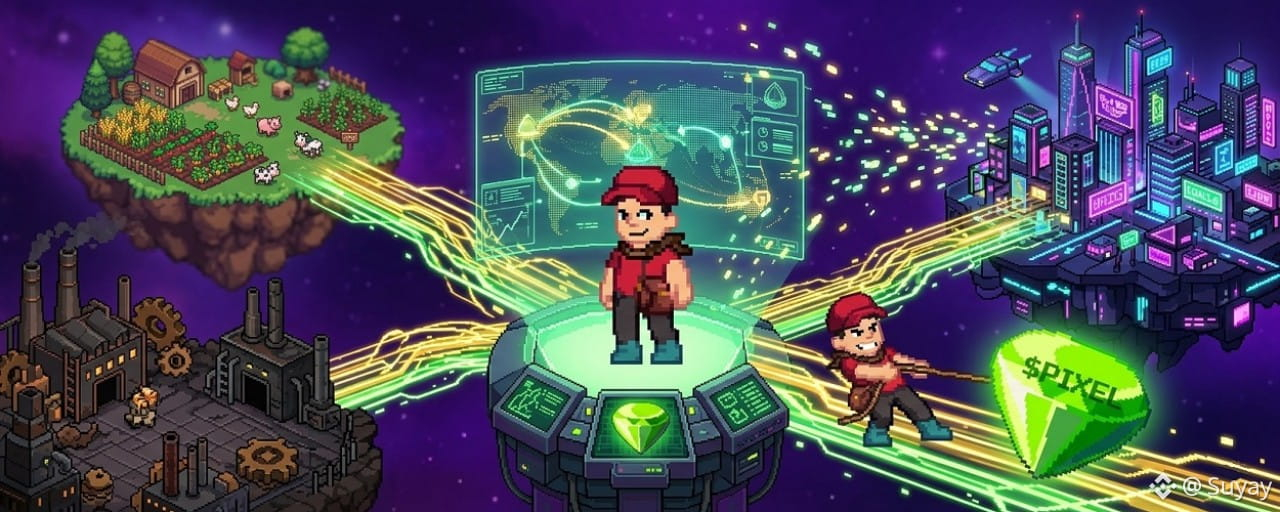

For most of its life, PIXEL had a clear role.
You played the game, you earned the token, and whatever value existed was tied to what happened inside that loop.
One game.
One economy.
One direction of flow.
That simplicity is gone.
What’s emerging now inside Pixels is not just expansion into more content or more players. With over a million daily active users and an ecosystem already generating tens of millions in revenue, scale is no longer the question.
The structure is.
Because PIXEL is no longer confined to a single environment.
Through Stacked, it’s starting to behave like a shared reward layer across multiple games that don’t necessarily compete for the same mechanics…
but absolutely compete for the same thing:
your time.
And that changes how the token functions.
In a single-game system, value is mostly linear.
You participate, you earn, you decide when to exit.
But in a multi-game structure, participation becomes fragmented.
Now there are multiple places where your time can be deployed.
Multiple loops competing for engagement.
Multiple environments influencing how rewards are distributed.
And suddenly, the token is no longer just something you earn.
It becomes something that allocates your attention.
This is where the system starts behaving differently.
Because not all games inside an ecosystem perform equally.
Some retain better.
Some generate more revenue.
Some create deeper engagement cycles.
And if rewards are being influenced by performance…
then your tokens are no longer neutral.
They are implicitly positioned.
Not in a market sense.
Inside the system itself.
Delegating $PIXEL toward one game over another is no longer just a gameplay choice.
It’s an allocation decision.
Where you place your tokens starts to determine where value flows back to you.
Which means something subtle, but important, begins to happen.
The ecosystem stops being a collection of games.
And starts acting like a network of competing economies sharing the same currency.
That competition doesn’t destroy value.
It reshapes it.
Because now, instead of inflation coming from blind distribution…
value is pressured to concentrate where engagement is strongest.
Where players stay longer.
Where loops are harder to abandon.
Where systems prove they can hold attention under real conditions.
From the outside, this still looks like a game expanding.
New regions.
New mechanics.
New forms of progression.
But underneath, the logic has shifted.
The question is no longer “how do players earn?”
It’s “where does their time produce the most value?”
And more importantly:
“which part of the ecosystem deserves their tokens?”
Coming back into Pixels after some time, that’s the part that feels different.
Not the content.
Not the mechanics.
The tension.
Because now, staying in one loop means not staying in another.
And that tradeoff didn’t exist until now.
If this continues to evolve, $PIXEL stops behaving like a reward.
And starts behaving like something closer to internal capital.
Moving across environments.
Reacting to performance.
Gravitating toward retention.
And if that’s the case…
then the real competition inside Pixels isn’t between players anymore.
It’s between the games themselves.
All trying to capture the same token.
And the same time.