
At first glance, Pixels feels intentionally soft around the edges. An open-world farming game, light social loops, nothing too demanding. Built on Ronin, sure—but it doesn’t immediately confront you with that fact. And maybe that’s the point. Still, the thing is, whenever something feels this smooth in Web3, I start wondering what exactly has been smoothed out… and what hasn’t.
Because these systems rarely break where you expect them to. It’s usually not during the gameplay itself. It’s earlier—somewhere in the setup, the assumptions, the invisible steps you’ve already agreed to without fully noticing.
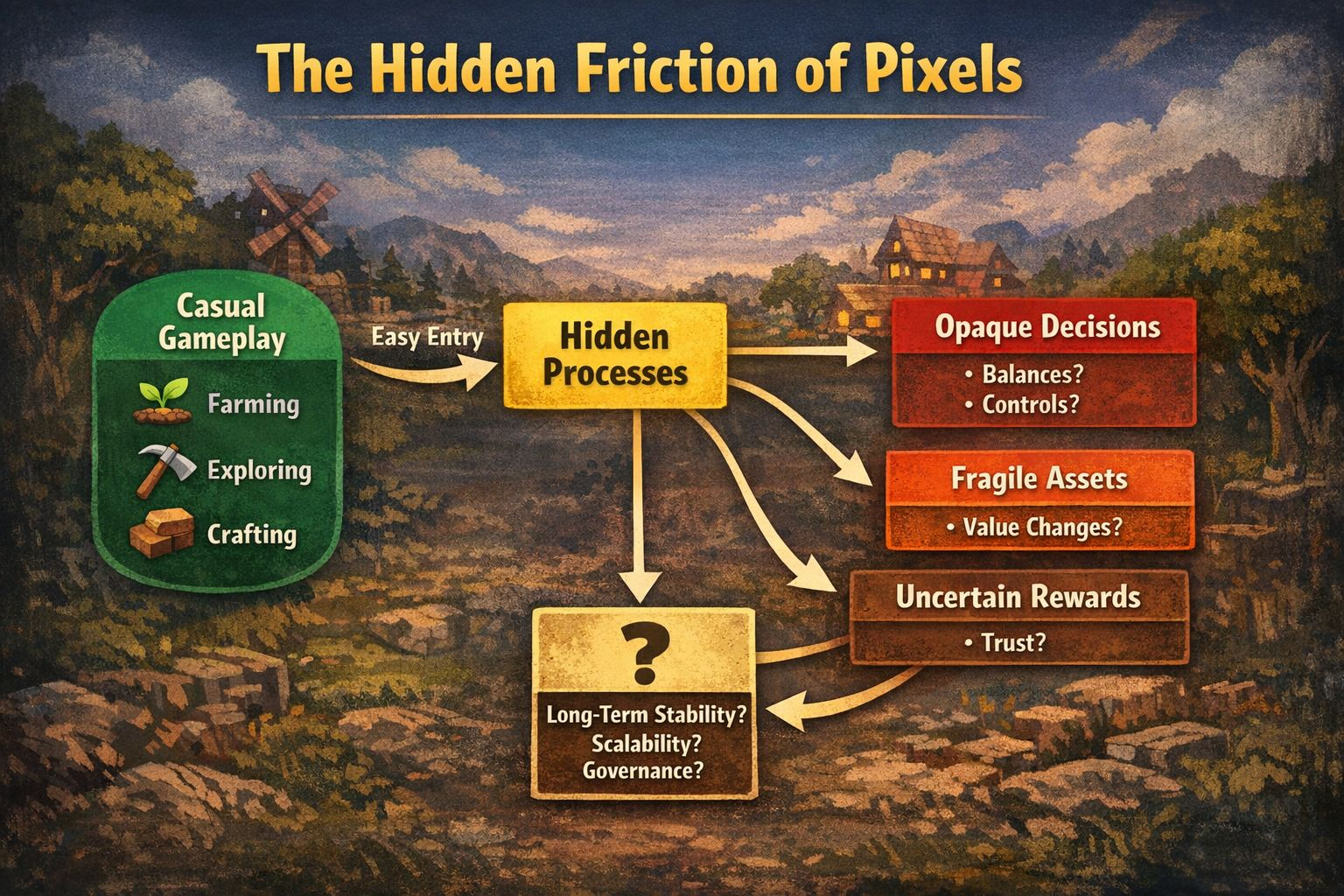
Pixels seems to be responding to a real issue: onboarding friction. Wallets, bridging, tokens, all the small decisions that pile up before you even begin. Here, those layers are tucked away behind familiar mechanics—farming, crafting, exploring. It works, to an extent. You don’t feel the weight of the system as much. But that doesn’t necessarily mean the weight is gone. It’s just… displaced. Hidden in places you don’t directly interact with, but still rely on.
And that’s where things start to feel a bit uncertain. You’re playing inside a system that feels open, but you don’t quite see how decisions are made. Balance changes, asset values, reward structures—these don’t emerge naturally. Someone is adjusting them, somewhere. Quietly. The interface doesn’t show that, and maybe it’s not supposed to. But it’s still there.
Ownership is another one of those ideas that sounds solid until you look at it for too long. Yes, you own your assets. Technically. But what that ownership means depends entirely on the game’s internal logic. If that logic shifts—and it will—then the meaning of what you own shifts with it. The asset stays in your wallet, but its relevance, its function… those aren’t guaranteed. It starts to feel like ownership without stability.
And then there’s recognition. What does it actually mean to achieve something in Pixels? Is that achievement legible outside the game? Could it hold meaning somewhere else, or even later on? I’m not sure. It seems tied pretty tightly to the system itself, which means its value is constantly being reinterpreted. Not erased, exactly, but not fixed either.
What’s strange here is how the economic layer blends into everything else. You can play casually, sure. But there are incentives underneath—tokens, rewards, progression systems that hint at something more than just play. And over time, that tension creeps in. Are you here to enjoy the loop, or to optimize it? Maybe both, but the balance doesn’t always hold. Especially when the underlying incentives change, which they tend to do.
I don’t think Pixels is ignoring these issues. If anything, it’s trying to make them less intrusive, less immediate. And that has value. It lowers the barrier, makes the system feel more approachable. But the deeper structure—the parts that decide how things evolve, what holds value, who gets to influence that—those don’t disappear. They just become harder to see.
And maybe that’s what lingers. Not whether the game works right now, but whether the system behind it can sustain itself when things get messier. When more people arrive, when expectations shift, when decisions need to be explained instead of quietly implemented. It’s not obvious how that plays out. And I’m not sure the game, as it stands, fully answers that. @Pixels #pixel $PIXEL