
At some point, they stop being designed only as games.
They start being designed as systems.
In a traditional game, design is controlled.
Developers define progression.
They shape difficulty.
They guide how players interact with the world.
The experience is structured to feel balanced because it is centrally managed.
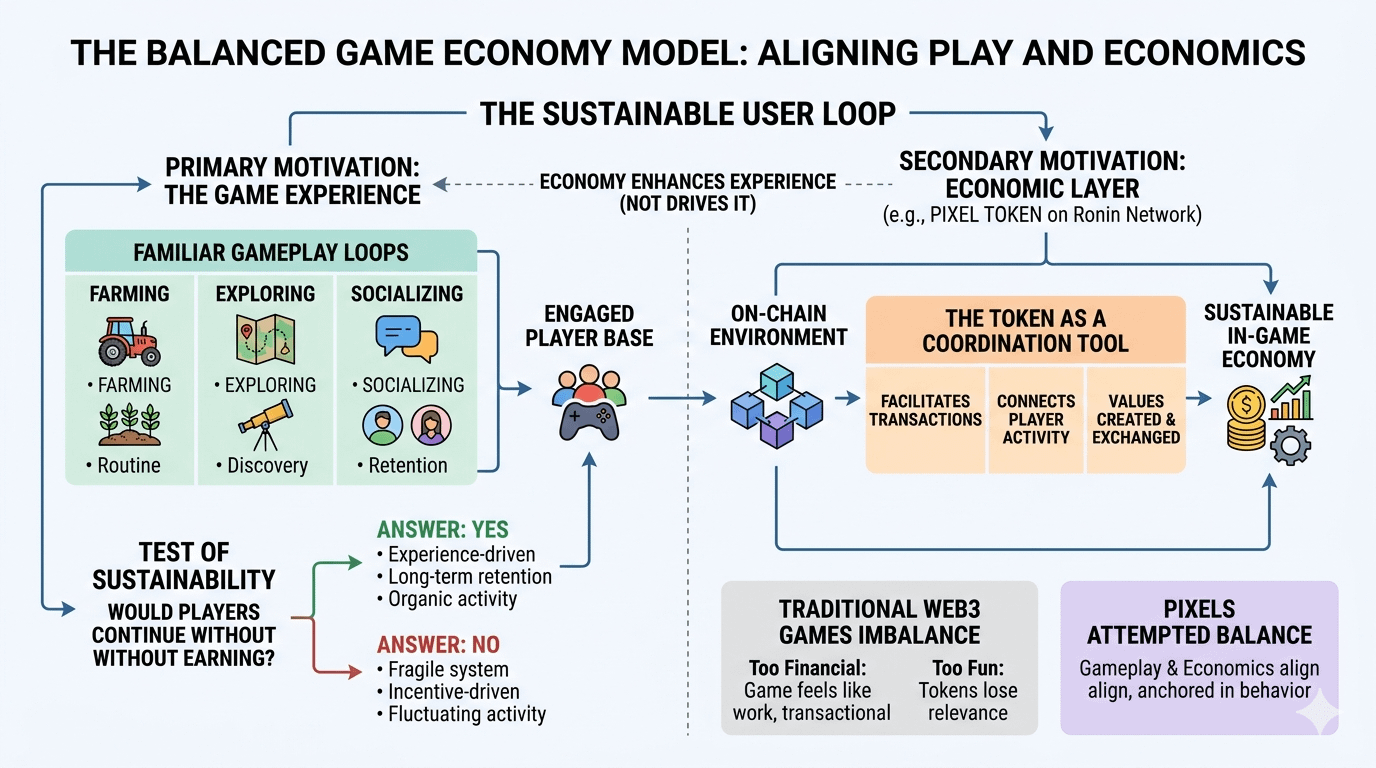
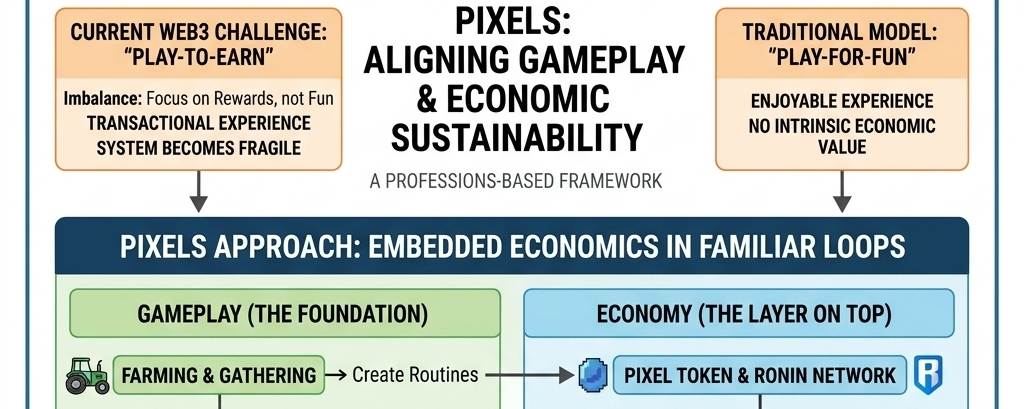
Pixels begins within that familiar structure.
Farming, crafting, exploration, and social interaction create a world that players can understand immediately. The mechanics feel intuitive because they are built on patterns that already exist in gaming.
But the introduction of an open economy changes the role of design.
The moment player activity connects to value, the system becomes less predictable.
Design no longer controls everything.
Behavior begins to shape outcomes.
This is where Pixels shifts from game design to system design.
Instead of focusing only on how players progress, the system must account for how players interact with each other, how resources move, and how value circulates through the environment.
The game becomes a network of interactions rather than a sequence of tasks.
This introduces a different kind of complexity.
In a game, balance is achieved by adjusting mechanics.
In a system, balance emerges from behavior.
Pixels cannot fully control how players trade, collaborate, or optimize. It can only create conditions that influence those behaviors.
That distinction changes how the experience evolves over time.
Players begin to create their own structures.
Markets form.
Patterns of interaction develop.
Certain activities become more prominent than others.
The system starts to reflect collective behavior rather than predefined design.
This is where Web3 games differ from traditional ones.
They are not just experiences.
They are environments.
Pixels operates as both.
It provides a structured game world, but it also allows players to shape how that world functions through their actions.
The $PIXEL token plays a role in this transition.
It connects activity to value, enabling interactions between players to carry economic weight. But it does not dictate how those interactions occur.
The system remains open.
That openness is powerful.
It allows the environment to evolve naturally.
But it also introduces uncertainty.
When players shape the system, outcomes are not always predictable.
Certain behaviors may dominate. Others may disappear. The balance between gameplay and economy can shift depending on how participants engage.
This is where system design becomes critical.
Pixels must create conditions that encourage diverse behavior rather than a single dominant pattern.
If the system allows only one optimal path, the experience becomes repetitive.
If multiple approaches remain viable, the environment stays dynamic.
The social layer helps support this balance.
Interaction between players introduces variability that pure optimization cannot replicate. People trade, collaborate, and engage in ways that are not always driven by efficiency.
This keeps the system from becoming purely mechanical.
Pixels is not just designing mechanics.
It is designing an environment where mechanics, behavior, and economics interact continuously.
That is a different kind of challenge.
The success of the system will depend on whether it can maintain its identity as a game while functioning as an open network.
If the experience remains engaging, the system benefits from the economy.
If the economy becomes dominant, the system risks losing its foundation as a game.
This is the central tension.
Pixels is navigating the transition from controlled design to emergent systems.
From structured gameplay to dynamic environments.
From players following rules to players shaping outcomes.
That shift is where Web3 gaming either creates lasting ecosystems.
Or collapses into temporary ones.
And the difference will come down to how well the system adapts to the behavior it creates.