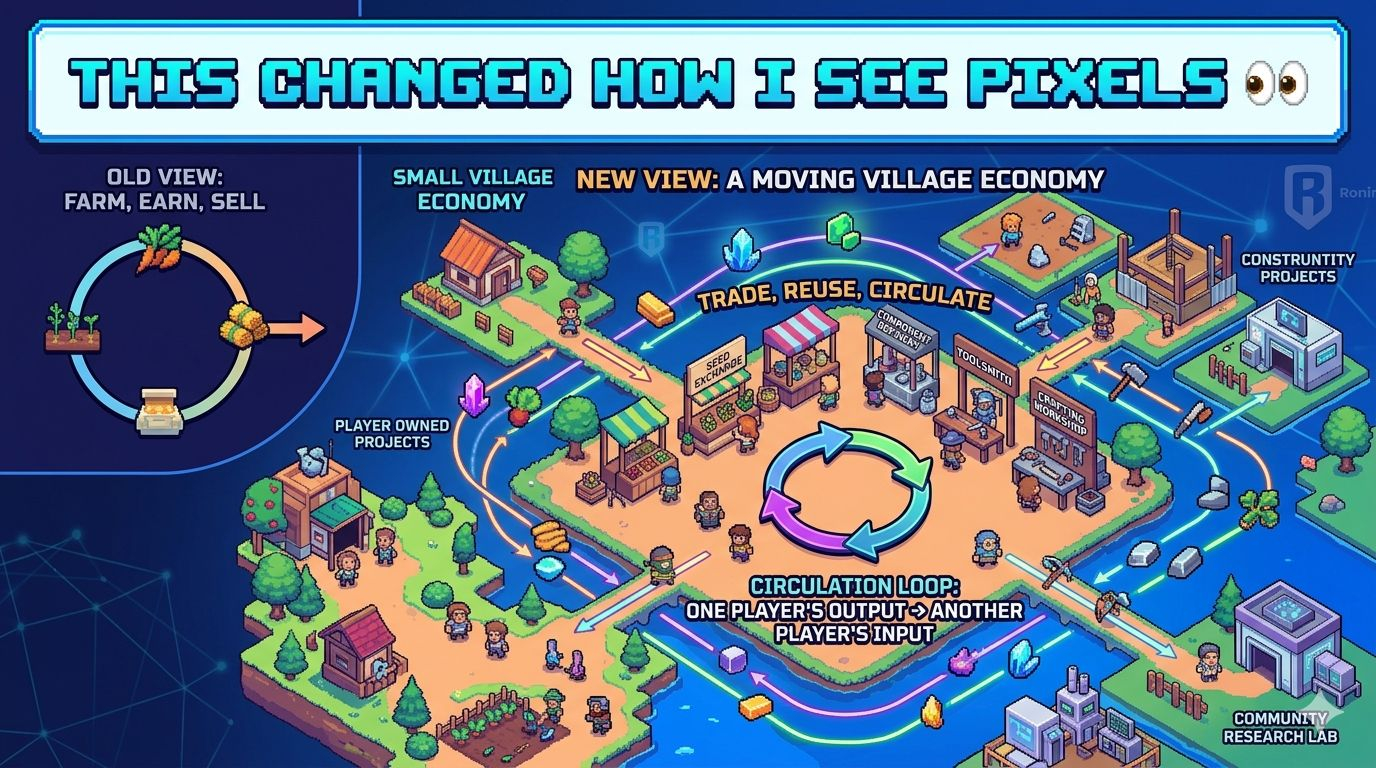
I used to look at Pixels the same way most people probably still do—
a simple loop.
Farm → earn $PIXEL → sell → repeat.
On the surface, it works.
It’s functional.
It rewards activity.
But that view misses what actually matters.
What changed my perspective wasn’t the rewards,
it was observing how the system behaves on Ronin in real time.
Because creating assets is easy.
Any project can mint tokens, items, or rewards.
The real question is what happens after creation.
Do those assets actually move?
Do they circulate between users?
Do they serve a purpose beyond being claimed and dumped?
That’s where Pixels starts to stand out.
It doesn’t feel like a static reward system.
It feels closer to a living, breathing loop.
Players don’t just produce resources—
they pass them on.
One player’s output becomes another player’s input.
That small detail changes everything.
It introduces dependency.
It creates interaction.
It builds a basic form of economy.
And that’s the part most people overlook.
Because what Pixels is quietly experimenting with
isn’t just gameplay—
it’s sustainability.
Right now, the system is still early.
You can feel it.
Some of the activity is clearly incentive-driven.
People show up because rewards exist.
And there’s nothing wrong with that—
early systems often need that push.
But incentives can only carry a system so far.
The real signal comes later.
What happens when rewards slow down?
What happens when the easy gains disappear?
Do players still log in?
Do they still trade, produce, and interact?
Or does everything stall?
That’s the line between a temporary loop
and a lasting system.
At the moment, Pixels sits somewhere in between.
Participation is growing,
but it’s uneven.
You can see clusters of activity—
groups of players interacting heavily—
while other areas feel quiet.
That suggests the economy isn’t fully self-sustaining yet.
It’s active, but not fully organic.
And that distinction matters.
Because a real economy doesn’t rely on constant incentives.
It relies on usefulness.
People return because they need something,
or because they can provide something.
That’s the stage Pixels hasn’t fully reached—
but is clearly moving toward.
For me, confidence doesn’t come from price.
It comes from behavior.
If interactions deepen—
if players rely on each other more over time—
that’s a strong signal.
If outputs keep circulating instead of piling up—
that’s even stronger.
But if activity only spikes around rewards,
then fades just as quickly…
that’s a warning sign.
It means the system isn’t standing on its own yet.
And that’s okay—
as long as it evolves.
Because the projects that actually last
aren’t the ones that create the most.
They’re the ones that keep things moving.
They build loops that don’t break
when incentives fade.
They create reasons to return
that go beyond earning.
Pixels isn’t fully there yet.
But it’s also not just another farm-and-dump loop.
It’s something in progress.
An early attempt at a small, player-driven economy.
And whether it succeeds or not
will depend on one simple thing:
Not how much it creates—
but how well it circulates.